What Survives Forgetting?
Oxbridge · Memory and Forgetting · Week 10 of 14 · Is the Human and Machine Line Essential or Contingent? | Whose Agreement Makes a Thing Real?
At a glance
| Core question | Is forgetting a failure of memory, or a function of it? |
| Duration | 45 minutes, standard template |
| Reading | none |
| Prepared | Students bring one memory from before they were ten, willing to describe it out loud |
| Carried out | Money is real. Borders are real. Weekends are real. Who agreed? |
Objectives
By the end of this lesson, students should be able to:
- Argue whether forgetting is a failure of memory or a function of it
- Use their own memory as evidence without turning the session into anecdote
- Say what survives when the record does not
Opening prompt (5 minutes)
Describe a memory from before you were ten. Then write down how you know it happened.
Give students two minutes to write silently.
Movement 1 · elicit (10 minutes)
Questions.
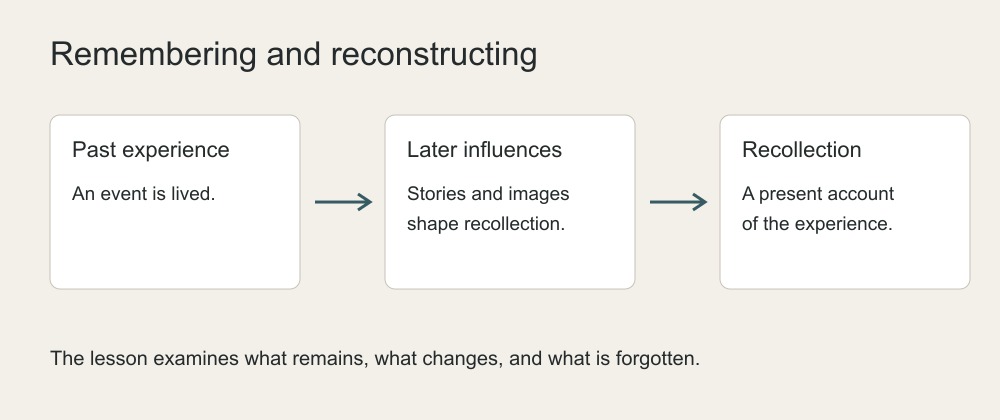
- How many of you are describing the event, and how many are describing a photograph, a story you were told, or a previous time you remembered it?
- Has anyone here discovered that a memory they trusted was wrong?
| Student says | Push |
|---|---|
| ”I can see it clearly, so it must be real” | Does clarity track accuracy anywhere else? Are your clearest dreams your truest ones? |
| ”My family told me the story so many times I cannot tell which part is mine” | Use this answer to introduce the distinction between remembering an event and remembering a later account of it |
Movement 2 · complicate (15 minutes)
The painted sheet
Remembering is not retrieval from storage. It is repainting a surface, and the new paint covers the old. After twenty years of remembering, what you have is the last painting, made from the previous painting, not the event.
Questions.
- If that is true, is a memory you have revisited often more reliable or less?
- Is a memory you have never revisited preserved, or simply gone?
- What is the difference between remembering something and remembering remembering it?
Bergson
Habit memory is performed by the body: you do not recall how to ride a bicycle, you do it.
Pure memory survives whole, and attention filters it rather than losing it. On this account we forget nothing; we simply cannot attend to most of it.
Question. If nothing is lost and only access fails, does that make forgetting less serious or more?
Freud
Forgetting is work. Things are pushed down, and they return in distorted forms: slips, dreams, repetitions.
Question. If forgetting is something you do rather than something that happens to you, are you responsible for what you forget?
Movement 3 · commit (10 minutes)
Question. Is forgetting a failure of memory or a function of it? Answer in one sentence.
Then the harder version, connecting back to W09:
If a machine forgot the way a body forgets, by accumulating distortion rather than deleting files, would the human and machine line still hold?
Closing question (5 minutes)
Money is real. Borders are real. Weekends are real. Who agreed?
Links
henri-bergson · sigmund-freud · Memory and Forgetting · Whose Agreement Makes a Thing Real?
Vocabulary
- Memory as reconstruction
- The account that remembering changes a memory rather than retrieving an unchanged record.
- Habit memory
- Memory performed by the body, such as riding a bicycle, in Bergson’s account.
- Pure memory
- Memory that survives whole while attention filters access, in Bergson’s account.