Semester index
Oxbridge · Interview preparation
The discussion group is now preparing for individual official mock interviews. You practice taking a position, supporting it with a passage or an image, and deciding how to respond when an interviewer challenges your claim. The earlier seminars are here to revisit as you prepare.
Interview preparation
- Current phaseInterview dates to be confirmed
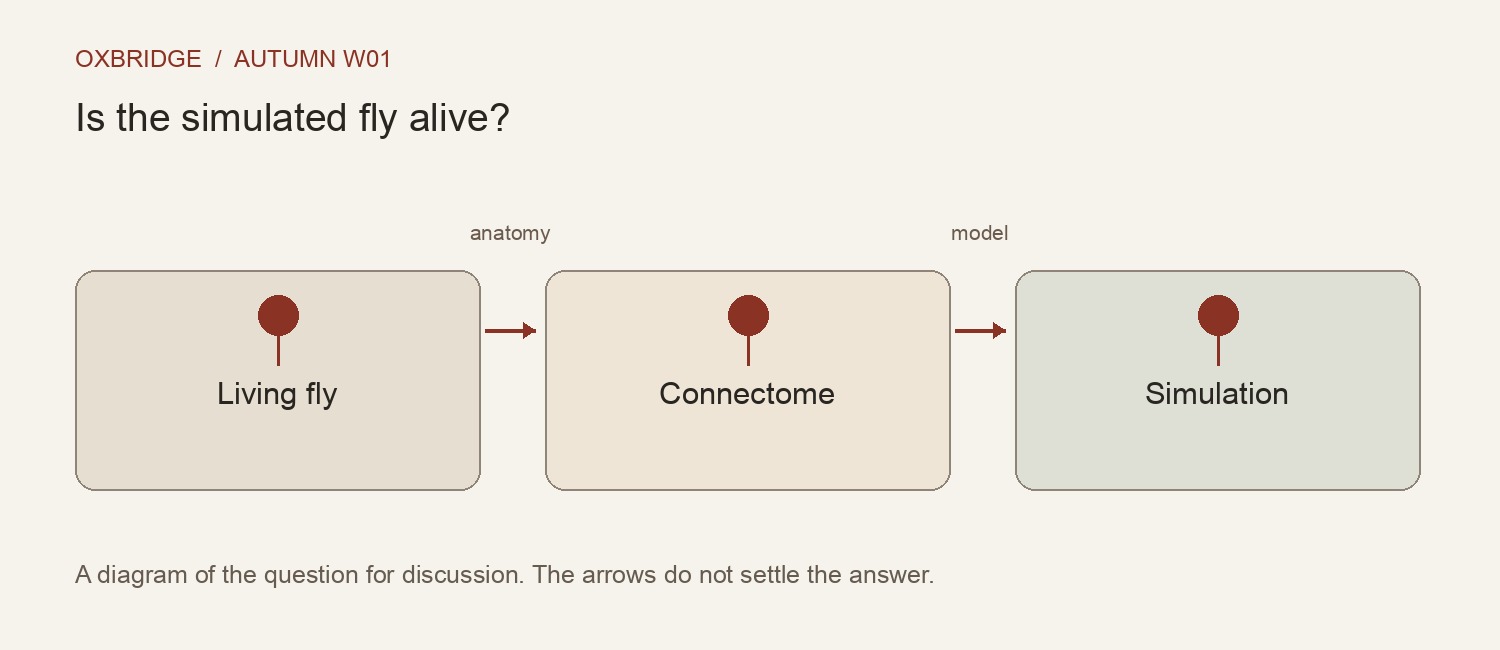
BNDS Oxbridge teaching materials. Discussion diagram: Is the simulated fly alive? Interview Preparation
This ungraded course continued last spring’s fourteen-week course into Grade 12 in autumn 2026. Regular Oxbridge classes are now over.
Earlier seminars
- Unit 1
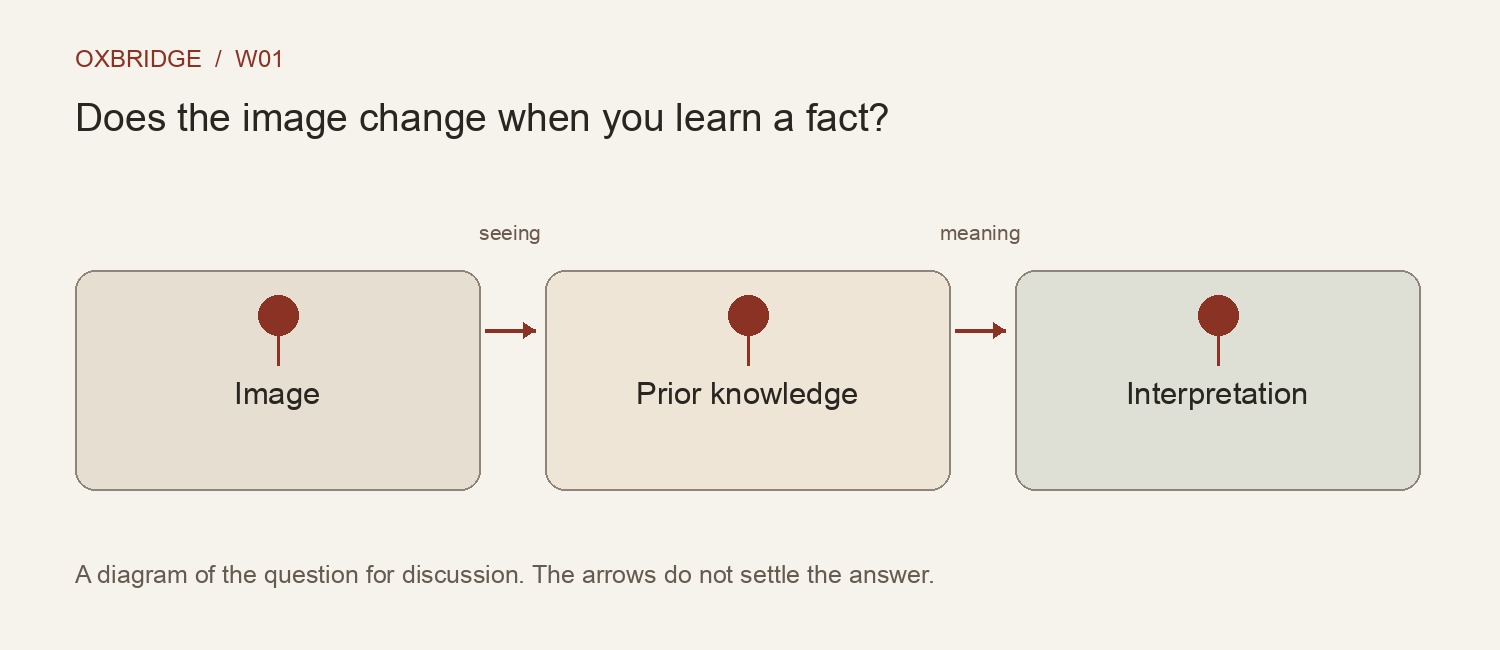
BNDS Oxbridge teaching materials. Images and Constructed Reality
Do images represent the world, or do they produce it?
You already use images and have views about resolution, screenshots, compression, filters and what counts as a real photograph.
- Unit 2
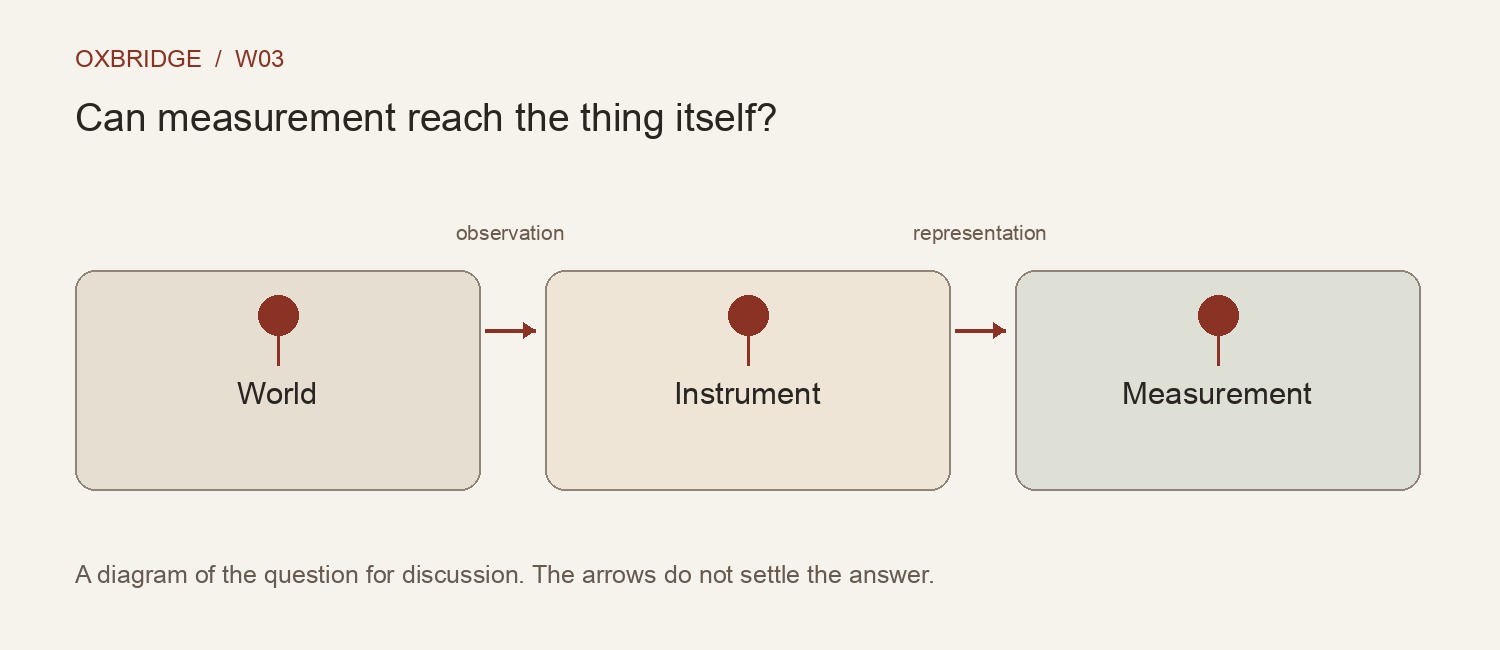
BNDS Oxbridge teaching materials. The Limits of Representation
Can any representation reach the thing itself?
This is the longest unit, with three sessions on the gap: the difference between a representation and what it represents.
- Unit 3
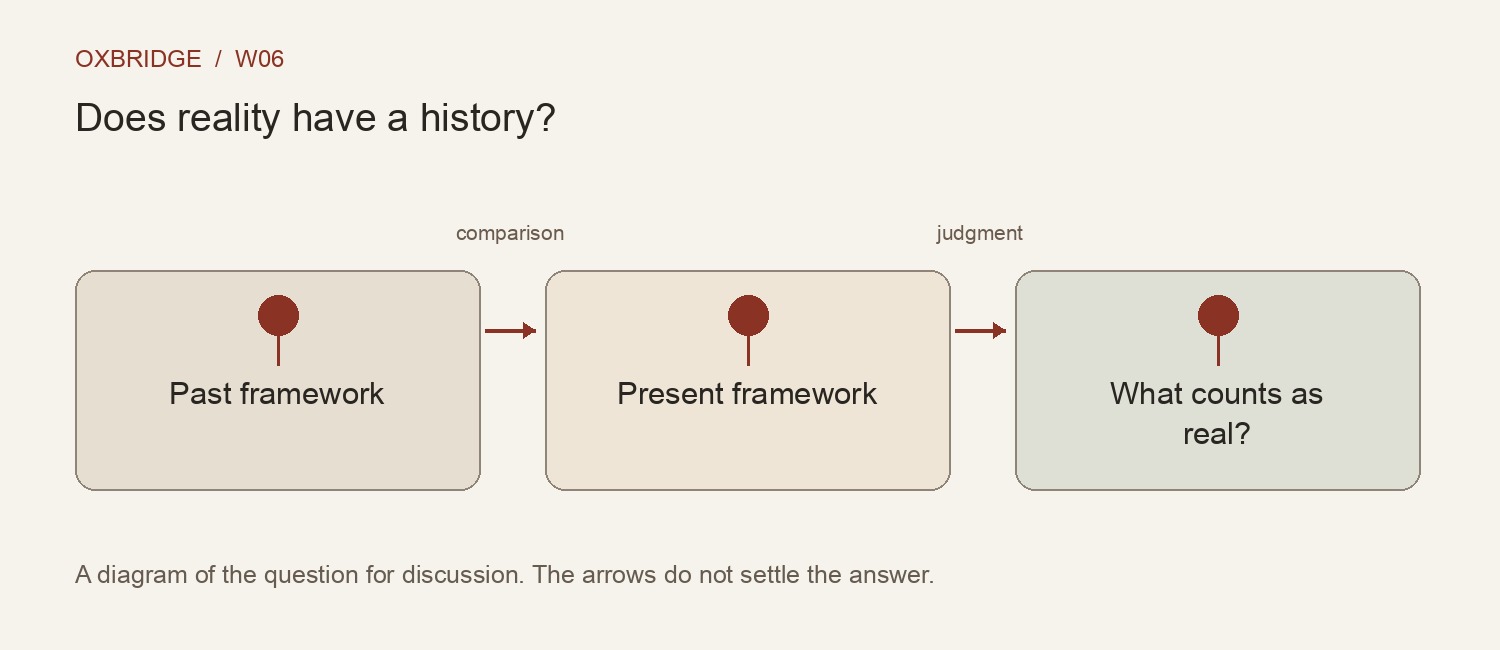
BNDS Oxbridge teaching materials. Discussion diagram: Does reality have a history? Historical Frameworks of Knowledge
Things considered real in the past are now considered false. Does that mean we were wrong then, or that reality itself changed?
- Unit 4
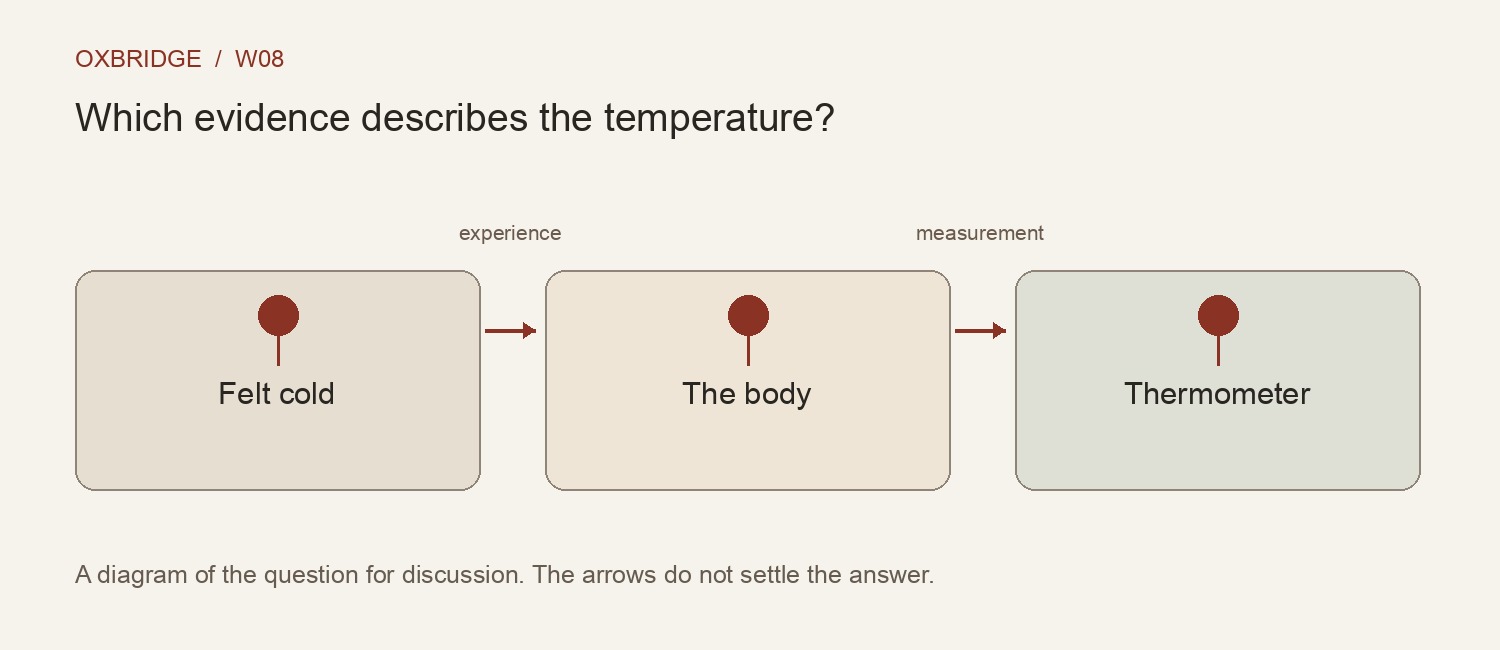
BNDS Oxbridge teaching materials. Embodiment and Machine Cognition
Where does the thinking thing end?
Both sessions ask whether a boundary is essential, a real difference in kind, or contingent, a result of current conditions.
- Unit 5
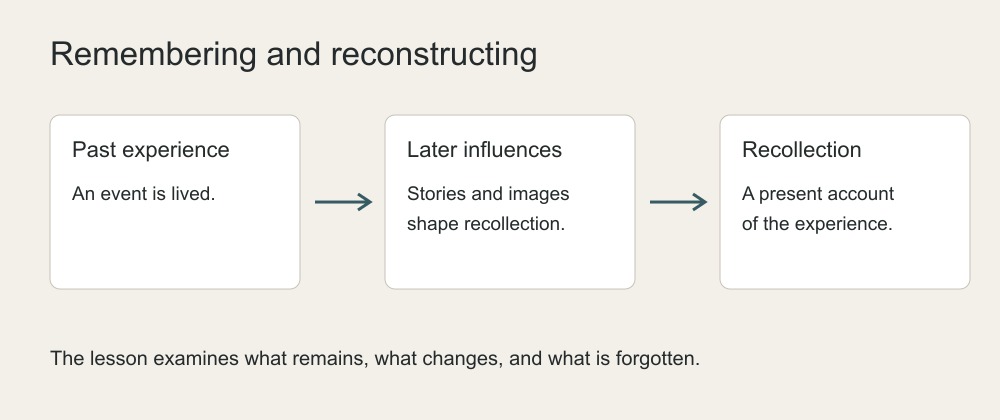
Class diagram based on the Memory and Forgetting lesson and its cited Bergson and Freud readings. Memory and Forgetting
This unit uses one session to test the distinction from W09: human memory changes through remembering, while machine memory is treated as a record. You discuss this distinction separately after Unit 4.
The unit uses a painted sheet as an image of memory. Each act of remembering adds paint over the previous layer.
Seminars
- Unit 6
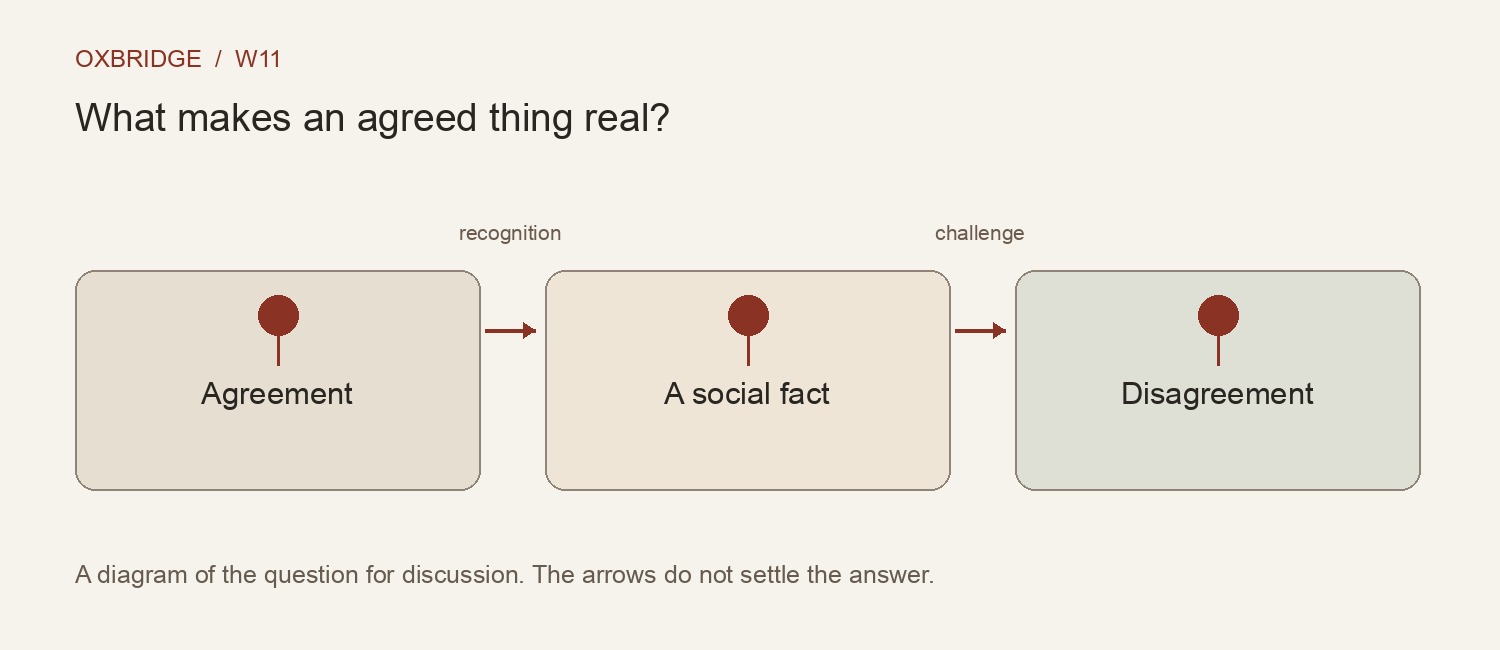
BNDS Oxbridge teaching materials. Discussion diagram: What makes an agreed thing real? Social Reality and Collective Agreement
Whose agreement makes a thing real?
Money, borders, and weekends are real, but they depend on collective agreement.
- Unit 7
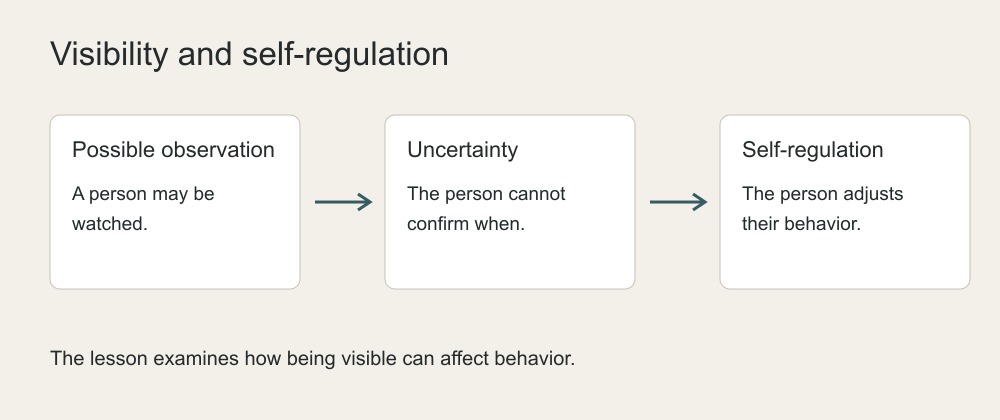
Class diagram of the panopticon argument discussed in the Power and Visibility lesson, based on its cited Foucault reading. Power and Visibility
Who gets to show us the world, and who has to be seen?
Michel Foucault: visibility is a trap. The panopticon works because the prisoner does not know when he is watched, so he watches himself.
Seminars
- Unit 8
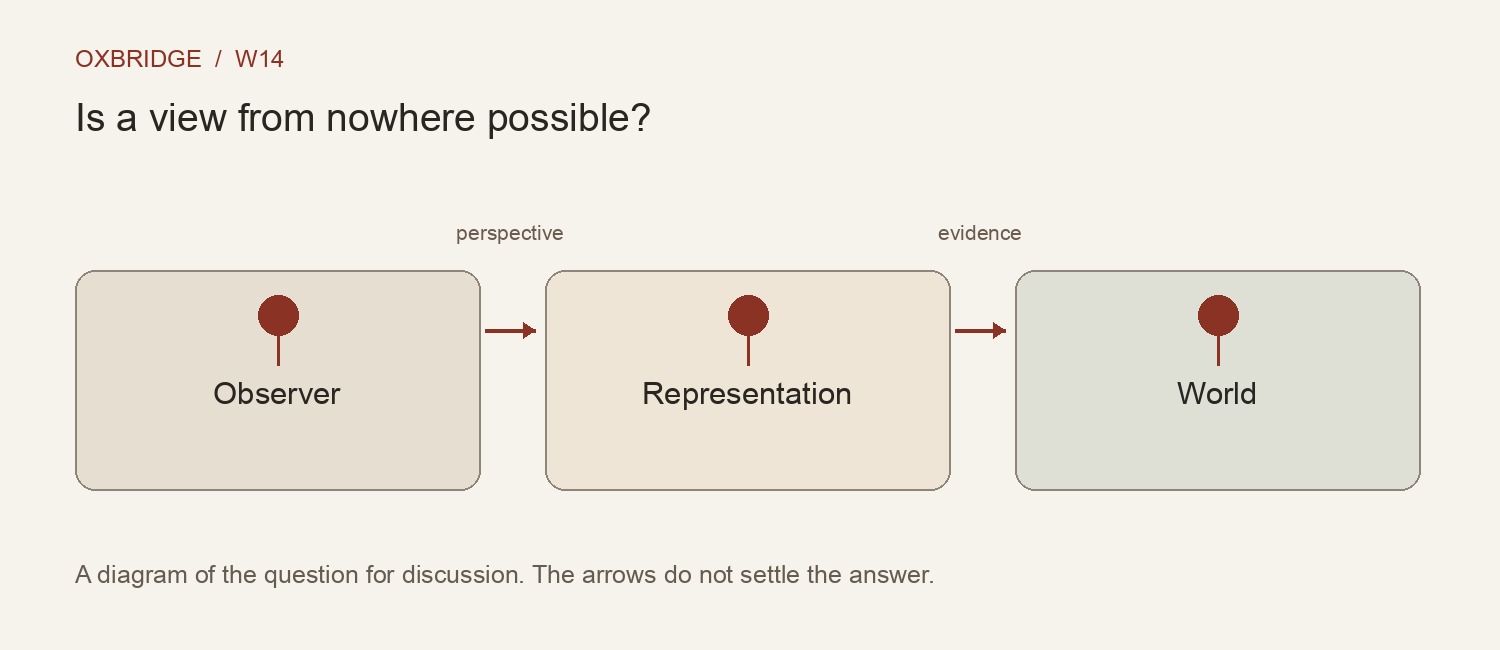
BNDS Oxbridge teaching materials. Discussion diagram: Is a view from nowhere possible? Objectivity and Situated Knowledge
Is a view from nowhere possible?
The phrase echoes Nagel and names a question that runs through the course.
Seminars
Course guide and weekly map
Regular classes have ended
Oxbridge has finished its regular classes and is moving to individual official mock interviews. There are no more Thursday classes. The autumn class schedule ended on October 22, 2026. Earlier lessons and materials remain available for reference. See Autumn 2026 Plan.
The Oxbridge Discussion Group began as a fourteen-week seminar for Grade 11 ESL students preparing for Oxbridge-style interviews. You practice discussion, close reading and argument through a sequence of questions. The course aim is: “Students arrive with positions and leave with better ones.”
The course’s central claim:
Frameworks conceal their own constructed edges, and they actively shape reality rather than merely representing it.
Each unit tests this claim through images, measurement, history, the body, machines, memory, the shared world or power. The final session asks you to test the claim against the course itself.
- Cohort
- Grade 12
- Units & phases
- 17
- Lesson pages
- 20
Learning pathways
Unit index
Interview PreparationWeek 1
7 Sept–13 Sept
1 lesson
Across units
Life and SimulationWeek 2
14 Sept–20 Sept
1 lesson
Across units
Argument and CounterargumentWeek 3
21 Sept–27 Sept
1 lesson
Across units
Literature and Other MindsWeek 4
28 Sept–4 Oct
No dated items this week.
Week 5
5 Oct–11 Oct
1 lesson
Across units
Linguistic Typology and Its LimitsWeek 6
12 Oct–18 Oct
1 lesson
Across units
Measurement and Embodied ExperienceWeek 7
19 Oct–25 Oct
1 lesson
Across units
Land, Belonging, and OwnershipThese pages are available; teaching dates are not confirmed.
Unit index
Images and Constructed RealityThe Limits of RepresentationHistorical Frameworks of KnowledgeEmbodiment and Machine CognitionMemory and ForgettingSocial Reality and Collective AgreementPower and VisibilityObjectivity and Situated KnowledgeLessons, guides and work
The fourteen weeks
The course has eight units. Full details are in the Seminar Plan.
| Unit | Weeks | Question |
|---|---|---|
| Images and Constructed Reality | W1–2 | Do images represent the world or produce it? |
| The Limits of Representation | W3–5 | Can any representation reach the thing itself? |
| Historical Frameworks of Knowledge | W6–7 | Does reality have a history? |
| Embodiment and Machine Cognition | W8–9 | Where does the thinking thing end? |
| Memory and Forgetting | W10 | What survives forgetting? |
| Social Reality and Collective Agreement | W11–12 | Whose agreement makes a thing real? |
| Power and Visibility | W13 | Who gets to show us the world? |
| Objectivity and Situated Knowledge | W14 | Is a view from nowhere possible? |
Thinkers in teaching order: Berger → Steyerl → Plato → Sartre/Camus → Barthes → Merleau-Ponty → Rees (with Bergson and Freud as counterpoints) → Bergson/Freud again → Emmelhainz → Foucault/Fanon → Haraway and Nagel at the close.
Method
Four rules from Course Design Principles guide the discussions:
- Questions guide the discussion. Students do most of the talking.
- Discussion starts with something familiar, such as a map, a thermometer, a screenshot or a video-game boundary. A philosopher’s ideas come later to name what you have already been discussing.
- The teacher asks you to examine consequences within your own claim that you may not have noticed.
- The course uses plain English while keeping the concepts difficult. Its rule for register, the language used to explain ideas, is: “A hard concept in easy words is the target. An easy concept in hard words is failure.”
The standard session has five parts: a silent opening, elicit, complicate, commit, and a closing question to consider afterward. See Session Structure Template. You must take a position. Neutrality is not an option.
Assessment: none
The course is discussion only. Nothing is set, collected, or graded. There are no attainments, Course Skills, Learning Behaviour postings, End of Term assessments or written work of any kind. The course sits outside 20 framework.
Prepare by reading and arriving with a position you can explain aloud. The only thing carried between sessions is the closing question, posted to the group chat with a quote attached.
The prior run included seven writing tasks assessed against four criteria: commitment, pressure, precision and movement. These are no longer writing assignments. Teachers now use the criteria for spoken feedback during the commit movement. Every essay prompt remains in the question bank as a discussion question. The former writing scheme is available for reference in Assessment, none.
Course resources
- Course Design Principles explains the six teaching rules, including the ESL register rule.
- Session Structure Template explains the 45-minute session structure and the closing question shared in the group chat afterward.
- Question Bank contains about 60 single-line questions across eleven topics, plus five worked opening-and-push pairs.
- Interview Preparation covers the three moves, the push-line format and the 12-minute mock.
- Reading List contains 7 set texts, 5 live quotations, 10 extension readings, visual references and the case bank.
- Assessment, none explains the ungraded, discussion-only policy and the four criteria used for spoken feedback. The former writing scheme is not in force.
Schedule
The course resumed as a second installment on Thu 10 Sep, Thursdays P5. Regular classes ended with the October 22 session. The next phase is individual official mock interviews. See Autumn 2026 Plan.