Memory and Forgetting
This unit uses one session to test the distinction from W09: human memory changes through remembering, while machine memory is treated as a record. You discuss this distinction separately after Unit 4.
Unit plan
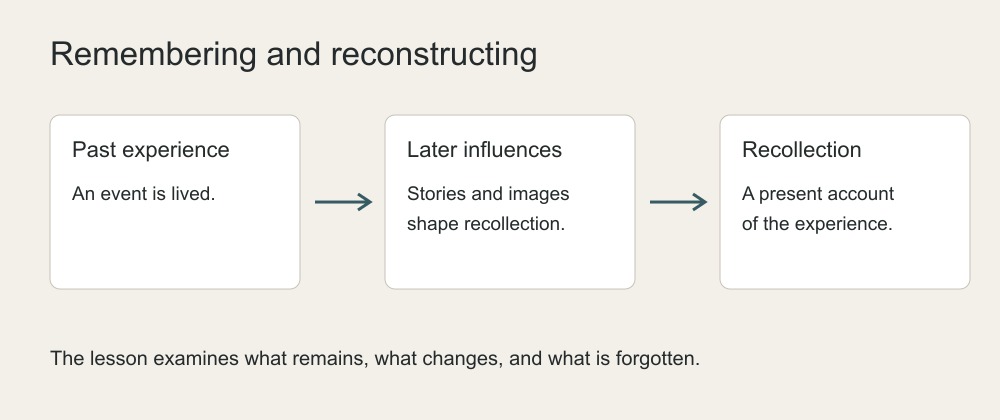
The unit uses a painted sheet as an image of memory. Each act of remembering adds paint over the previous layer.
Read the complete unit plan
Unit question
What survives forgetting?
This unit uses one session to test the distinction from W09: human memory changes through remembering, while machine memory is treated as a record. You discuss this distinction separately after Unit 4.
The image to work from
The unit uses a painted sheet as an image of memory. Each act of remembering adds paint over the previous layer. After twenty years, the surface represents the latest act of remembering, made from earlier memories, rather than the original event.
Use this image to discuss how remembering may change a memory.
The two philosophers
The unit compares two incompatible accounts that support the same conclusion:
- Henri Bergson separates habit memory, which the body performs, from pure memory, which survives whole and is filtered out by attention rather than lost. On this account we forget nothing; we simply cannot attend to most of it.
- Sigmund Freud proposes that forgetting is not decay but active work: things are pushed down, and they return in distorted form.
Their shared conclusion is that forgetting is a function of memory, rather than its failure.
Consider how these two incompatible accounts can support the same conclusion. You can assess that conclusion without choosing one account as the winner.
Session
- What Survives Forgetting?: Bring a memory from before you were ten. Discuss whether you remember the event itself, a photograph, or a story about it.
Concepts introduced
The unit introduces no new concepts. It applies the gap to personal memory and the concept of a framework to attention.
Preparation
There is no assigned reading. Choose one memory from before you were ten that you are willing to describe aloud. This is the only session with personal rather than textual preparation.
Nothing is written or collected: the course is discussion only. The commit question is: Is forgetting a failure of memory or a function of it?
Discussion focus
- Describe your memory, then use that description to develop an argument in movement 3.
- Keep the discussion focused on what memory is for. This is not a discussion of memory techniques or exam revision.
- Return to W09’s human/machine distinction in the commit movement. Movement 3 asks: if a machine forgot by accumulating distortion as a body does, rather than deleting files, would the human/machine distinction still hold? Use this question to test Bergson’s objection from W09.
Bridge to Unit 6
If each person’s memory of the past changes privately, how can two people share an understanding of it?
W10 closes on the question that opens the next unit: money is real, borders are real, weekends are real: who agreed? Social Reality and Collective Agreement.
Lessons
Unit gallery