The Components and the Assessment Objectives
Lesson slides: The three components (PowerPoint, 3.7 MB) · The four assessment objectives (PowerPoint, 3.6 MB) · image credits
At a glance
| Sessions | 1 session (W1, Thu P6) |
| Dates | Thu 3 Sep |
| AO focus | All four AOs, named, defined and told apart |
| Deliverable | Every student can say, of any page, which objective it serves; exit ticket: one thing you made this summer and the objective it serves |
| Feeds | Assessment Objectives II, the Game, and the Theme, the second objectives session, and every review afterwards: the objectives are the vocabulary the whole portfolio is marked in |
| Homework | Re-read the two tables below before Friday. Bring the object you want to draw, and your sketchbook |
| Decks | 9479-intro-02-the-three-components (11 slides) · 9479-intro-03-the-four-assessment-objectives (17 slides, pages from one real portfolio) |
Objectives
By the end of this lesson, students can, observably:
- Name the three components, what each wants, and where the marks are
- Give Cambridge’s four assessment objectives in plain words and say which verbs give each one away
- Sort an action an art student might take onto the right objective, with a reason, and say when a page serves two
Goal
Students use the assessment objectives to explain what a sketchbook page does. For example, a student might say “that is recording, and it becomes developing when it changes my own work”. They will use this vocabulary when discussing and assessing their portfolios throughout the semester.
How it runs
- Thu 3 Sep, P6.
Deck intro-02 first, ten minutes: the three components, what each wants from you, and the marks.
Then deck intro-03, about thirty minutes:
-
Cambridge’s four definitions verbatim and in plain words;
-
the Component 1 split (15 · 15 · 20 · 10) and the level ladder;
-
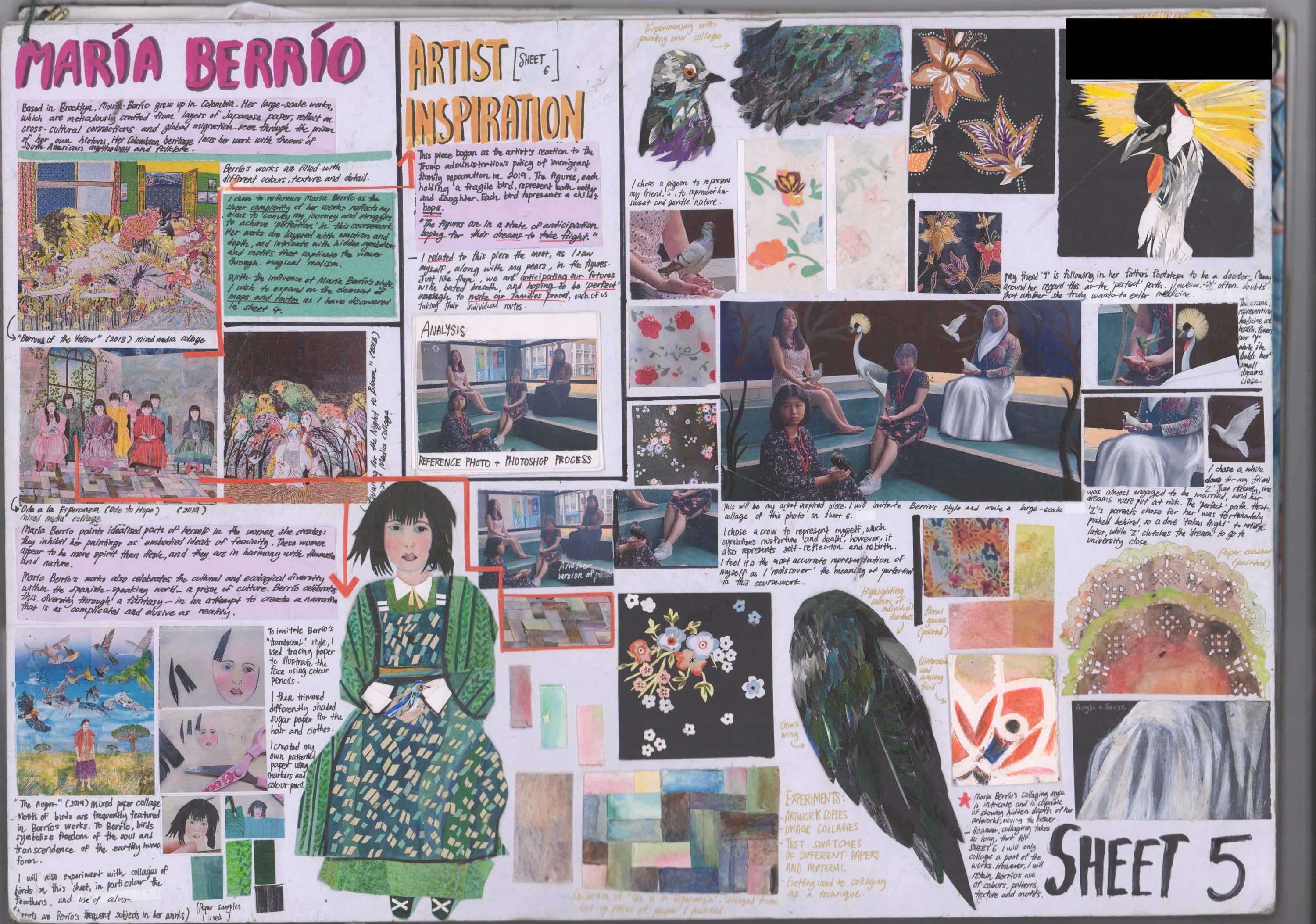
one feature slide per objective showing a page from one real Component 1 portfolio (the department handbook’s sample 1), the tell verbs, and a natural-forms and a still-life example each;
-
the “one portfolio, four objectives” grid;
-
three game cards that belong and one trap per objective;
-
the border cases.
Exit ticket, five minutes: one thing you made this summer and the objective it serves.
✅ Delivered. The game moved to Assessment Objectives II, the Game, and the Theme so it gets a full period.
The three components
Cambridge marks all three. Semester 1 builds the portfolio that goes to Cambridge in 2028. Deck: 9479-intro-02-the-three-components.
| Component | What it is | Marks | Share of the A Level | Built in |
|---|---|---|---|---|
| C1 Portfolio | Work made over the course on a theme from the menu, chosen and sequenced by you. Set here, marked by Cambridge | 60, weighted to 90 | 30% | Semester 1 |
| C2 Externally Set Assignment | A paper with three starting points arrives. Preparatory studies, then the final outcome inside a 15-hour supervised test | 60 | 20% | Semester 4 |
| C3 Personal Investigation | Your own theme, proposed and locked in writing, investigated across a year: visual work with two outcomes plus 2000 to 2500 words integrated with it | 75, weighted to 150 | 50% | Semesters 2 and 3 |
Half the A Level is one investigation, which is why two semesters are given to it. The full numbers and the AO split per component are on 9479 Assessment Criteria.
The four assessment objectives
Cambridge reads the whole portfolio once and gives one mark out of 60. Each objective is marked on its own level, so a portfolio can sit high on Record and low on Develop. Deck: 9479-intro-03-the-four-assessment-objectives, which shows each objective as a page from one real Component 1 portfolio.
| Cambridge says | In plain words | C1 marks | The tell | |
|---|---|---|---|---|
| AO1 Record | Record ideas, observations and insights relevant to intentions, reflecting critically on work and progress. | Look hard at real things and keep the evidence: your drawings, your photographs, your notes. Artist research and gallery visits count here too | 15 | record, observe, collect, document, annotate |
| AO2 Explore | Explore and select appropriate resources, media, techniques and processes, reviewing and refining ideas as work develops. | Try materials and processes on purpose. Compare them. Keep what works and say why | 15 | experiment, test, try out, compare, refine |
| AO3 Develop | Develop ideas through investigations informed by contextual and other sources, making purposeful connections and demonstrating analytical and critical understanding. | Grow the idea. Learn from artists and contexts, connect them to your own work, try alternative compositions, decide in writing | 20 | research, study, investigate, connect, alternative |
| AO4 Present | Present a personal and coherent response that realises intentions and applies visual language to communicate ideas. | Finish it. The final piece does what you said, and the whole portfolio reads as one story in your own visual language | 10 | final, complete, resolve, sequence |
Develop carries the most marks and Present the fewest. The assessment gives substantial weight to the decisions and investigations that lead to the finished work.
What each one looks like in your sketchbook, one example per theme:
| Natural Forms and Decay | Still Life and the Everyday | |
|---|---|---|
| AO1 | One shell drawn five times from five angles on one page, the light noted under each | Your kitchen table photographed at three times of day, then one tonal drawing from the best shot |
| AO2 | The same seed head in pencil, ink wash and charcoal on brown paper, one line under each: what did the medium do? | One glass drawn with three tools: 2B, fine liner, white chalk on black paper. Which one held the reflection? |
| AO3 | Blossfeldt magnifies a horsetail twelve times. You try his rule on your seed head, then write what changed | Morandi paints the same bottles for forty years. You arrange your three objects six ways in thumbnails and reject five in writing |
| AO4 | A resolved charcoal drawing of the decayed pear, with the pages behind it in order | Your final arrangement in the medium your tests chose, and the portfolio edited down |
The question the examiner asks of your recording pages, in Cambridge’s own words: “Have different angles, viewpoints, close-up study, observation of surface quality, colour, tone and form been investigated?” It is also the list of things to do this weekend.
The ladder. Each objective is marked on five levels, and the level words are the same for all four: perceptive · confident · competent · adequate · limited. Learn to say which word describes a page. The full grid with the mark ranges is on 9479 Assessment Criteria.
One page can serve two objectives. Thumbnails record ideas (AO1) and consider alternative compositions (AO3). Notes from a museum trip are recording (AO1) until they change a page of your own work, which is developing (AO3). Several versions of a design are refining media (AO2) or choosing between compositions (AO3). The rule: ask what the page is for, then write it on the page, so the examiner never has to guess.
The game. Sixty-four things an art student might do, one per card; the room calls the objective. The mats say Record, Explore and experiment, Develop from sources, Present a personal response. Cambridge says Record, Explore, Develop, Present. These are the same four objectives. Students earn the point for a different placement if they support it with a reason.
Practice
Try each question before you open its answer.
1. Name the four assessment objectives and their Component 1 marks.
Answer: AO1 Record, 15. AO2 Explore, 15. AO3 Develop, 20. AO4 Present, 10. Sixty in total, marked once, on the whole portfolio, with each objective on its own level. Develop is worth the most and Present the least, which is the opposite of what most students assume.
2. What is the tell for each objective, the verb that gives it away?
Answer: Record: observe, collect, document, annotate. Explore: test, try out, compare, refine. Develop: research, study, connect, alternative. Present: final, complete, resolve, sequence. A card that says “testing” is exploring even if the drawing is beautiful; a card that says “final” is presenting even if the work is small.
3. Card 25 in the game reads “Visual notes taken during a museum trip, reflecting on how specific artworks influence your ideas.” The key says AO1. When does the same page become AO3?
Answer: When the notes change a page of your own work. Recording what you saw is AO1. Forming a purposeful connection between what you saw and what you make is AO3. Keep both pages and link them, and write on each which objective it serves, so the examiner never has to guess.
4. Which component is half the A Level, and why does that shape the semesters?
Answer: Component 3, the Personal Investigation, 75 marks weighted to 150. It is one investigation across a year, which is why Semesters 2 and 3 are both given to it. Semester 1 builds Component 1, the Portfolio, so students learn the portfolio process before beginning the Personal Investigation.