Foundations on the Theme
Unit plan
This unit introduces the foundations of the Component 1 portfolio. You learn how the four Assessment Objectives (AOs) are marked and examine the evidence in a top-band portfolio.
Read the complete unit plan
What this unit does
This unit introduces the foundations of the Component 1 portfolio. You learn how the four Assessment Objectives (AOs) are marked and examine the evidence in a top-band portfolio. You use five criteria to choose and commit to one theme from the menu.
You then study line, tone, form, texture, and color through your chosen theme, with a focus on AO1 Record. You use these observations to build your first portfolio page in Lesson 05.
Dates & span
Tue 1 Sep → Mon 14 Sep (W1 → W3 Monday; 10 sessions; four lessons).
There is no attainment assessment in W1–W2. The line diagnostic on Monday 09-07, the first session of Lesson 04, provides the baseline for your mid-term narrative. You make two studies of one object.
Lessons
- Introduction: The semester map, the four AOs in plain words, and the survey set on Tue 1 Sep.
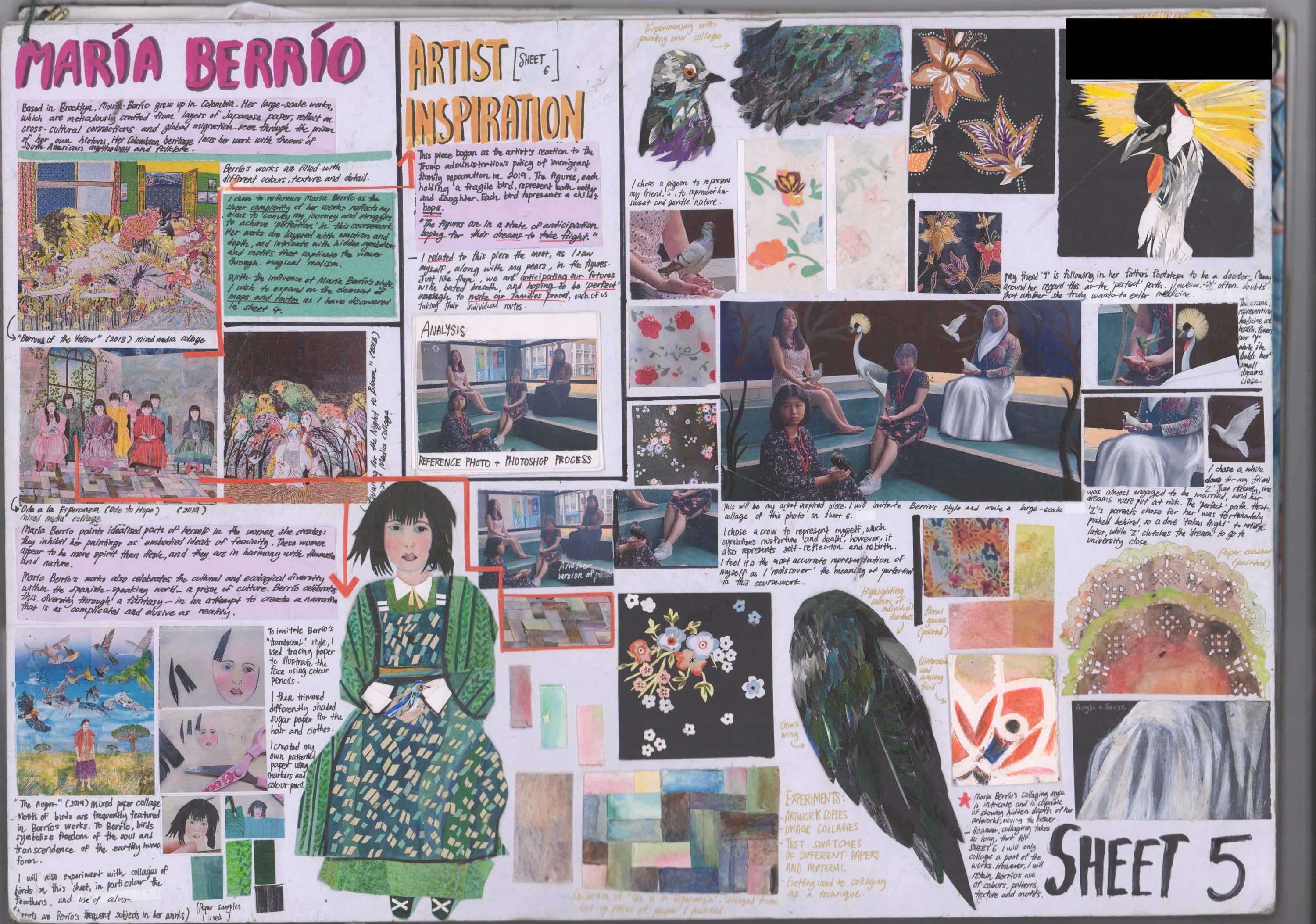
- The Components and the Assessment Objectives: The three components and their marks on Thu 3 Sep. You study Cambridge’s four objectives verbatim and in plain words, the evidence that shows each objective, pages from one real portfolio, and cases where the objectives overlap.
- Assessment Objectives II, the Game, and the Theme: A second objectives session with the AO Sorting Game (P3) on Fri 4 Sep, the double. You check the cohort’s two main themes against the five criteria and study six approaches to a theme. The weekend drawing homework is set.
- Formal Elements on the Theme: The lesson begins on Mon 7 Sep with the line diagnostic, comparing contour with structure. You then study how tone builds form, test limits through push-to-fail, match marks to surfaces, and use color from observation. From Tue 8 Sep, you mark Example 9 on the sheet at home. You discuss it on Thu 10 Sep as Portfolio Marking, the second CS check. On Mon 14 Sep, you read Impressions, study the first-page guide, and set up your digital portfolio as screen pages. This lesson ends the unit. You build the first page, “a page that argues” in Lesson 05.
Assessment
There are no attainment gates in this unit. There are two CS tasks:
- Weekend Drawing Homework: Three studies on your theme in your sketchbook. Submit them on Tue 8 Sep. This is the first check of the semester.
- Portfolio Marking: Mark Example 9 on the marking sheet at home, then discuss it in class. Submit the sheet on Thu 10 Sep. This is your first calibration toward A1’s self-check.
The Formal Elements Set is not collected. Your studies feed the first page, which you build in Lesson 05. See the full register.
Key content
- The theme menu: Natural Forms and Decay · Still Life and the Everyday · Identity and the Portrait · The Built Environment. This menu was issued in the Summer Preparation Homework. Your theme must pass all five criteria: you can photograph primary sources within daily reach; it supports four months of looking; it supports line, tone, texture, and color; it allows both 2D and 3D work; and it has a wide range of artist references for assigned study. Sign-off is one-to-one. You use a physical commitment card.
- The two main themes: By Thu 3 Sep, after the summer work and Tuesday opener, the cohort had converged on Natural Forms and Decay and Still Life and the Everyday. The other two menu themes remain available if you make a case for them at sign-off.
- The four Assessment Objectives (AOs): You study Cambridge’s definitions verbatim from 9479 Assessment Criteria before signing off your theme. The Component 1 marks are split 15 · 15 · 20 · 10 across the four objectives. You examine a natural-forms example and a still-life example for each objective. The AO Sorting Game uses 64 cards in a call-out format.
- Six approaches to a theme: Turn it · Look close · Light it · Arrange it · Time it · Touch it. Each approach connects to a phrase from Cambridge’s AO1 or AO3 elaboration. For natural forms, start with Look close, Time it, and Turn it. For still life, start with Arrange it, Light it, and Touch it.
- Recording practice: Work from accessible first-hand subjects and your own photographs rather than depending on copied internet images. Relevant artist, contextual, and secondary sources remain legitimate when you credit them and use them purposefully. Cambridge does not exclude original photography or all borrowed sources.
- Studio and homework routines: Each studio session follows this sequence: entry look → demonstration → sustained work with a midpoint checkpoint → exit annotation. The conference rota includes 4–5 students per day. Your annotations record decisions, rejections, and observations, not feelings. Homework is sketchbook work, annotation, or reflection only, with a limit of 30 minutes.
Lessons
Unit gallery

Assignments
- A Level Art & Design · S1: Weekend Drawing Homework · September 8, 2026
- A Level Art & Design · S1: Portfolio Marking · September 10, 2026
- A Level Art & Design · S1: Intention and Mind Map · September 14, 2026