Literature and Other Minds
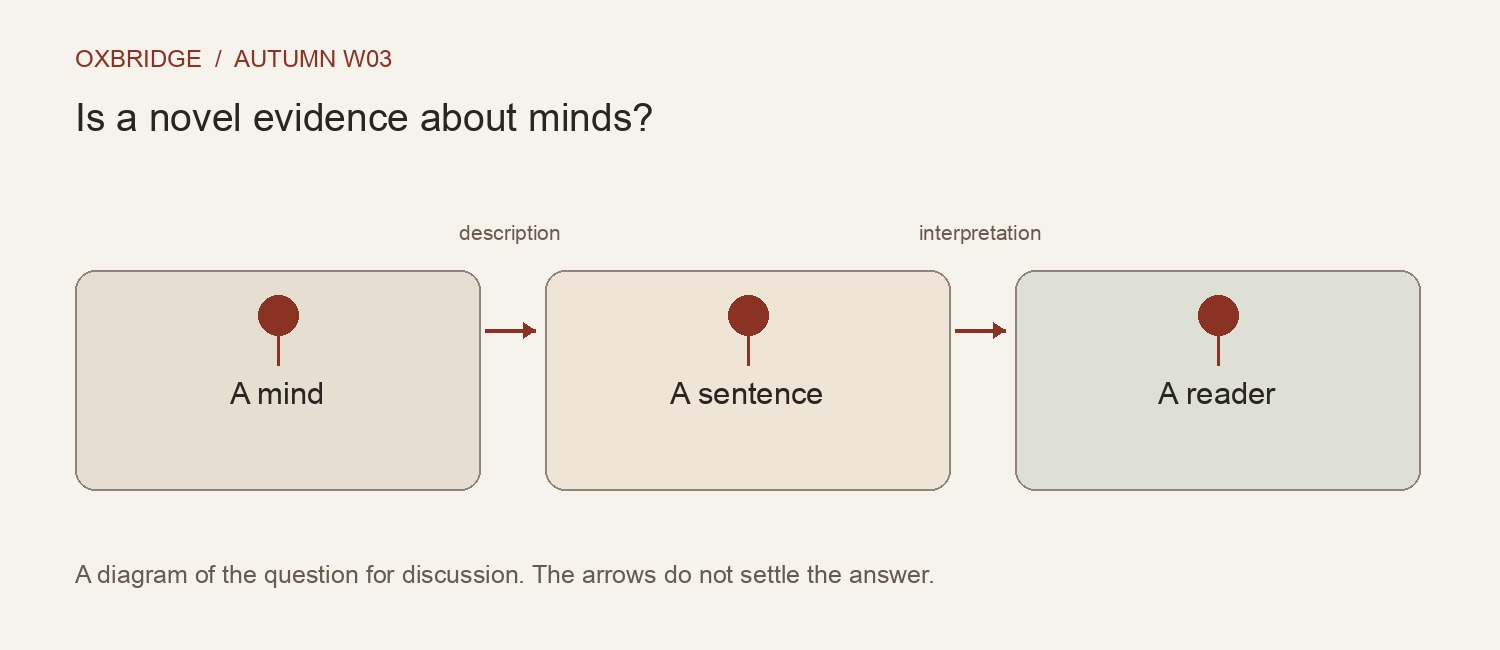
Oxbridge · Autumn 2026 · Discussion 3 of 7 · Thu 24 Sep, P5, 11:40 to 12:25 · the English applicant in the chair, the other three on the panel
At a glance
| Core question | When a novel describes a mind, is it evidence about minds or an invention of one? This moves W01’s photograph question to the sentence through the student’s interest in literature and psychology |
| Duration | 45 minutes. One student in the chair; the other three sit as a panel and bring one question each |
| Bring | The passage you named in W02, on paper, short enough to read aloud in one minute. The one claim about it you would defend. If your submitted written work exists, bring it too |
| Carried out | Name one thing a novel can know about a mind that no experiment can. Then say how you would know if you were wrong |
Objectives
By the end of the session, the student should be able to:
- State a position on the core question within a minute, claim first and qualification second, with the passage as the evidence
- Absorb three pushes without abandoning the claim, narrowing it at least once and saying aloud where the narrowing happened
- Push the interviewer on the same question for seven minutes, with at least one push that follows a consequence rather than importing a counterexample
How it runs
Settle (2 min) Ask the student to put the passage on the table and read the claim aloud.
Opening prompt (3 min)
On the board: When a novel describes a mind, is it evidence about minds or an invention of one? Give the student two minutes to write one sentence with one reason. No abstention, and no “it depends” without picking the meaning that makes the answer most defensible.
The chair (20 min)
The student reads the passage aloud, then defends the sentence. Choose three follow-up questions from the tree below, based on the reason the student gives. Ask them one at a time.
Ask each panel member to use the question they prepared before the session. Then ask the consequence push. Allow thirty seconds for the student to state the narrower claim.
The other way round (7 min)
The student takes the interviewer’s chair and pushes the interviewer on the same question, who defends the opposite of whatever the student committed to. The student is told the rule once: a push has to come from inside the interviewer’s own answer, not from a new example. The panel may join in.
Written work, if it exists (5 min)
Ask the student to read one paragraph of their submitted writing aloud. Ask which sentence states the claim and what the paragraph would lose if that sentence were cut.
Debrief (5 min)
Ask the panel when the student stopped considering the question and began only defending the answer. The student then answers the same question about their own response.
Finally, the interviewer reflects on the seven minutes in which the student questioned them.
Close (3 min)
The carried-out question, to be answered in the group chat by Sunday, so the others read it: name one thing a novel can know about a mind that no experiment can, and how you would know if you were wrong.