Linguistic Typology and Its Limits
Oxbridge · Autumn 2026 · Discussion 4 of 7 · Thu 8 Oct, P5, 11:40 to 12:25 · the Linguistics applicant in the chair, the other three on the panel · first Thursday back after the National Day week
At a glance
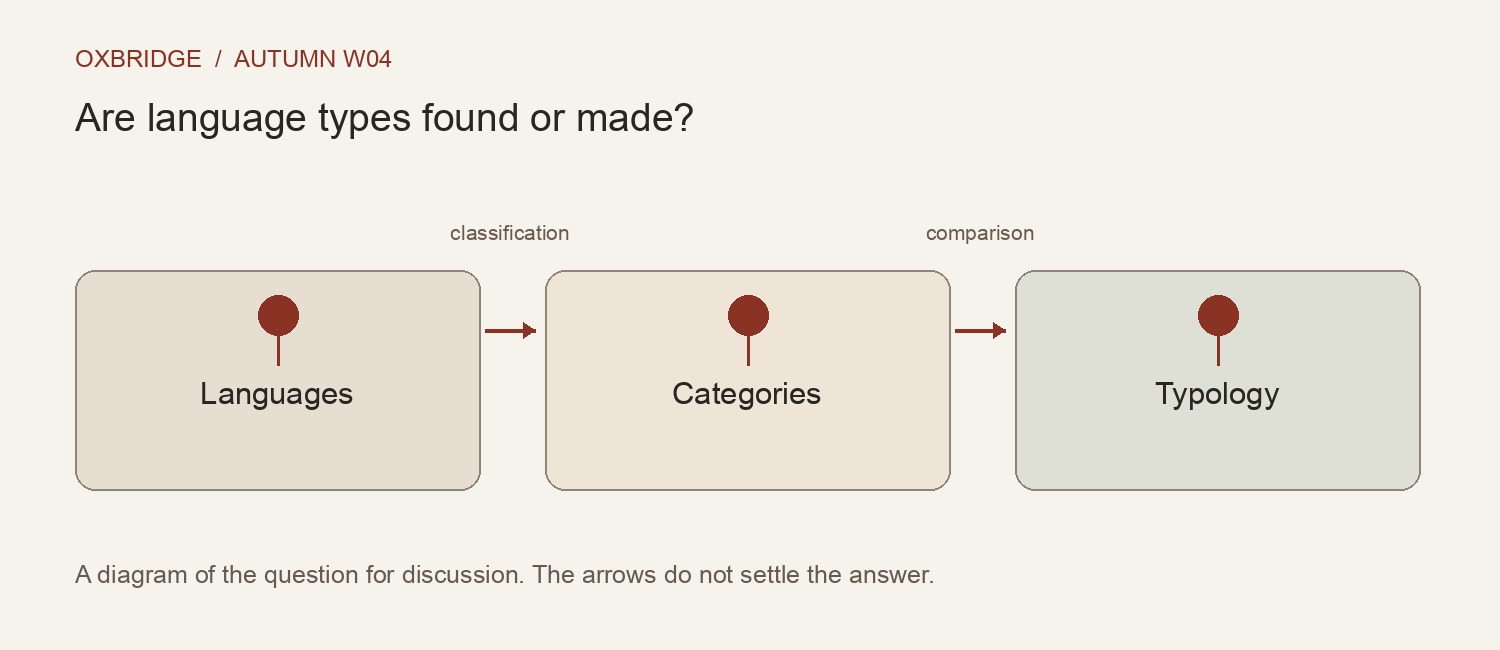
| Core question | A typologist sorts the world’s languages into types. Are the types found or made? Last spring’s W06 asked whether a map that distorts nothing is possible and why a game hides its edge as a mountain. This session asks the same of a grammar, and of the typology the student named as his own reading |
| Duration | 45 minutes. One student in the chair; the other three sit as a panel and bring one question each |
| Bring | The book you named in W02, with its full title and author, and one typological claim from it written out in one sentence. Your answer to the question you asked on the survey: why language at all, if we must, and what a world without it would run on |
| Carried out | Name one thing a language can do that no animal signal and no machine can. Then say what would make you withdraw it |
Objectives
By the end of the session, the student should be able to:
- State a position on whether typological categories are found or made, within a minute, using a specific example from the student’s reading or the constructed language data as evidence
- Respond to three follow-up questions by defending, qualifying or revising the claim as the evidence warrants, and distinguish what the examples show about languages, minds or the linguist’s categories
- Push the interviewer for seven minutes using his own survey question, and follow one consequence of the interviewer’s answer rather than importing a counterexample
How it runs
Prepared route for the October 8 slot. This totals 45 minutes.
| Time | Teacher and student activity |
|---|---|
| 11:40–11:42 · 2 min | Confirm the book’s full title, author, page and claim, and check any changed or crossed-out questions. If no passage is available, use the constructed language data as the common example. |
| 11:42–11:45 · 3 min | Ask: A typologist sorts the world’s languages into types. Are the types found or made? Give quiet thinking time, then hear one claim and one reason. A mixed answer needs a clear distinction. A spoken answer is enough; notes are optional. |
| 11:45–11:53 · 8 min | Begin with the student’s reading. Ask for an example, how it supports the claim and what would count against it. Choose relevant follow-ups one at a time. If there is no book passage, discuss what makes a classification useful or misleading, then start the data early. |
| 11:53–12:03 · 10 min | Show rows 1–4 of the constructed language data. Ask the student to identify a pattern, explain the evidence and predict “The bird sees the child.” Reveal rows 5–6 only after the first rule is clear; ask what changes and what survives. The examples are invented classroom data, not a natural language or an admissions question. |
| 12:03–12:09 · 6 min | Each of the three panel members asks one brief question built from the student’s actual reasoning, allowing about two minutes including the answer. If a prepared question is missing, use a reserve question. |
| 12:09–12:13 · 4 min | Return to the opening book claim or the constructed-data classification. Ask what the student can now defend, what was given up and which further observation could settle the remaining question. |
| 12:13–12:20 · 7 min | Switch chairs at 12:13 even if a previous discussion remains unfinished. The student questions the teacher about why language exists or how animals communicate. Test a provisional position by following a consequence of the teacher’s answer. |
| 12:20–12:24 · 4 min | Panel first, then student, then teacher: identify an exchange where evidence clarified a claim, changed a rule or exposed repetition. The teacher names one effective question from the reversal and one useful next step. |
| 12:24–12:25 · 1 min | Close with: “What would you need to observe before saying a nonhuman system has language?” Leave it as a question to consider. No submission, grade or new deadline is created. |