Land, Belonging, and Ownership
Oxbridge · Autumn 2026 · Discussion 6 of 7 · Thu 22 Oct, P5, 11:40 to 12:25 · the fourth in the room, not an Oxbridge applicant in the chair, the other three on the panel
At a glance
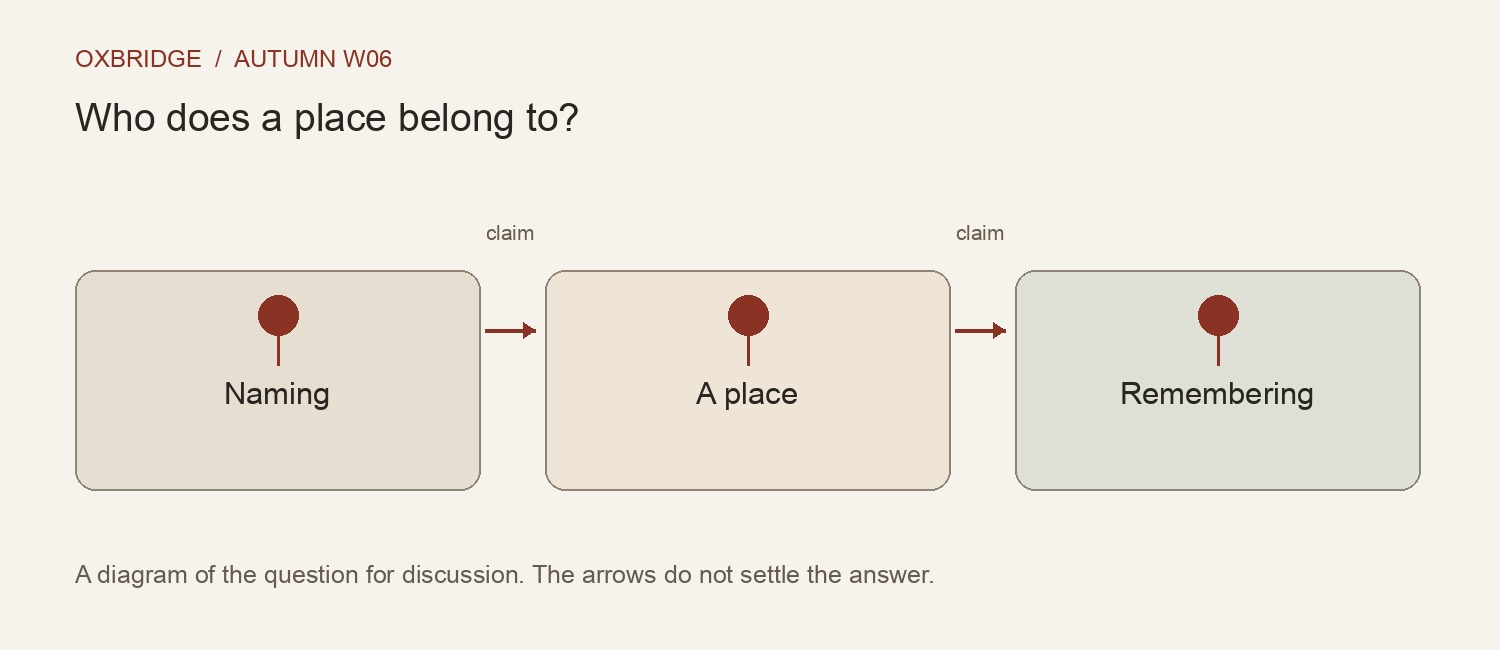
| Core question | Who does a place belong to: the people who name it, the people who measure it, or the people who remember it? This connects W06’s maps, W03’s measurement and W10’s memory through the student’s interests in Indigenous and environmental studies |
| Duration | 45 minutes. One student in the chair; the other three sit as a panel and bring one question each |
| Bring | One place you can describe in detail, on a card in three sentences: somewhere you have been, or somewhere you have read about, that more than one group of people has a claim on. One object from that place, or from any place, that now sits somewhere else, in a museum or a collection |
| Carried out | Name one thing about a place that no map, no measurement and no memory can hold. If there is nothing, say which of the three holds the most |
Objectives
By the end of the session, the student should be able to:
- State a position on who a place belongs to within a minute, claim first and qualification second, with her own place as the evidence
- Respond to three follow-up questions by defending, qualifying or revising the claim as the evidence warrants, and state a defensible criterion for deciding between competing claims to a place
- Push the interviewer for seven minutes on the museum object, and follow a consequence rather than importing a counterexample
How it runs
| Time | Teacher and student activity |
|---|---|
| 11:40–11:42 · 2 min | Check the student’s chosen place and object, and briefly ask what the student wants to practice. Use that material first. If needed, introduce one short historical place or object case from the prepared bank. |
| 11:42–11:45 · 3 min | Ask: Who does a place belong to: the people who name it, the people who measure it, or the people who remember it? Allow quiet thinking and the existing one-sentence note with a reason. The student may challenge the alternatives or distinguish different claims, but must explain how to decide when claims conflict. The note is not collected or graded. |
| 11:45–12:05 · 20 min | Hear the student’s account, choose three responsive pushes and give each panel member one question turn. Test a consequence using the displaced object. Aim to reach the panel around 11:55 and the object around 12:01. Distinguish evidence about a place from authority to decide its future; do not impose the older push tree’s suggested conclusions. |
| 12:05–12:12 · 7 min | Switch roles at 12:05 even if an earlier question is unfinished. The student questions the teacher’s position about the museum object, following a consequence of the answer. The panel may join when invited. |
| 12:12–12:17 · 5 min | Connect Indigenous and environmental questions through one disputed decision. Ask who decides, which evidence matters and what should happen when interests conflict. |
| 12:17–12:22 · 5 min | Panel first, then student, then teacher: identify a specific exchange that changed or strengthened the reasoning, including the student’s questioning during the reversal. |
| 12:22–12:25 · 3 min | Ask: “Give me your answer now. What changed it, or why did it survive?” Retain the closing question: name one thing about a place that no map, measurement or memory can hold; if there is nothing, say which holds the most. No new submission is required. |