Measurement and Embodied Experience
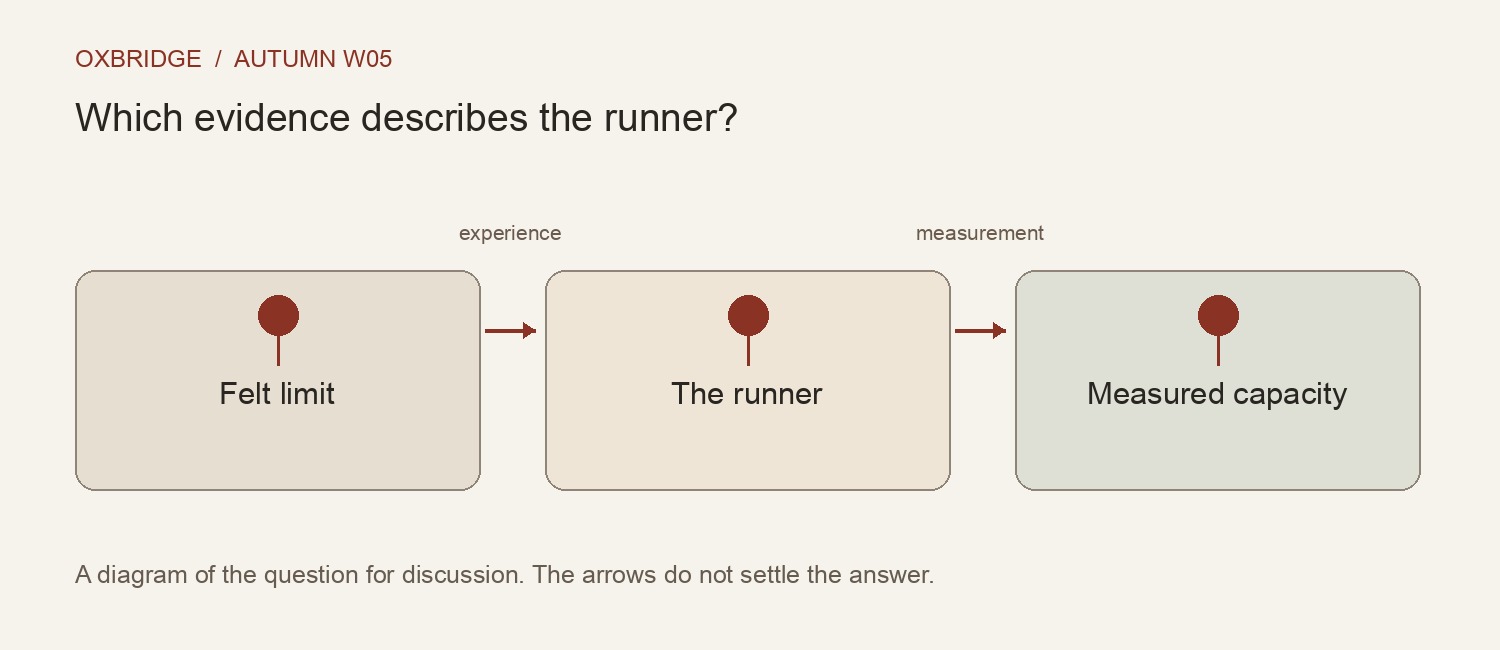
Oxbridge · Autumn 2026 · Discussion 5 of 7 · Thu 15 Oct, P5, 11:40 to 12:25 · the Biochemistry applicant in the chair, the other three on the panel · the Oxbridge application deadline is this day
At a glance
| Core question | A runner feels she cannot go on. Her blood chemistry says she can. Which is wrong? Last spring’s W08 asked the same of a thermometer reading 22 while you shiver. This session asks it of the body in motion, which is the student’s own reading: neurophysiology, kinesiology and sport |
| Duration | 45 minutes. One student in the chair; the other three sit as a panel and bring one question each |
| Bring | One case of fatigue or performance that you can describe in detail: an event, an athlete, a mechanism, a paper. Written on a card in three sentences. Your answer to the question you did not answer on the survey: why biochemistry and not the pure chemistry you considered |
| Carried out | Name one thing the body does in a race that a complete biochemical account of it would leave out. If nothing, say what kinesiology is for |
Objectives
By the end of the session, the student should be able to:
- State what can and cannot be concluded from the runner’s feeling and one unchanged blood-test result, identifying what each reports and using the case as evidence
- Respond to three follow-up questions by defending, qualifying or revising the claim as the evidence warrants, and identify what further evidence would test a biochemical explanation of the case
- Push the interviewer for seven minutes on the doping line, and follow a consequence rather than importing a counterexample
- Answer “why biochemistry and not chemistry” in one sentence with one reason, before anyone at Oxford asks
How it runs
Prepared route for the October 15 slot. This totals 45 minutes.
| Time | Teacher and student activity |
|---|---|
| 11:40–11:42 · 2 min | Hear the student’s case and confirm its source. Check any changed or crossed-out questions. If no case is available, use the runner example. |
| 11:42–11:45 · 3 min | Ask what draws the student to biochemistry rather than pure chemistry and connect that interest to a mechanism in the case. Briefly ask what any earlier mock required. Treat the subjects as overlapping fields; application logistics remain with counselors. |
| 11:45–11:48 · 3 min | Ask: “A runner feels she cannot continue. One blood-test result is unchanged. What can we conclude?” Hear a first position. Clarify what was measured and whether “cannot continue” refers to feeling, performance or risk. |
| 11:48–11:58 · 10 min | Test the explanation with up to three responsive follow-ups, one at a time. Ask for two possible explanations, what the measurement could miss and which observation could distinguish the explanations. Let the student finish the attempt before adding another question. |
| 11:58–12:05 · 7 min | Use the constructed enzyme data. Describe the pattern before explaining it, predict the direction of both rates at the next substrate concentration, then reveal row 5. Ask what the new values support, what remains unproved and what further comparison would help. No mechanism name or exact numerical prediction is required. |
| 12:05–12:10 · 5 min | Take one short question from each panel member. Questions should follow the student’s actual reasoning. |
| 12:10–12:13 · 3 min | Return to the runner and the student’s own case. Ask for a revised or more precise claim and identify the missing measurement that matters most. |
| 12:13–12:20 · 7 min | Switch chairs at 12:13. The student questions a clearly labeled hypothetical position about enhancement and fairness. Each new question should follow the teacher’s answer; the hypothetical assumptions do not establish real-world equivalence between methods. |
| 12:20–12:25 · 5 min | Panel first, then the student, then the teacher: identify a question that made the explanation more precise and name one effective move and one next step. Integrate the closing question: what would a complete biochemical account of a race explain, and what might remain? Notes are optional; nothing is collected or graded. |