Is Perception Ever Neutral?
Oxbridge · Images and Constructed Reality · Week 1 of 14 · Do Images Represent Reality or Produce It?
Related ideas: John Berger · Representation · Visual Evidence.
At a glance
| Core question | Is seeing something we do, or something that happens to us? |
| Duration | 45 minutes, standard template |
| Reading | Berger, Ways of Seeing, ch. 1, first six pages (BBC episode as second entry point) |
| Bring | One image no student will recognize, plus one uncomfortable fact about it, withheld |
| Carried out | If seeing is never neutral, what is a photograph evidence of? |
Objectives
By the end of this lesson, students should be able to:
- Separate what they see from what they know from what they assume, on an unfamiliar image
- State why seeing might be something that happens to them rather than something they do
- Carry the question out of the room: if seeing is never neutral, what is a photograph evidence of?
Preparation
Read Berger’s first six pages. The BBC episode of the same name “works as a second entry point for students who struggle with the prose”. Offer it from the first session so students do not need to request support.
Bring one image no student will recognize: a minor painting, an unlabeled photograph, an object in an unfamiliar context. Do not tell them what it is.
Opening prompt (5 minutes)
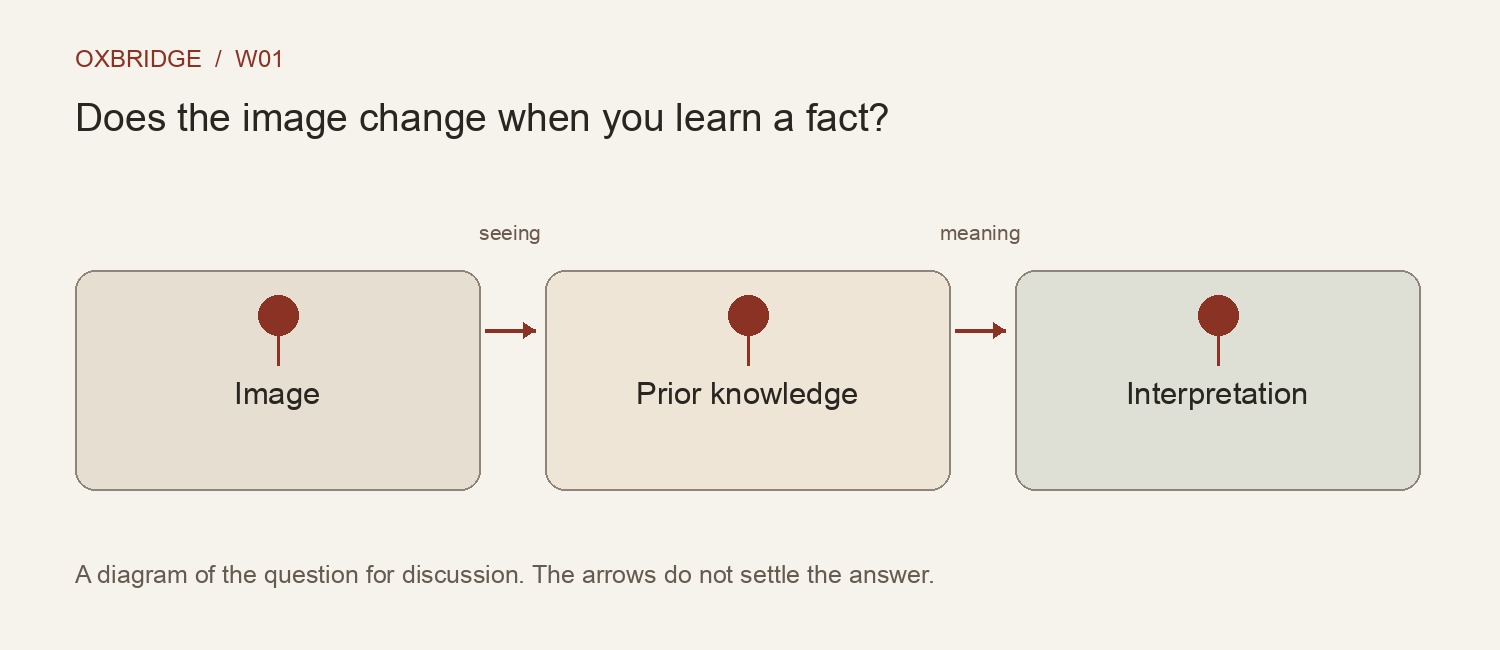
Show the unfamiliar image. Give students two minutes to write silently, using these three instructions in order:
- Write down what you see.
- Write down what you know.
- Write down whether knowing changed the seeing.
Take no answers yet.
Movement 1 · elicit (10 minutes)
Question. What did you see?
Collect descriptions. Write the differences on the board without commenting on them.
When two students describe the same image incompatibly, name it: “You are looking at the same picture and reporting different things. Why?”
Anticipated responses and the pushes:
| Student says | Push |
|---|---|
| ”We noticed different parts” | Fine, but ask why those parts |
| ”We have different eyesight” | Does eyesight explain noticing a face rather than a color? |
| ”It depends what you already know about” | Identify the connection with Berger’s argument. Keep the student’s claim available for the discussion |
Follow-ups.
- If two people see differently, is one of them seeing wrongly?
- Can the class produce a description of this image that everyone agrees on?
Movement 2 · complicate (15 minutes)
Now tell them what the image is: title, date, context, and one uncomfortable fact.
Question. Look again. Has the image changed, or have you?
| Student says | Push |
|---|---|
| ”The image did not change, only my interpretation did” | Is there a version of the image that exists before interpretation? Describe it |
| ”It feels like a different picture now” | If the picture is the thing that produces an experience, and the experience changed, in what sense is it the same picture? |
| ”Knowing ruined it” | Take seriously. Was ignorance giving them a truer view, or only a more comfortable one? |
Berger’s claim goes on the board only now, after students have generated it: the way we see things is affected by what we know or what we believe.
Follow-ups.
- Berger says we look at the relation between things and ourselves. Is that true of a photograph of a stranger?
- Can you unlearn something in order to see freshly, and has anyone ever managed it?
Movement 3 · commit (10 minutes)
Question. Is perception ever neutral? Take a side in one sentence.
Every student answers. No abstentions.
Record who said what, because week 2 will use it.
Two camps to expect:
- Trained eye: perception is shaped, but training can make it better, more accurate and more neutral. Ask: better according to what standard?
- No exit: there is no neutral position to be trained toward. Ask: if no view is better, why study anything?
Closing question (5 minutes)
On the board, unanswered:
If seeing is never neutral, what is a photograph evidence of?
Links
john-berger · framework · Images and Constructed Reality · Do Images Represent Reality or Produce It?
Vocabulary
- Trained eye
- The position that training can make perception more accurate and neutral.
- No exit
- The position that there is no neutral view to train toward.