Images and Constructed Reality
Do images represent the world, or do they produce it?
Unit plan
You already use images and have views about resolution, screenshots, compression, filters and what counts as a real photograph.
Read the complete unit plan
Oxbridge · Seminar Plan · Weeks 1–2 · The Limits of Representation
Unit question
Do images represent the world, or do they produce it?
Why this opens the course
You already use images and have views about resolution, screenshots, compression, filters and what counts as a real photograph. You need no prior reading to begin this unit.
John Berger introduces the claim that seeing is not neutral. Hito Steyerl examines the political and economic implications of how images are made and shared.
The unit also introduces the discussion method used throughout the course. You begin with a view you already hold and test it against a difficult case. You then study a thinker to connect your arguments with the reading. See Course Design Principles.
Sessions
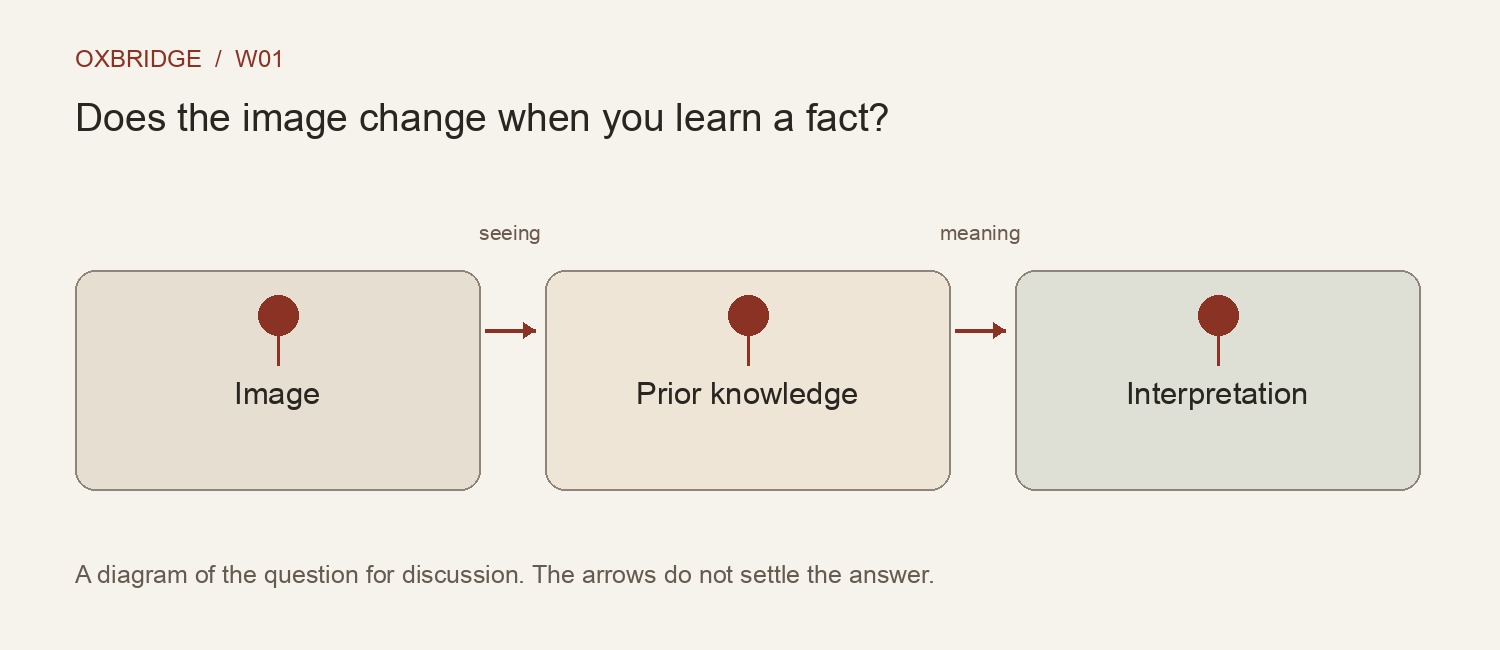
- Is Perception Ever Neutral?: You see one unfamiliar image twice, before and after being told what it is. Berger is introduced at the end.
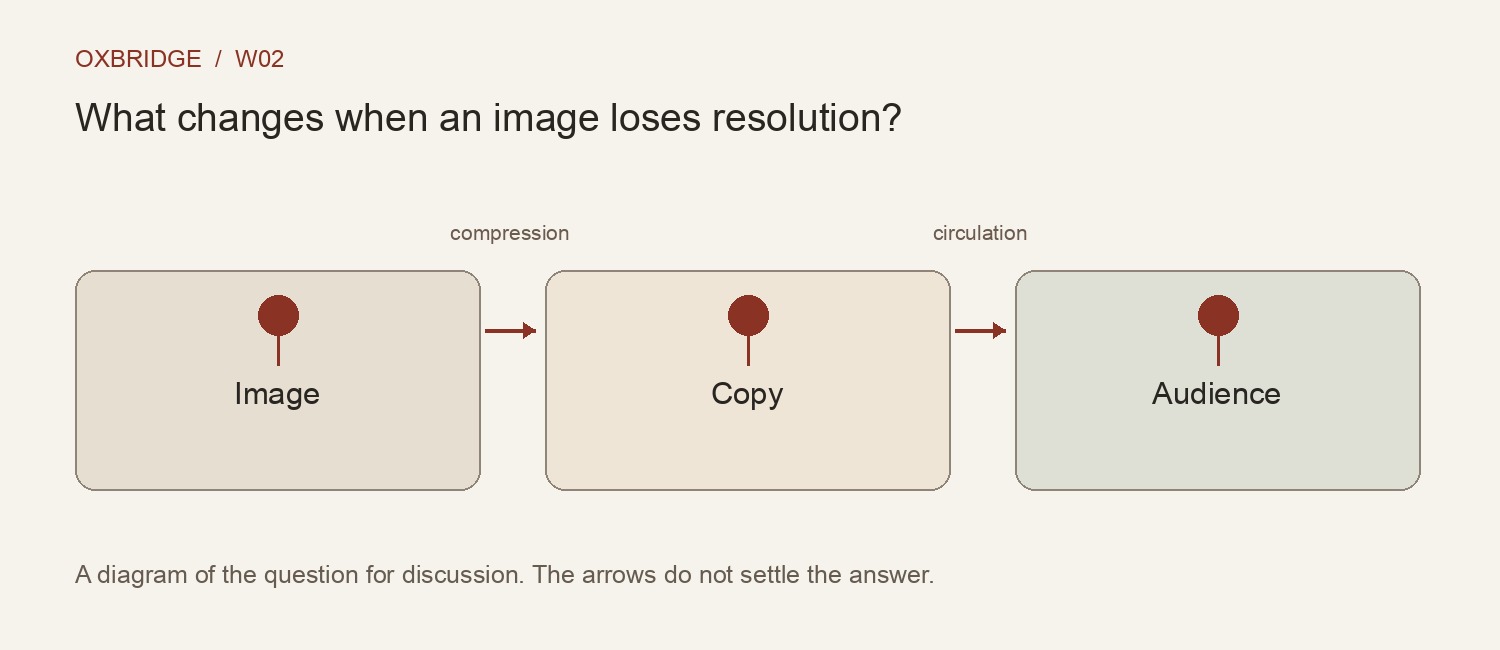
- Do Images Represent Reality or Produce It?: You examine the same image at two resolutions. Steyerl uses the vocabulary of compression to make an argument about access.
Key texts
- John Berger, Ways of Seeing, chapter 1 (first six pages; the BBC episode is the alternative entry point)
- Hito Steyerl, “In Defense of the Poor Image”, e-flux journal
See the reading list.
Concepts introduced
Preparation
Both sessions set a reading. This is the only consecutive pair in the course that does. Nothing is written or collected; the course is discussion only.
Come to W02 having read Steyerl and picked the single sentence you found most arguable. Be ready to identify the sentence and explain why you chose it.
Is a low quality image worth less than a high quality one? was a previous first essay prompt. It is now a closing discussion question, not an essay assignment.
What students should leave with
You should be able to defend a position on whether image quality is a technical property or a political one. You should also begin to consider how the way something is shown affects what you see.
Teaching notes across the two weeks
- W01 introduces two positions: the trained eye camp and the no exit camp. In W02, students who argued for the trained eye position describe a neutral image and say who could afford it.
- W02 uses the scientific vocabulary of resolution and compression. Steyerl then uses these terms to examine political and economic questions.
- W01 examines a claim stronger than “people have different opinions.” Berger’s claim is that seeing is already interpretive, before you consciously begin to interpret an image.
Bridge to Unit 2
If images are not neutral representations, you can ask whether measurement is neutral.
W02 closes with the question: A thermometer measures temperature; does it show you the temperature, or change it? The Limits of Representation asks you to test whether measurement avoids the problem of representation.
Lessons
Unit gallery