Do Images Represent Reality or Produce It?
Oxbridge · Images and Constructed Reality · Week 2 of 14 · Is Perception Ever Neutral? | Can Measurement Reach the Thing Itself?
Related ideas: Reproduction · Appropriation · The Poor Image.
At a glance
| Core question | Is the quality of an image a technical fact or a political one? |
| Duration | 45 minutes, standard template |
| Reading | Steyerl, “In Defense of the Poor Image”, e-flux |
| Prepared | The single sentence in Steyerl students found most arguable, ready to say which and why |
| Bring | Two versions of one image: high resolution, and badly compressed / screen-recorded / re-uploaded |
| Carried out | A thermometer measures temperature. Does it show you the temperature, or change it? |
Objectives
By the end of this lesson, students should be able to:
- Argue whether the quality of an image is a technical fact or a political one
- Use Steyerl’s poor image to make a case an opponent has to answer
- Hold the distinction between representing reality and producing it without collapsing one into the other
Opening prompt (5 minutes)
Show both versions of the image on screen.
Which of these is more real?
Give students two minutes to write silently.
Movement 1 · elicit (10 minutes)
Question. Which one did you choose, and what does “more real” mean in your answer?
| Student says | Push |
|---|---|
| ”The high resolution one, it has more information” | More information about what? Is a blurry photograph of a real event less real than a sharp photograph of a staged one? |
| ”The poor one, it has been seen more, it has travelled” | Ask the student to explain why the image’s circulation matters. Relate the answer to Steyerl’s position |
| ”They are the same image” | Push hard: if they produce different feelings, different levels of trust, and different audiences, in what sense are they the same? |
Follow-ups.
- Where did each of these images come from, and who paid for the difference?
- Does a high resolution image cost something a poor image does not?
Movement 2 · complicate (15 minutes)
Steyerl’s central reversal:
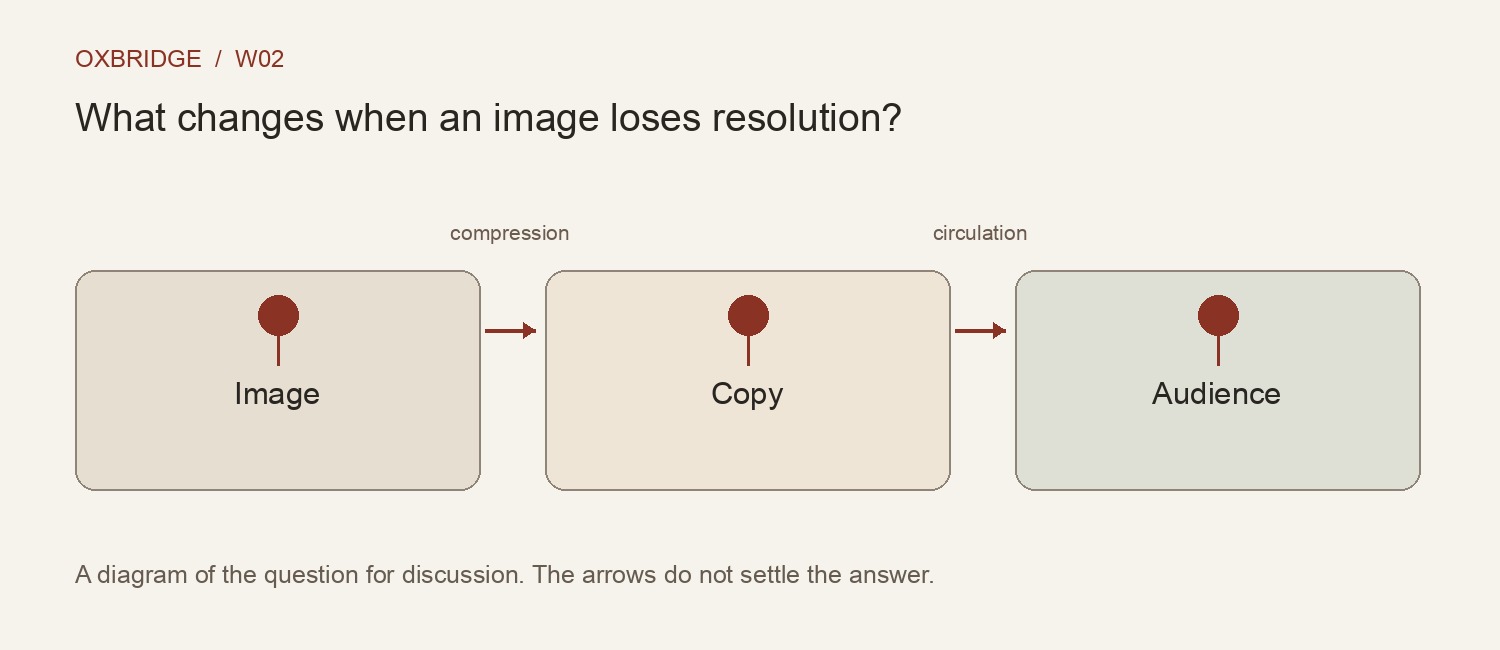
Resolution is not only a technical property. It is a marker of value, of institutional access, and of who is permitted to circulate. The poor image is degraded because it moved. The high resolution image is pristine because it was kept.
Questions.
- If an image loses quality every time it is shared, what does high quality tell us about how much it was shared?
- Steyerl says the poor image is about defiance and appropriation as much as about conformism and exploitation. Can something be both?
- Does an image represent an event, or does it produce the event as a public thing?
| Student says | Push |
|---|---|
| ”Quality is just physics, compression is measurable” | Accept the claim about measurable compression. Ask how those measurable differences relate to ownership and institutional access |
| ”So a bad image is more democratic” | Is a poor image democratic, or only cheaper to distribute? Are those the same? |
| ”This is only about digital images” | Push toward reproduction generally: prints, copies, textbook plates, museum lighting |
Follow-ups.
- Is a screenshot of a painting a painting?
- If an event is not photographed, did it happen publicly?
Movement 3 · commit (10 minutes)
Question. Do images show us the world, or make the world showable? Answer in one sentence with one reason.
Call back to week 1 by name. Students who said perception can be trained toward neutrality must now say what a neutral image would look like and who would be able to afford it.
This is why Is Perception Ever Neutral? records the camps.
Closing question (5 minutes)
A thermometer measures temperature. Does it show you the temperature, or change it?
This is the deliberate handoff into W03. Students will assume it is a different subject. It is not.
Links
hito-steyerl · the-poor-image · Images and Constructed Reality · Is Perception Ever Neutral?
Vocabulary
- Image quality
- Technical properties such as resolution and compression, also treated as markers of value and access.
- Poor image
- An image degraded through movement and sharing, in Steyerl’s account.
- Representing reality
- Showing an event or the world.
- Producing reality
- Making an event public through an image, in this discussion.