Can the Body Be Trusted?
Oxbridge · Embodiment and Machine Cognition · Week 8 of 14 · Argument and Conceptual Revision | Is the Human and Machine Line Essential or Contingent?
At a glance
| Core question | You know you are cold because you feel it. Is feeling more reliable than any system, or is the body just another framework? |
| Duration | 45 minutes, standard template |
| Reading | None. One quotation sent in advance |
| Sent ahead | ”The body is our general medium for having a world”, Merleau-Ponty |
| Carried out | What can you do that a machine cannot? |
Objectives
By the end of this lesson, students should be able to:
- Argue whether feeling is more reliable than any system, or whether the body is another framework
- Test one quotation against their own experience rather than restating it
- Carry out the question of what they can do that a machine cannot
Opening prompt (5 minutes)
Describe being cold without using the word cold, and without using a number.
Give students two minutes to write silently.
This is harder than it looks and it puts the whole session in the room immediately.
Movement 1 · elicit (10 minutes)
Questions.
- Can you be wrong about being cold?
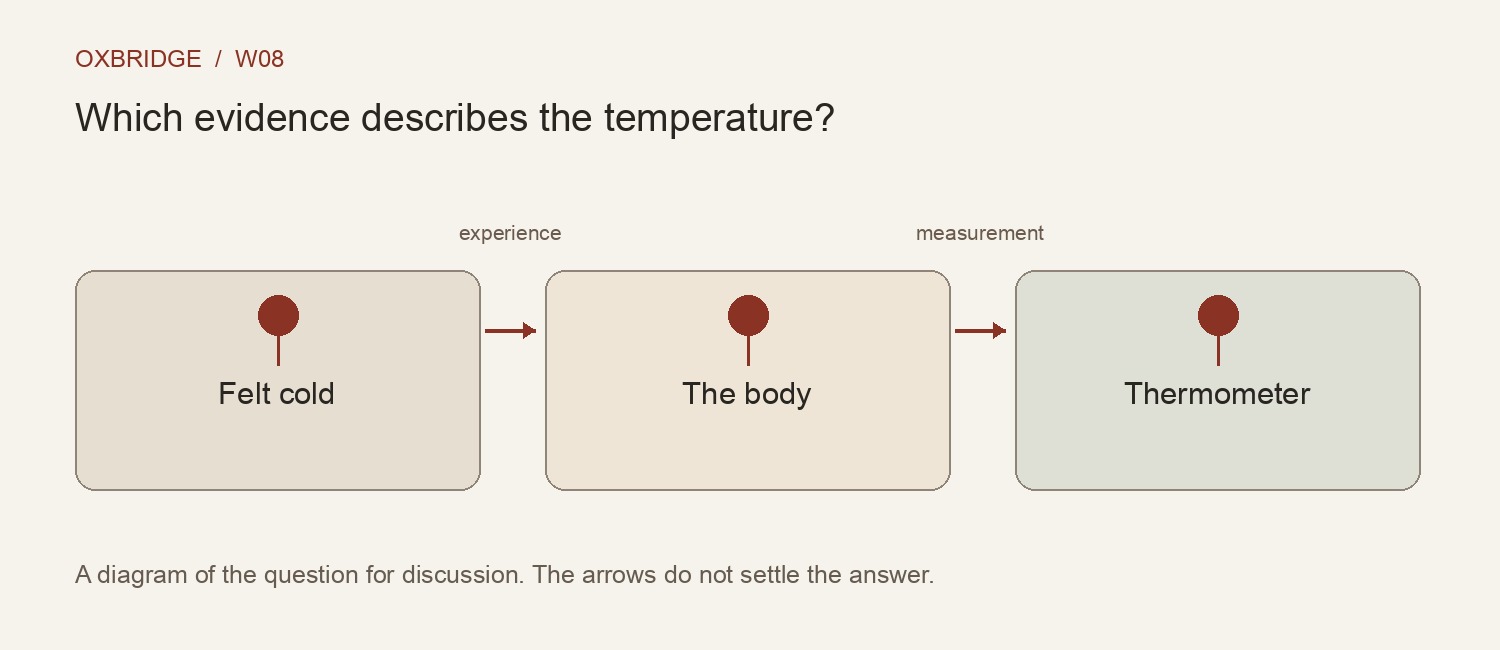
- If a thermometer says 22 degrees and you are shivering, which one is wrong?
| Student says | Push |
|---|---|
| ”Neither. The thermometer measures the room and I measure me” | Very strong. Then what is the body an instrument of? |
| ”The body, because it is subjective” | Subjective compared to what? You only reach the thermometer through a body that reads it |
| ”You cannot be wrong about a feeling, only about its cause” | This is the classical position. Return to it in movement 2 |
Movement 2 · complicate (15 minutes)
Introduce the four cases one at a time. Ask students to test their position against each case.
Case: Phantom limb
The question: A person feels pain in a leg that is not there. Is the pain real? Is it accurate?
Case: Chronic pain without injury
The question: The signal fires with nothing to report. Is the body lying, or reporting honestly about itself?
Case: Synaesthesia
The question: Someone hears color. Are they perceiving more of the world, or differently?
Case: Adaptation
The question: Move from a cold room to a warm one and the same water feels hot, then neutral. Which reading was correct?
Questions.
- Is the body a window onto the world, or a medium that shapes what can appear in it?
- Merleau-Ponty says the body is the medium for having a world. If the medium is wrong, are you wrong about the world, or do you have a different world?
- Is a blind person perceiving less of the world, or a different world?
| Student says | Push |
|---|---|
| ”These are malfunctions, the normal body works fine” | What makes one configuration normal rather than simply common? |
| ”This proves the body cannot be trusted” | Trusted to do what? A hammer that is bad at cutting is not untrustworthy |
Movement 3 · commit (10 minutes)
Introduce the Spinoza reframe.
We do not yet know what a body can do.
Question. Stop asking what a body is and ask what a body can do. Does that dissolve the problem or dodge it?
Each student states a position: the body is an instrument to be corrected, or the body is the condition of there being anything to correct.
Closing question (5 minutes)
What can you do that a machine cannot?
Links
maurice-merleau-ponty · friedrich-nietzsche · Embodiment and Machine Cognition · Is the Human and Machine Line Essential or Contingent?
Vocabulary
- Subjective
- Dependent on the person feeling or perceiving something.
- Medium
- Something that shapes what can appear to you, in this discussion of the body.