Argument and Conceptual Revision
Oxbridge · Historical Frameworks of Knowledge · Week 7 of 14 · Does Reality Have a History? | Can the Body Be Trusted?
At a glance
| Purpose | The midpoint. No new material, six weeks of discussion put under interview pressure |
| Duration | 45 minutes, template bent: the three movements become what an argument is / live pressure / build the spine |
| Reading | none |
| Carried out | Every framework so far turned out to hide its edges. Is there anything that does not? |
Objectives
By the end of this lesson, students should be able to:
- Say what an argument is, as distinct from an opinion or a reaction
- Hold a position under live interview pressure without either collapsing or digging in
- Build the spine of an argument from six weeks of discussion, with no new material
Opening prompt (5 minutes)
Write the strongest objection to something you argued in the last six weeks.
Give students two minutes to write silently. They must challenge their own argument, not a classmate’s.
Movement 1 · what an argument is (10 minutes)
Put two paragraphs on the board, both about the same topic.
- One surveys three views and concludes that the truth lies somewhere in between.
- One takes a narrow position and names the case that would defeat it.
Questions.
- Which of these could be wrong? Which could be right?
- Which one would you rather have to defend? Which one is worth listening to?
The principle.
An argument is not a survey of views. It is a committed act of reasoning. A claim narrow enough to be wrong is worth more than a claim broad enough to be safe.
Compare the displayed paragraphs as arguments. Students can reread the difference between surveying views and committing to a claim. The course remains discussion only, with no written submission.
Movement 2 · live pressure (15 minutes)
Students work in pairs. One states a position in one sentence. The partner asks three follow-up questions using only these moves:
- The consequence. If that is true, then what follows?
- The hard case. Here is an example your claim does not cover.
- The definition. You used a word that is doing all the work. Define it.
Ask students to swap roles. Debrief with one question only:
At which push did you stop thinking and start defending?
The same question the mock interview debrief asks. See Interview Preparation.
Movement 3 · build the spine (10 minutes)
Each student writes four lines to prepare their spoken answer.
Students keep these notes. Nothing is collected.
- My claim, in one sentence.
- The reason.
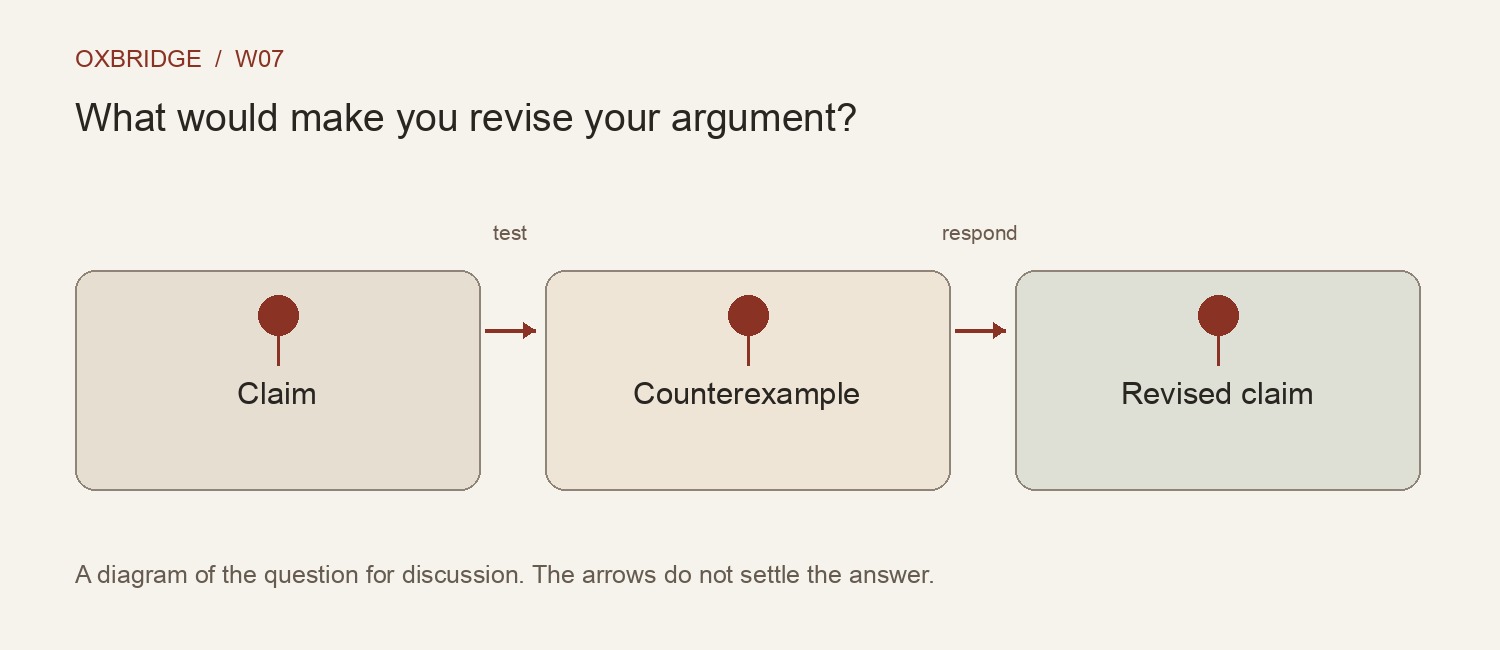
- The strongest objection.
- Why the claim survives, or how it must narrow.
Ask three students to read their notes aloud. The class then tests each argument with follow-up questions.
The four lines also organize an interview answer: state the claim, give a reason, identify an objection before being asked, and explain what you concede.
Practice writing this in ten minutes before giving the answer aloud in ninety seconds.
Closing (5 minutes)
Every framework so far turned out to hide its edges. Is there anything that does not?
Links
Interview Preparation · Assessment, none · Does Reality Have a History? · Can the Body Be Trusted?
Vocabulary
- Argument
- A claim supported by a reason, rather than only an opinion or reaction.
- Consequence
- What follows if a claim is true.
- Hard case
- An example that a claim does not cover.
- Objection
- A reason that challenges an argument.