Who Gets to Show Us the World?
Oxbridge · Power and Visibility · Week 13 of 14 · Is a Common World Still Possible? | Is a View from Nowhere Possible?
At a glance
| Core question | Is being seen a form of recognition or a form of capture? |
| Duration | 45 minutes, standard template |
| Reading | Two short extracts: Foucault on the panopticon (Discipline and Punish); Fanon, the look passage (Black Skin, White Masks) |
| Carried out | Is a view from nowhere possible? |
Objectives
By the end of this lesson, students should be able to:
- Argue whether being seen is recognition or capture
- Set Foucault’s panopticon against Fanon’s look and say what each one catches that the other misses
- Name who holds the position of showing, and who is required to be seen
Opening prompt (5 minutes)
Describe a situation in which being watched changed what you did, even though nobody said anything.
Give students two minutes to write silently. Begin with this familiar experience before introducing the readings.
Movement 1 · elicit (10 minutes)
Questions.
- Did you change because you were watched, or because you might be watched?
- Is there a difference between being watched and being seen?
| Student says | Push |
|---|---|
| ”Cameras in shops, so I do not steal” | Were you going to? What is the mechanism if the camera changes behavior in people who were never going to steal? |
| ”I perform online” | For whom, exactly? Can you name the audience, or is it imagined? |
Movement 2 · complicate (15 minutes)
Foucault
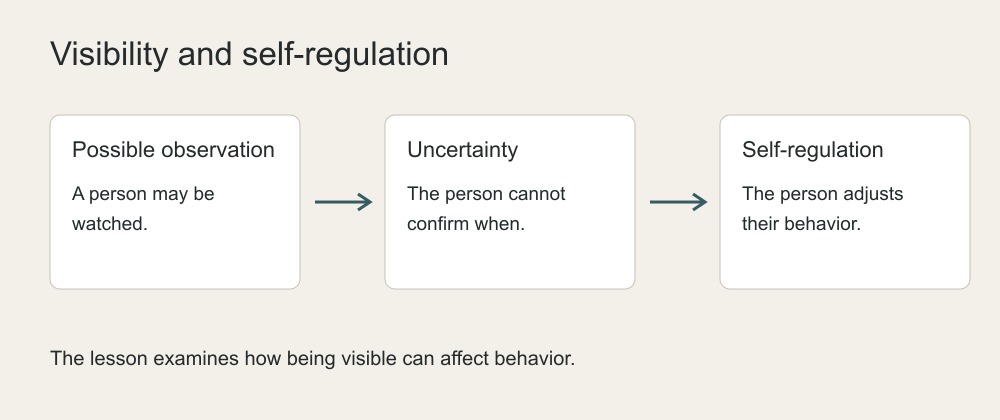
The panopticon works because the prisoner cannot tell when he is watched, so he watches himself.
Power becomes automatic and no longer needs an operator.
Questions.
- If power works best when nobody has to exercise it, where is it located?
- Is visibility a trap? Who set it?
- Is a framework that makes you police yourself more or less powerful than one that punishes you?
Fanon
Fanon describes a look that assigns a person an identity before they speak.
Ask students to consider how that imposed identity affects what the person can do or say.
Questions.
- Foucault says visibility is a trap. Fanon says invisibility is also one. Can both be true?
- Is demanding to be seen a demand for power or a request for permission?
- Who in this room has the option of being unmarked, of being seen as simply a person rather than as a type?
| Student says | Push |
|---|---|
| ”So the solution is not to be seen” | Who can afford invisibility, and who is punished by it? |
| ”Representation fixes this, more people on screen” | Push with W12: does being represented give you the position of the one who shows, or only of the one shown? |
Movement 3 · commit (10 minutes)
Write this course-wide claim on the board for students to examine.
Every framework has a maker, and the maker is not in the picture.
Question. Does knowing who made the frame change anything, or only how you feel about it?
This is the awareness versus action question and it should be pressed hard. Students who say awareness is enough must say enough for what.
Closing question (5 minutes)
Is a view from nowhere possible?
Links
michel-foucault · frantz-fanon · Power and Visibility · Is a View from Nowhere Possible?
Vocabulary
- Panopticon
- A model in which uncertainty about being watched leads the prisoner to watch himself.
- Look
- An imposed identity assigned before a person speaks, in Fanon’s account.
- Unmarked
- Seen as simply a person rather than as a type.