Power and Visibility
Who gets to show us the world, and who has to be seen?
Unit plan
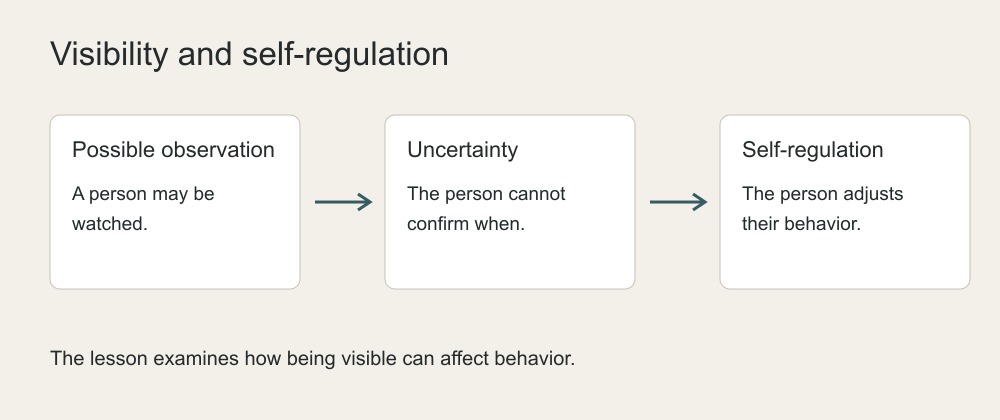
Michel Foucault: visibility is a trap. The panopticon works because the prisoner does not know when he is watched, so he watches himself.
Read the complete unit plan
Unit question
Who gets to show us the world, and who has to be seen?
The two positions
Michel Foucault: visibility is a trap. The panopticon works because the prisoner does not know when he is watched, so he watches himself. Power does not need to look. It needs only to be able to look.
Frantz Fanon: being seen is not neutral either. The look can fix a person in place before they speak. It decides in advance what they are. Fanon addresses a difference that Foucault leaves out: not everyone is seen the same way.
The move that makes this the penultimate session
This unit asks who makes and controls the frameworks you have already studied. Perspective has a position that someone occupies. A map has a maker. A category has an author.
Every framework has a maker, and the maker is not in the picture.
In Movement 3, reconsider perspective from W04, the Mercator projection from W06 and naturalization. The unit introduces no new framework.
Session
- Who Gets to Show Us the World?: you discuss two short extracts and examine whether awareness leads to action.
Concepts introduced
The unit introduces no new concepts. It examines the political implications of framework and naturalization.
Preparation
You will work through two short extracts, one from Foucault and one from Fanon. This is the course’s densest reading. You will have time to discuss the ideas after working through the language.
Nothing is written or collected. The course is discussion only. Movement 3 asks: Who decides what is visible, and does knowing the answer change anything?
Discussion
- Compare Foucault and Fanon without treating Fanon as an illustration of Foucault. Foucault describes a general condition of visibility. Fanon describes how that condition differs between people. Not everyone is seen the same way. A framework for understanding visibility needs to account for that difference.
- Examine awareness. Does knowing who made the framework change anything, or only how you feel about it? If you argue that awareness is enough, explain what it is enough for. W14 will apply this question to the course itself.
- Examine invisibility and representation. If you propose avoiding visibility, consider who can afford invisibility and who is punished by it. If you propose showing more people on screen, return to W12: does being represented give you the position of the person who shows, or only of the person shown?
- Begin with personal experience. Describe a situation in which being watched changed what you did, even though nobody said anything.
Bridge to Unit 8
W13 closes on the course’s title question. In Objectivity and Situated Knowledge, you apply the course’s critique to the course itself.
Lessons
Unit gallery