Is a View from Nowhere Possible?
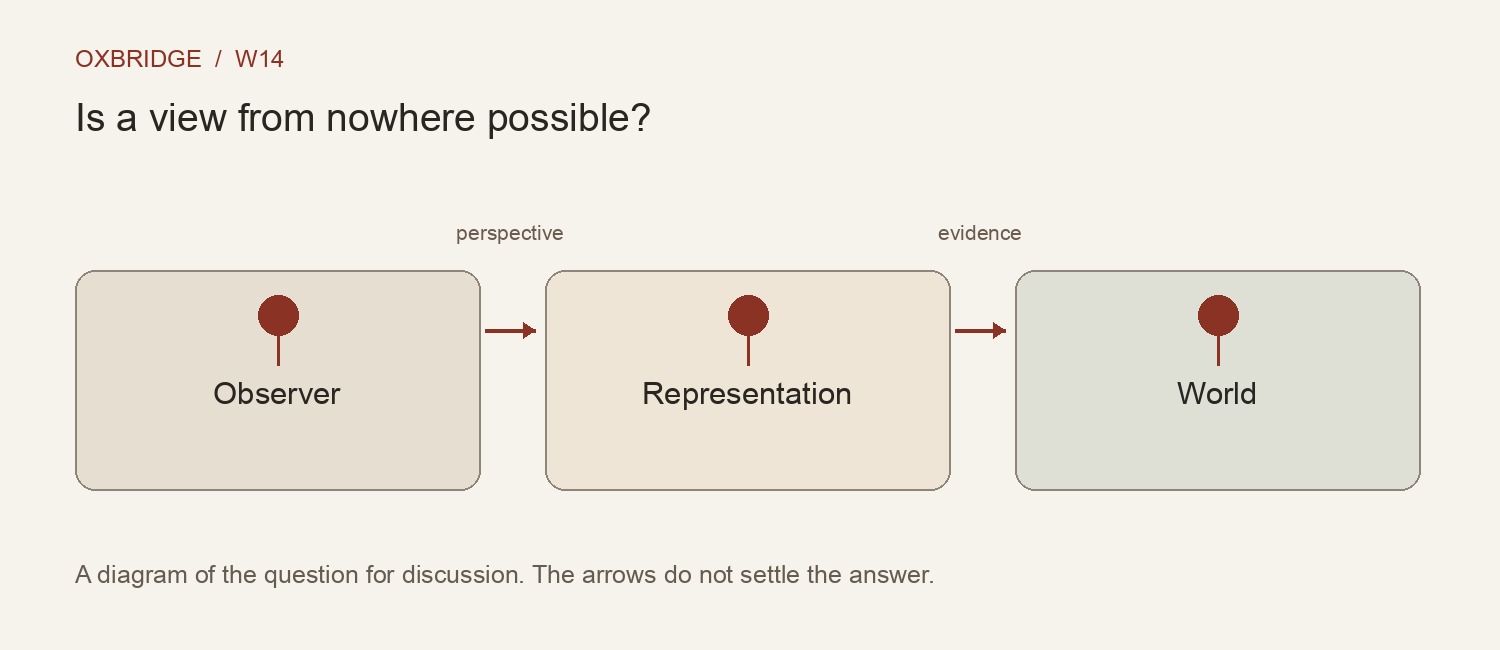
Oxbridge · Objectivity and Situated Knowledge · Week 14 of 14 · Who Gets to Show Us the World?
At a glance
| Core question | The title carries a deliberate echo of Nagel and names the course throughline in five words |
| Duration | 45 minutes, template dropped: four questions at ≈ 10 minutes each |
| Reading | None. Students think back over the term, their notes, and the group-chat thread |
| Prepared | The position they have changed their mind about |
| Carried out | Nothing. For the first time in fourteen weeks, students answer a question instead |
Objectives
By the end of this lesson, students should be able to:
- Name a position they have changed their mind about over the term, and say what changed it
- Answer a question directly, for the first time in fourteen weeks, rather than carrying it out
- Say what the throughline of the course was, in their own words
Opening prompt (5 minutes)
What does the world look like?
Give students two minutes to write silently.
Deceptively plain, and it will produce fourteen weeks of material in one line each.
The four questions
Keep supporting notes off the board. Introduce one question at a time and allow roughly ten minutes for each.
1. Is an unframed view of anything even possible?
Every framework this term hid the edges that made it a framework rather than reality: the map, linear perspective, the body, machine cognition, the categories that decide who counts.
Expect someone to offer science as the exception. Push there: if science is also a chosen set of exclusions, what distinguishes a good frame from a bad one, if not closeness to an unframed reality nobody can access?
That is the W04 question returning, and situated knowledge is the third option for students stuck between neutral science and total relativism.
2. Does the human and machine line survive its own test?
We drew the line at memory: human memory is sedimented and repainted, machine memory is a clean record.
If a system learned the way a body learns, through accumulation and distortion rather than storage, would the distinction hold?
Were we only describing what AI happens to be right now?
Strong students will notice this is structurally identical to the Plato question from week 4.
3. Whose agreement made this real?
Choose an object in the room. Ask students to trace the agreements that give it its meaning or status.
Ask where power enters that account.
Then ask whether power and agreement are different things or the same thing described from two positions.
4. Is “everything is a framework” itself a framework?
Ask students to examine the course’s own assumptions. Apply the questions about frameworks to the claim that everything is a framework.
Push lines.
- If every position is framed, is that claim framed? If it is, why should we accept it? If it is not, you have found your view from nowhere.
- Has this course given you a better view, or only a different one? What would tell you which?
- Is the suspicion useful, or does it end in a place where nothing can be said?
Closing (5 minutes)
No closing question. For the first time in fourteen weeks, students answer one instead.
Say one thing you now believe that you did not believe in March, and say what changed it.
“March” is an artifact of the prior spring run. Re-anchor it to whenever this run began before the session.
Links
view-from-nowhere · situated-knowledge · Objectivity and Situated Knowledge · Question Bank · Interview Preparation · Who Gets to Show Us the World?
Vocabulary
- Framework
- A system that shapes a view while hiding the edges that distinguish it from reality.
- View from nowhere
- The possibility of an unframed view.
- Human memory
- Memory that accumulates and changes, in this lesson’s comparison.
- Machine memory
- A clean record, in this lesson’s comparison.
- Situated knowledge
- Knowledge that names and takes responsibility for its own position.