Objectivity and Situated Knowledge
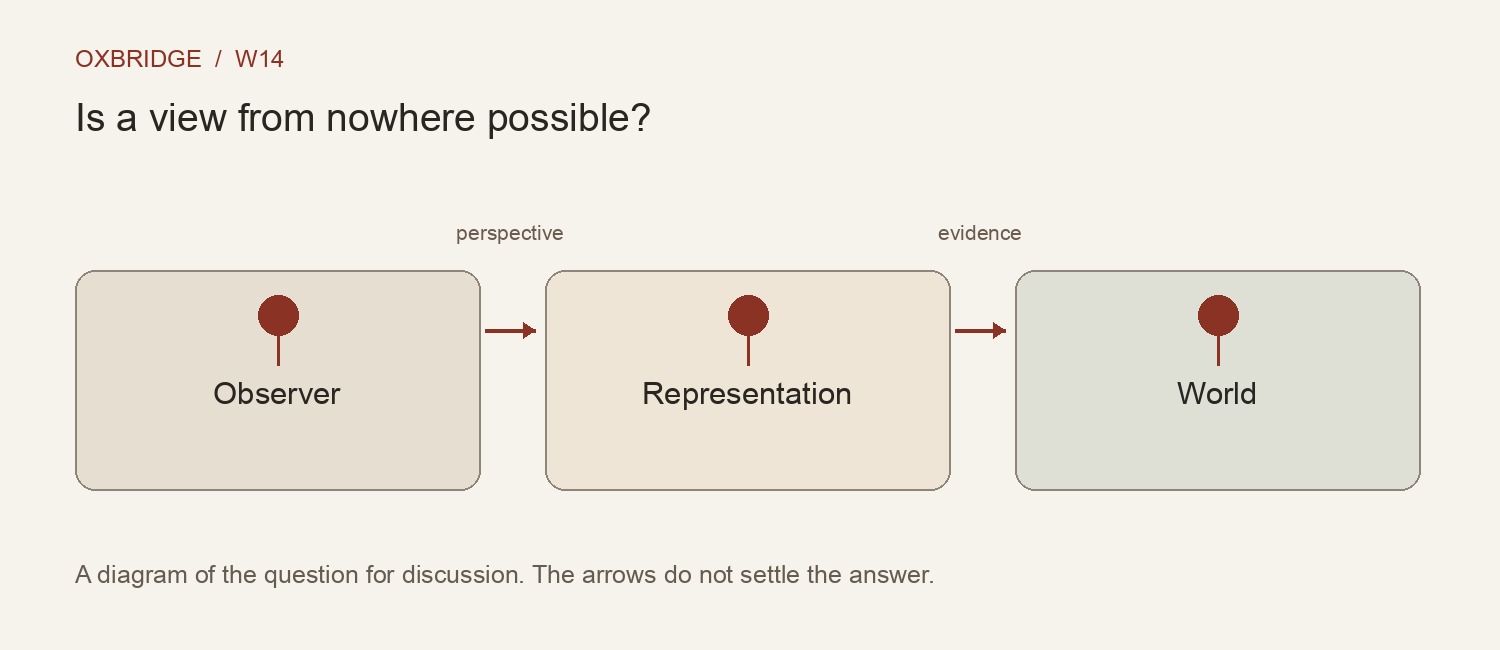
Is a view from nowhere possible?
Unit plan
The phrase echoes Nagel and names a question that runs through the course.
Read the complete unit plan
Unit question
Is a view from nowhere possible?
The phrase echoes Nagel and names a question that runs through the course.
What the session does
You discuss four questions using the material already studied. There is no new reading or content.
You also test the course’s own assumptions. If every framework leaves something out, does the framework this course has built do the same? Consider whether the claim “everything is a framework” is itself a framework.
The course has asked you to question frameworks. In this session, you consider whether that approach can withstand the same questioning.
Session
- Is a View from Nowhere Possible?: four questions at roughly ten minutes each. This is the only session in the course with no closing question to take away.
Concepts
View from Nowhere is this unit’s central concept. Situated Knowledge offers a third position for question 1, between “science is neutral” and “everything is subjective.”
Preparation
There is no assigned reading. Prepare to discuss a position you have changed your mind about. Think back over the course, using your notes and the group-chat thread. This is the only preparation task that asks you to look back over the course. It prepares you for the closing response.
Nothing is written or collected (discussion only). Is a view from nowhere possible? was the final position paper in a previous run of the course. In this run, it is the session title, and you discuss it rather than submit a paper.
The three retrospective moves
Each of the four questions connects ideas from earlier parts of the course:
- Is an unframed view of anything even possible? Connect the map, perspective, the body, machine cognition, and the categories that decide who counts. Consider all the frameworks studied this term.
- Does the human/machine line survive its own test? Return to the W09 question after the memory objection introduced in W10. Consider how this question has the same structure as the Plato question from week 4.
- Whose agreement made this real? Connect W11 and W13. Identify where power enters an account of agreement. Consider whether power and agreement are different things or the same thing described from two positions.
- Is “everything is a framework” itself a framework? Test the course’s own assumptions.
The closing discussion
Question 4 remains open. Consider whether you can hold the paradox without accepting relativism or returning to naive realism. Holding an open question without needing to resolve it is a capacity tested in an Oxbridge interview.
For the first time in fourteen weeks, you do not leave with a new question to consider. Instead, you answer this prompt: Say one thing you now believe that you did not believe when this course began, and say what changed it.
The last session focuses on movement, the fourth quality named in every commit movement. Your preparation is to think back over the term and bring a position you have changed your mind about.
After the unit
Mock interviews run in the following week if the timetable allows. Each interview lasts twelve minutes, with one question and no preparation. This week is outside the fourteen-week course. See Interview Preparation for the format and scheduling information.
Lessons
Unit gallery