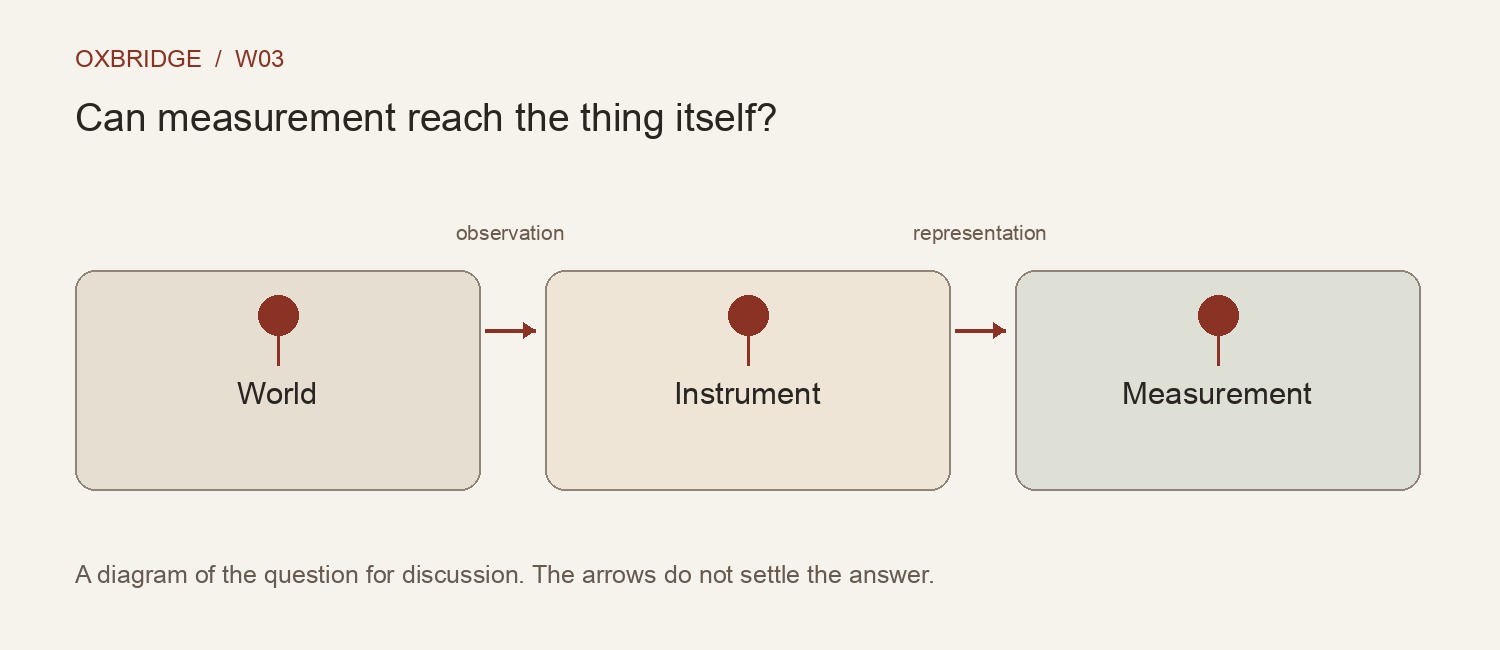
Can Measurement Reach the Thing Itself?
Oxbridge · The Limits of Representation · Week 3 of 14 · Do Images Represent Reality or Produce It? | Is There a Reality Behind Appearances?
At a glance
| Core question | Is the gap between us and the world a problem with our instruments, or a condition of being an observer at all? |
| Duration | 45 minutes, standard template |
| Reading | None. “This session runs entirely on examples students already possess” |
| Carried out | A tree falls in a forest with no one there. Does it make a sound? |
Objectives
By the end of this lesson, students should be able to:
- Build an argument from examples they already possess, with no reading to lean on
- Say whether the gap between observer and world is an instrument problem or a condition of observing at all
- Name what an instrument changes by measuring
Opening prompt (5 minutes)
A thermometer placed in a glass of water changes the temperature of the water.
Give students two minutes to write silently. Ask whether this is a serious problem or a trivial one.
Movement 1 · elicit (10 minutes)
Questions.
- Name a measurement that does not disturb what it measures.
- The double slit experiment: observing which slit the particle passes through changes the result. Is that the same kind of problem as the thermometer, or a different one?
| Student says | Push |
|---|---|
| ”Trivial, we calculate the disturbance and subtract it” | Strong answer. To calculate it you need another measurement, which also disturbs. Does this terminate? |
| ”It only matters at very small scales” | Then is the gap a fact about reality or a fact about magnitude? |
| ”A limit of technology, better instruments will fix it” | Keep this claim available. The later questions ask students to test it |
Movement 2 · complicate (15 minutes)
Move the same problem into language.
Questions.
- You say the water is cold. I say it is cool. Which of us is wrong?
- Some words cannot be translated. Does that mean the thing they name does not exist for other speakers, or only that it is harder to reach?
- Which gap is wider: between “cold” and the actual temperature, or between the thermometer reading and the actual temperature?
| Student says | Push |
|---|---|
| ”Language is vague, science is precise, so the gaps differ in kind” | The expected consensus, and a good one. Let them build it fully |
| ”Language is not trying to be precise, so it is not failing” | Excellent. Does that make language better suited to some things than measurement is? |
| ”Numbers are also a language” | Develop the claim with them. It introduces the ontological question planned for next week |
The claim to test: both language and measurement involve a gap. Science can narrow the gap, but cannot close it.
Ask students what would support or challenge this claim.
Follow-ups.
- If the gap can be narrowed but never closed, is narrowing it progress toward something, or just narrowing?
- What would it feel like to have no gap?
- Can you describe that state without using a representation?
Movement 3 · commit (10 minutes)
Question. Is the gap a fact about our instruments, or a fact about reality?
Force each student to choose. Note the split; W04 will use it, “because the students who said ‘about reality’ have already stepped into ontology.”
Closing question (5 minutes)
A tree falls in a forest with no one there. Does it make a sound?
Do not discuss. Tell them to bring an answer next week. Is There a Reality Behind Appearances? opens by polling it.
Links
the-gap · the-ontological-turn · The Limits of Representation · Is There a Reality Behind Appearances?
Vocabulary
- Magnitude
- The scale at which measurement happens.
- The gap
- The difference between a representation and what it represents.