The Limits of Representation
Can any representation reach the thing itself?
Unit plan
This is the longest unit, with three sessions on the gap: the difference between a representation and what it represents.
Read the complete unit plan
Oxbridge · Seminar Plan · Weeks 3–5 · Images and Constructed Reality | Historical Frameworks of Knowledge
Unit question
Can any representation reach the thing itself?
The arc
This is the longest unit, with three sessions on the gap: the difference between a representation and what it represents.
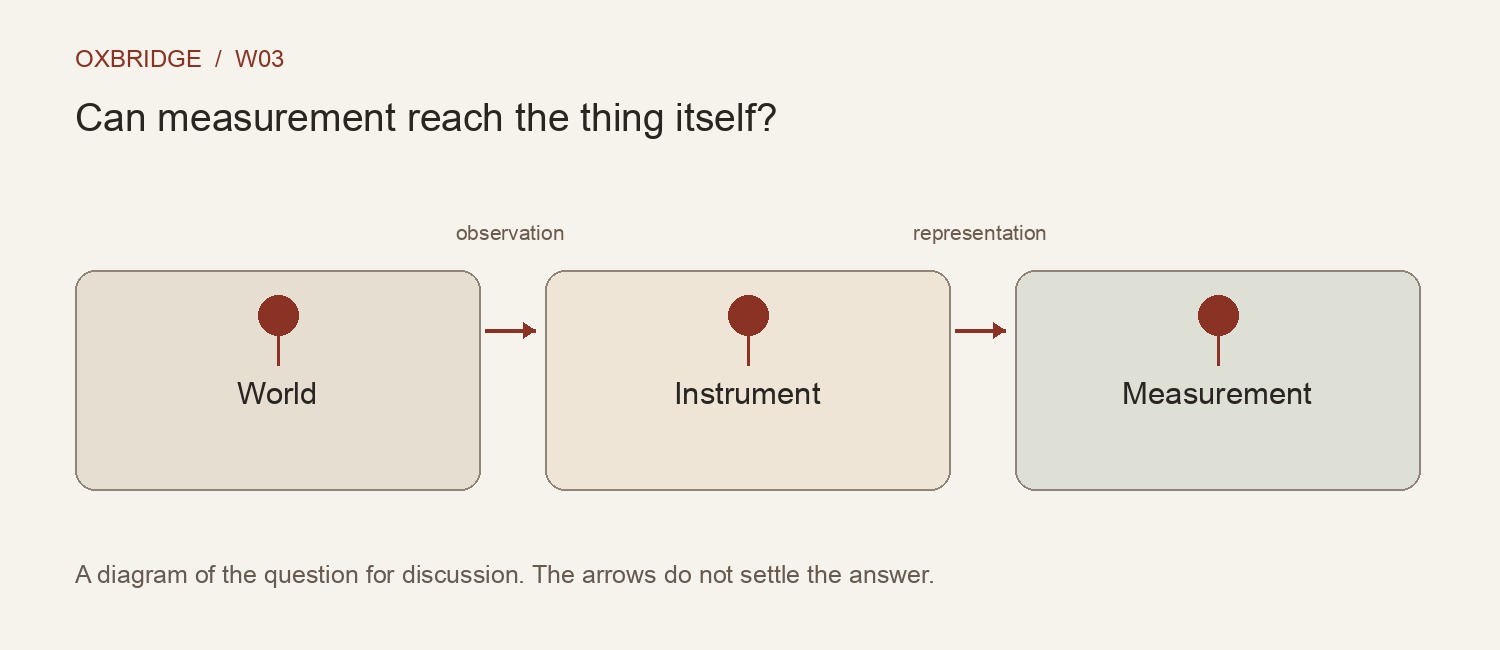
Week 3, epistemology. Epistemology concerns how well we can know things. A thermometer changes the temperature of what it measures. Observation in the double slit experiment changes what is observed. Language calls something warm, but warm means different things to different speakers. You consider whether the gap is wider in language than in science, but present in both. This is a starting position for discussion, not a final conclusion.
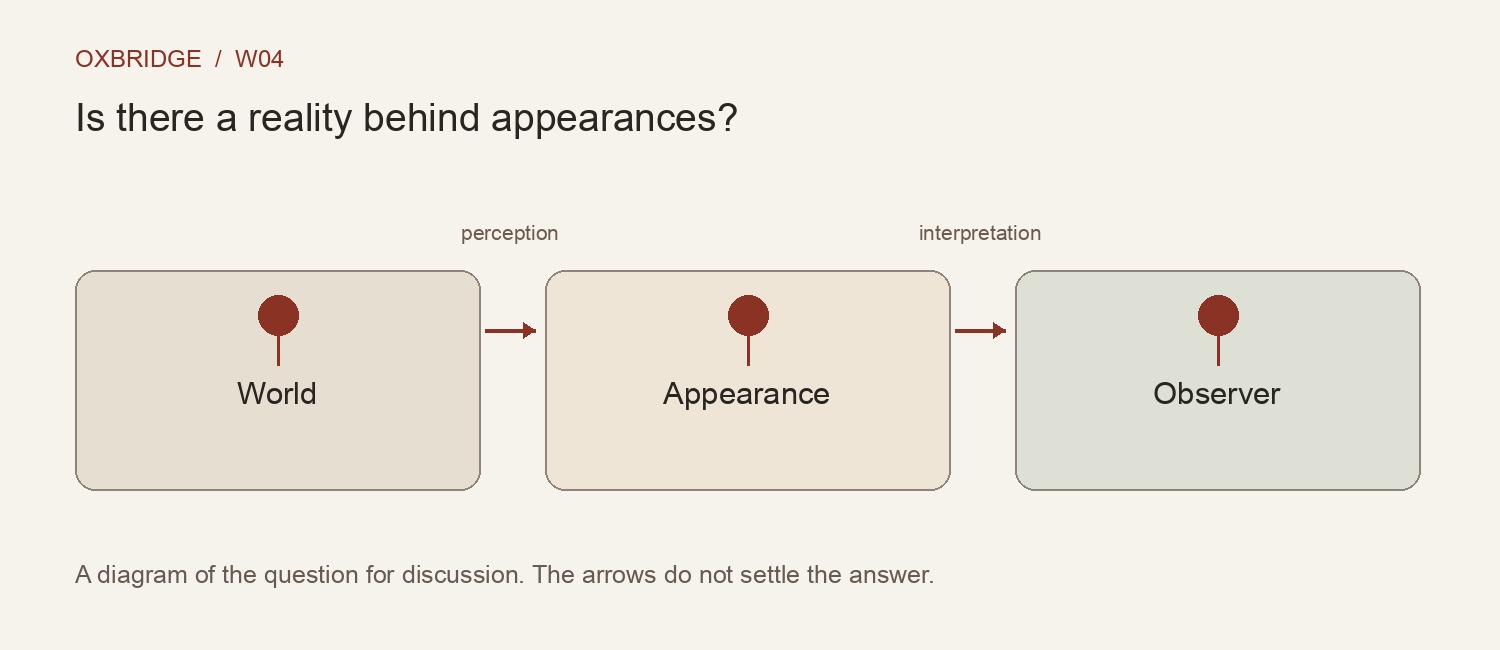
Week 4, ontology. Ontology concerns what kind of things there are to know. The ontological turn shifts the question from how well we can know things to what those things are. You study plato alongside linear perspective. Linear perspective is a technique for depicting the world from a point of view. That depiction came to look like the world itself.
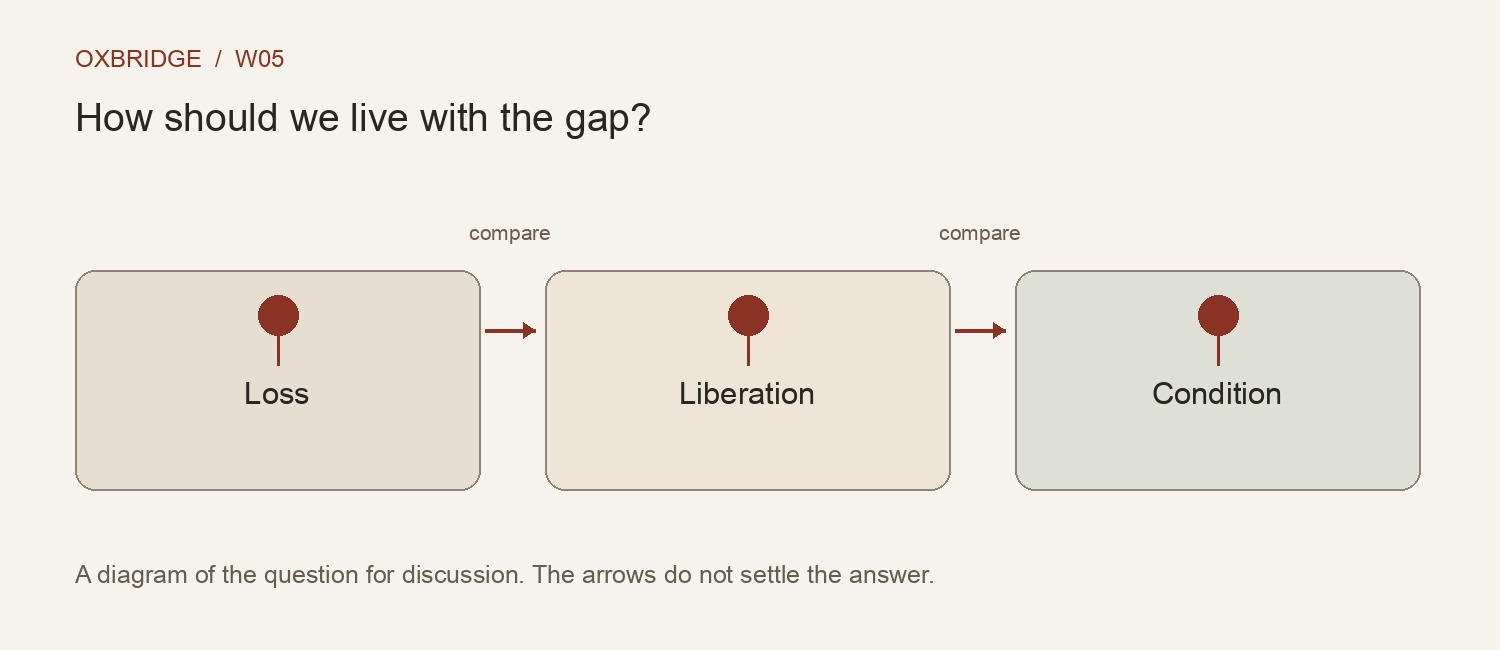
Week 5, the existential turn. You consider how to live with the claim that the gap cannot be closed. Jean-Paul Sartre, Albert Camus and Heidegger offer three positions you can adopt and defend.
Sessions
- Can Measurement Reach the Thing Itself?: You examine the thermometer and the double slit, then consider the same problem in language. There is no reading.
- Is There a Reality Behind Appearances?: You study the cave and the perspective construction through the ontological turn.
- Is the Gap a Loss, a Liberation, or a Condition?: You discuss four quotations and choose between three positions, shown in columns on the board. You may change columns.
Concepts introduced
The Gap · Linear Perspective · The Ontological Turn
Preparation
Only W04 sets a reading: Plato, approximately two pages. W03 and W05 use cases and passages introduced in class. The limited reading gives you more time to work through the difficult concepts.
You bring a position rather than written work. W03 closes with the tree falling in the forest question. Do not discuss it before W04. W04’s closing question asks you to bring a case to W05. Nothing is written for submission or collected. The course is discussion only.
Questions to work through
In W03, you can build the case that science gets closer to truth rather than being another frame of representation. In W04, you consider what distinguishes a good frame from a bad one if closeness to an unframed reality is not available as a criterion.
- W03: Measurement is an interaction with two sides: what measures and what is measured. This does not mean that everything is subjective or that measurement is unreliable. Precision and disturbance are not opposites. More precise interaction is still interaction.
- W05: The existentialists offer positions to defend. You do not need to know Sartre’s biography. You need to explain why you hold the Sartre position and why the Camus objection does not defeat it. This practices an interview skill.
The two connections inside the unit
The sessions connect through two questions:
- W02 → W03: The thermometer question closes the image unit and opens this one.
- W03 → W04: W03 closes with the tree falling in the forest question. Do not discuss it before W04, which opens with a poll on it. If you commit to the answer “the gap is about reality” in W03, you have taken an ontological position. W04 examines the differences between your answers.
Bridge to Unit 3
If frameworks cannot be escaped, the next question is whether they change. That is a historical question.
W04’s closing question prepares for this issue. W05’s closing question asks it directly: Things considered real in the past are now considered false. Were we wrong then, or did reality change? This leads to Historical Frameworks of Knowledge.
Lessons
Unit gallery