Is There a Reality Behind Appearances?
Oxbridge · The Limits of Representation · Week 4 of 14 · Can Measurement Reach the Thing Itself? | Is the Gap a Loss, a Liberation, or a Condition?
At a glance
| Core question | Last week asked how well we can know things. This week asks what kind of things there are to know |
| Duration | 45 minutes, standard template |
| Reading | Plato, Allegory of the Cave, Republic VII, clean modern translation, ≈ two pages |
| Bring | A Renaissance perspective construction |
| Carried out | Is the gap a loss, a liberation, or just the condition? Bring a case |
Objectives
By the end of this lesson, students should be able to:
- State Plato’s cave precisely enough to argue against it
- Distinguish a question about how well we know things from a question about what kinds of things there are
- Bring a case to the next session rather than a position
Opening prompt (5 minutes)
W03’s closing question is already on the board.
A tree falls in a forest with no one there. Does it make a sound?
Take a quick poll and count the responses. Begin the discussion afterward.
Movement 1 · elicit (10 minutes)
Question. Those who said no: what exactly is missing when there is no one there?
| Student says | Response |
|---|---|
| ”The vibration happens, the sound does not, because sound requires a hearer” | The ontological position stated cleanly. Name it |
| ”Of course it makes a sound, physics does not need an audience” | Also clean. Name it |
| ”It depends what you mean by sound” | Correct, and the point. Ask for both definitions and which is doing more work |
Follow-up.
- Is this an argument about the world or an argument about a word?
- How would you tell the difference?
Movement 2 · complicate (15 minutes)
Plato
Questions.
- The prisoners mistake shadows for real things. Is our situation the same as theirs, or different?
- You have never seen a perfect circle, only approximately circular things. But you know what a perfect circle is. Where does that knowledge come from?
- Is the prisoner who leaves better off than the ones who stay?
| Student says | Push |
|---|---|
| ”We are not like the prisoners because we know we might be wrong” | Does knowing you are in a cave change your relationship to it, or only your feelings about it? |
| ”The circle comes from idealizing, from averaging the imperfect ones” | Good empiricist answer. How do you average toward a perfection you have never encountered? |
| ”The prisoner who leaves is worse off, he cannot go back” | Take the objection seriously. Plato raises this concern too |
Linear perspective
Show a Renaissance perspective construction, then Steyerl’s argument from W02.
Questions.
- Perspective does not show us the world. It shows us the world from a point. What is the difference?
- If a perspective becomes invisible as a perspective, what do we think we are looking at?
- Is perspective a discovery about vision, or an invention that trained vision?
Movement 3 · commit (10 minutes)
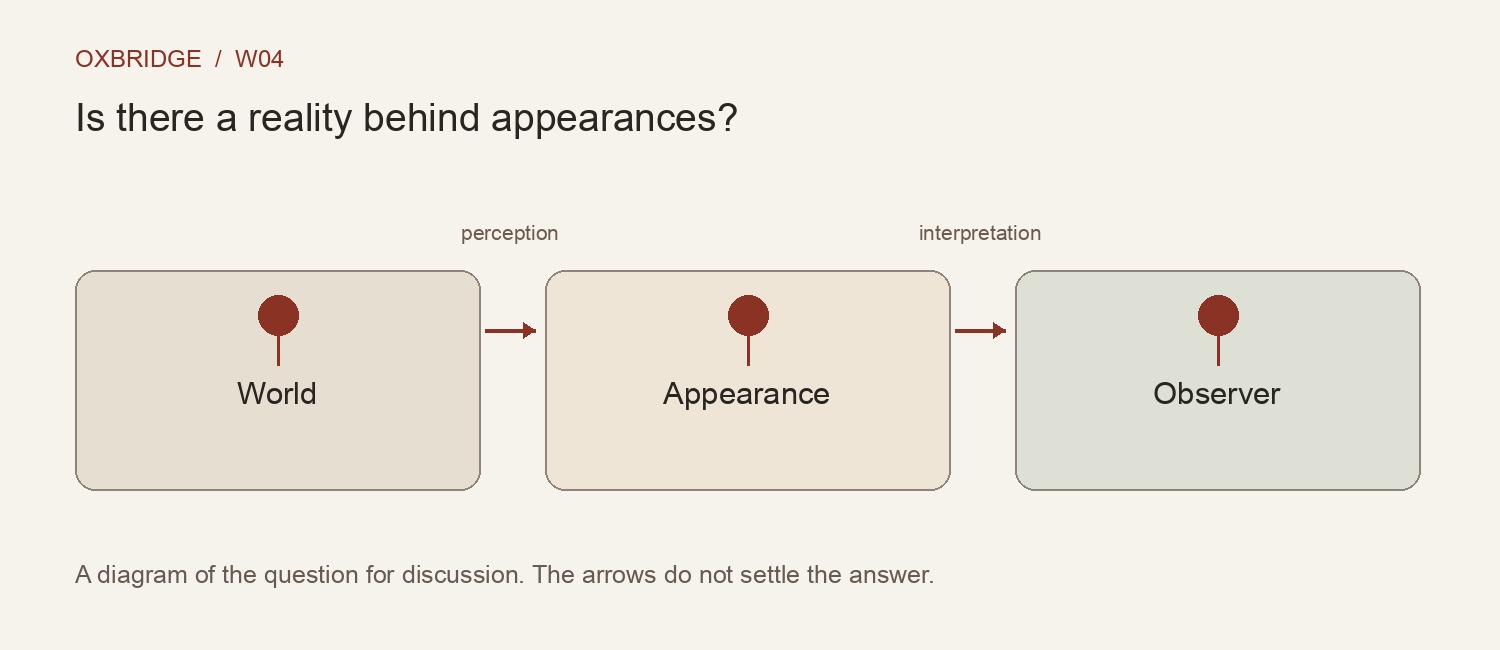
Question. Is there a reality behind appearances, and if there is, what would count as evidence of it?
The second half of that question is the trap. Any evidence arrives as an appearance.
Closing question (5 minutes)
We cannot measure without disturbing. We cannot see without a position. Is that a loss, a liberation, or just the condition?
Bring a case.
Links
plato · linear-perspective · the-ontological-turn · Can Measurement Reach the Thing Itself? · Is the Gap a Loss, a Liberation, or a Condition?
Vocabulary
- Ontological question
- A question about what kinds of things exist.
- Linear perspective
- A way of showing the world from a point.
- Empiricist answer
- An account that knowledge comes from the things we encounter.