Is the Gap a Loss, a Liberation, or a Condition?
Oxbridge · The Limits of Representation · Week 5 of 14 · Is There a Reality Behind Appearances? | Does Reality Have a History?
At a glance
| Core question | Given that no representation reaches the thing itself, how should we live? |
| Duration | 45 minutes, standard template |
| Reading | None. Four quotations, delivered live |
| Prepared | Students arrive with a position and a case, from W04’s closing question |
| Carried out | Things considered real in the past are now considered false. Were we wrong then, or did reality change? |
Objectives
By the end of this lesson, students should be able to:
- Take one of the three readings of the gap and defend it against the other two
- Work from four quotations delivered live, without a text to prepare against
- Move from an epistemological claim to a claim about how to live, and notice they are different moves
Opening prompt (5 minutes)
Keep last session’s question on the board. Give students two minutes to write their position and one reason in silence.
Movement 1 · elicit (10 minutes)
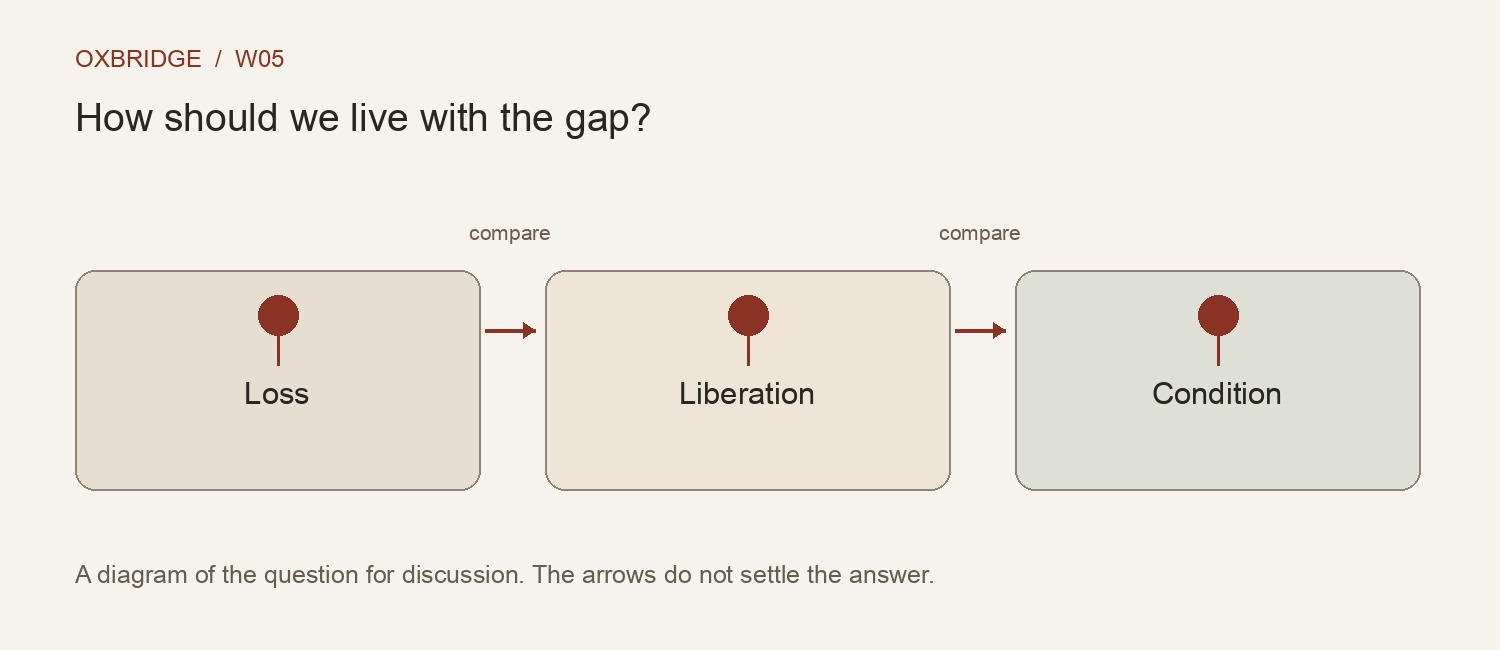
Take a position from each student in one sentence. Sort the room into three columns on the board: loss · liberation · condition.
| Column | The claim | Push |
|---|---|---|
| Loss | ”There is a real world and we are locked out of it” | Locked out implies you know what is on the other side. How? |
| Liberation | ”If there is no fixed reality, we get to make one” | Make one out of what? |
| Condition | ”It is just what having a mind is like” | If it is simply the condition, why does it feel like a loss to so many people? |
Movement 2 · complicate (15 minutes)
Introduce the four passages one at a time. Each presents a position students have already considered.
Sartre
Man is condemned to be free.
If there is no essence, no given nature, no original to return to, is the gap even a loss? Can you lose something that never existed?
Push. Sartre calls it a condemnation, not a gift. Why the harsh word, if freedom is good?
Camus
The absurd is born of the confrontation between the human need and the unreasonable silence of the world.
Camus locates the absurd in the meeting between human need and the world’s silence.
Does that change anything?
Is revolt a position you could actually hold, or only a mood?
Heidegger
We are always already thrown into a world we did not choose, with tools and frameworks that were there before us.
If the framework is what makes understanding possible rather than what blocks it, does the word “gap” still fit? Is a lens an obstacle to sight?
Camus again
We must imagine Sisyphus happy.
Is that convincing, or is it a rhetorical trick?
Is happiness inside the condition the same as accepting a loss?
Movement 3 · commit (10 minutes)
Students return to their column. Anyone who wants to move must say which quotation moved them and why.
Movement under argument is the skill being trained here, and it should be praised openly rather than treated as inconsistency.
This session explicitly asks students to explain a change in their position. It rehearses the second interview move (absorb the push without abandoning the claim) and movement, the fourth quality the course names.
Closing question (5 minutes)
Things considered real in the past are now considered false. Were we wrong then, or did reality change?
Links
jean-paul-sartre · albert-camus · the-gap · Is There a Reality Behind Appearances? · Does Reality Have a History?
Vocabulary
- Gap
- The separation between a representation and the thing itself.
- Epistemological claim
- A claim about what we can know.
- Absurd
- The meeting between human need and the world’s silence, in Camus’s account.
- Thrown
- Already placed in a world we did not choose, in Heidegger’s account.