Does Reality Have a History?
Oxbridge · Historical Frameworks of Knowledge · Week 6 of 14 · Is the Gap a Loss, a Liberation, or a Condition? | Argument and Conceptual Revision
At a glance
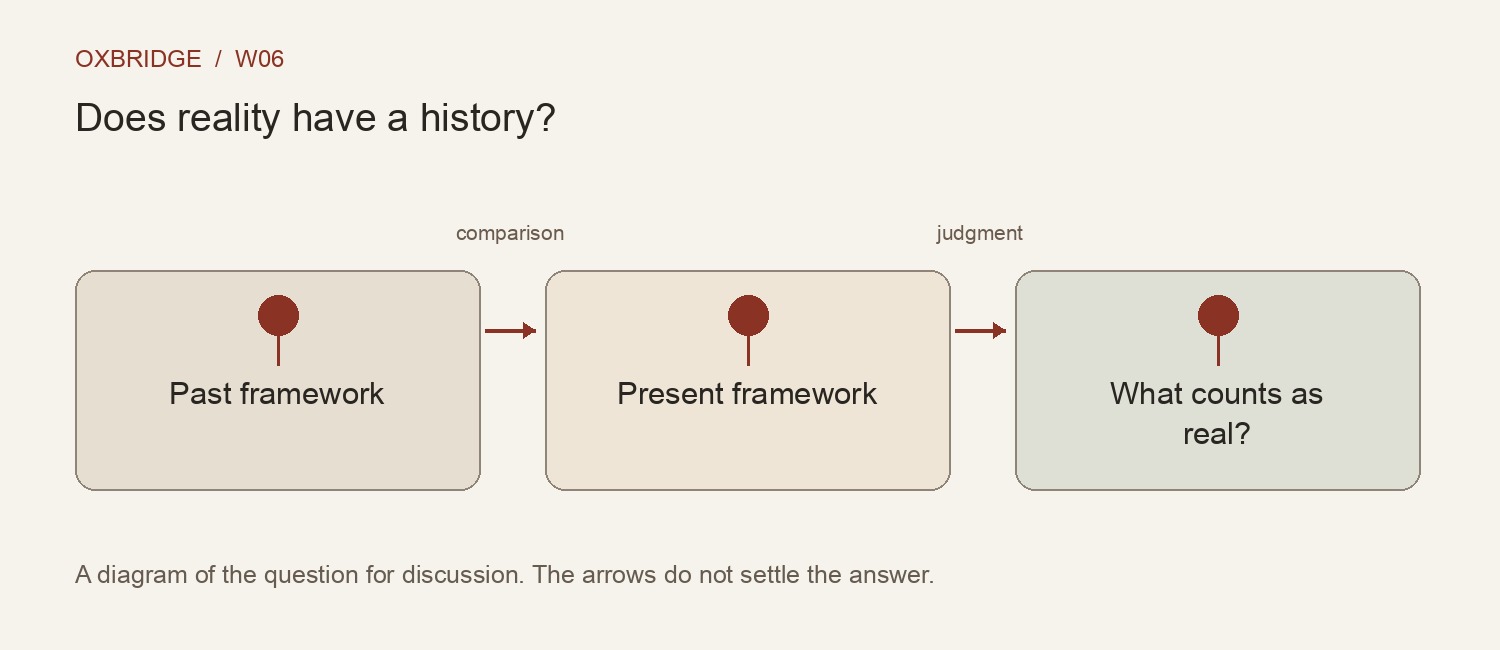
| Core question | Things considered real in the past are now considered false. Does this mean we were wrong then, or that reality itself changed? |
| Duration | 45 minutes, standard template |
| Reading | none |
| Bring | Three artifacts, Mercator beside Gall-Peters; an early modern map showing Taprobana; a one-paragraph account of Barry Marshall, 1984 |
| Carried out | The Merleau-Ponty quotation: the body is our general medium for having a world. If that is true, what happens when the medium is wrong? |
Heaviest preparation in the course. The Marshall paragraph does not exist in the vault and should be written once and kept. See the reading list.
Objectives
By the end of this lesson, students should be able to:
- Say whether a superseded belief means we were wrong then, or that reality itself changed
- Use a historical example precisely rather than as illustration
- Hold a position on whether reality is the kind of thing that can have a history
Opening prompt (5 minutes)
Name one thing people used to be certain about that we now consider false.
Give students two minutes to write one example each in silence.
Movement 1 · elicit (10 minutes)
Collect examples. Sort them live into two columns without announcing the criterion: things that were factually wrong, and things where the category itself has shifted.
Questions.
- Were the people who believed these things stupid, or were they reasoning well from a different starting point?
- Which of your examples will our grandchildren put on this list about us?
| Student says | Push |
|---|---|
| ”They just did not have the data” | Barry Marshall. The data was available; the framework rejected it. What does a framework do to data it cannot accept? |
| ”Some of these are not facts, they are definitions” | Excellent. Which ones, and why is the line hard to draw? |
Movement 2 · complicate (15 minutes)
The map
Show the Mercator and Gall-Peters projections side by side.
Questions.
- Is Mercator a lie?
- What is it good at?
- Who benefits from what it is good at?
- Is a projection that distorts nothing possible?
| Student says | Push |
|---|---|
| ”Not a lie, it is useful for navigation” | Ask what a framework makes clear and what it leaves out. Which choices are visible to the user? Which are not? |
| ”Every map distorts, so it does not matter” | Does every distortion have the same consequences? |
Taprobana
An island appeared on maps for centuries, referring unstably to Sri Lanka, to Sumatra, to nowhere. Sailors sailed toward it.
Question. Was Taprobana real? What would it take to answer that?
The video game map
Question. In a game, the edge of the map is disguised as a feature of the world. The mountain is too high. The road is closed. Why disguise it instead of showing a wall?
This is the session’s key image. Students supply the answer themselves: because a visible wall reminds you that you are inside something.
Movement 3 · commit (10 minutes)
Put Barthes on the board only now.
The author who disappears behind the text is the most ideological author of all.
The claim to discuss. A history book that claims to have no bias may make its assumptions harder to examine. A framework can hide its limits by presenting its account as the world itself.
Ask students whether their examples support this claim.
Question. Name one framework you use every day that claims not to be one.
Every student answers. Expect: exam grades, the calendar, the news feed, “common sense”, the school timetable, the map app.
W07 tests these answers. Make sure each student leaves with a claim to defend.
Closing question (5 minutes)
The body is our general medium for having a world. If that is true, what happens when the medium is wrong?
— Merleau-Ponty, Phenomenology of Perception, 1945
Links
roland-barthes · naturalization · framework · Historical Frameworks of Knowledge · Argument and Conceptual Revision
Vocabulary
- Framework
- A system that makes something knowable by excluding most of what could be known.
- Naturalization
- The process by which a constructed thing comes to look like a natural fact.