Historical Frameworks of Knowledge
Unit plan
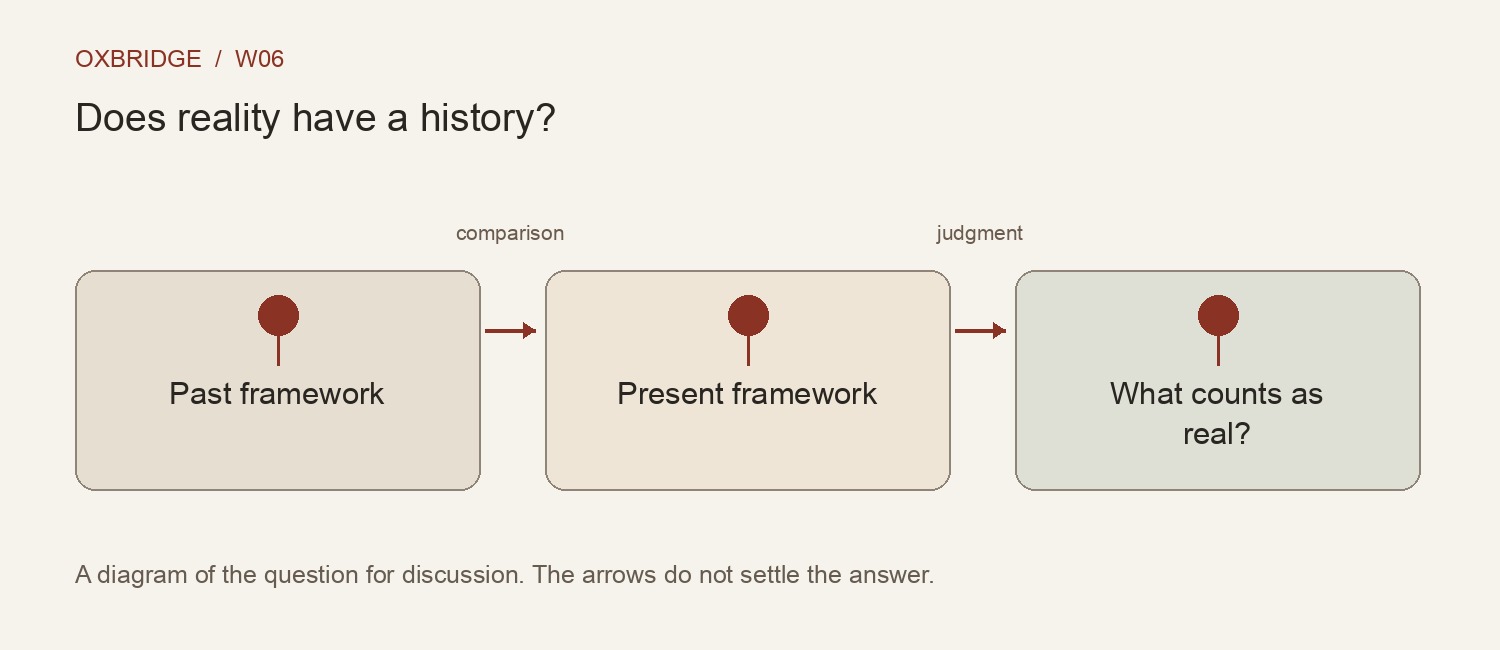
Things considered real in the past are now considered false. Does that mean we were wrong then, or that reality itself changed?
Read the complete unit plan
Oxbridge · Seminar Plan · Weeks 6–7 · The Limits of Representation | Embodiment and Machine Cognition
Unit question
Does reality have a history?
The core provocation
Things considered real in the past are now considered false. Does that mean we were wrong then, or that reality itself changed?
You will test your answer against three examples:
- The Mercator projection, shown beside Gall-Peters, lets you examine the consequences of a cartographic choice.
- Taprobana was an island that appeared on maps for centuries. What it referred to was unstable. Sailors sailed toward it.
- Barry Marshall had to infect himself in 1984 because an accepted framework could not accommodate the claim that ulcers were bacterial.
Marshall’s case tests the response “they just did not have the data”. The data was available, but it was rejected within the prevailing framework.
The key insight to reach
A biased history book is not the problem. The problem is the one that claims not to be.
A video-game map can present its edge as a mountain too high to cross or a closed road. Naturalization means presenting a designed limit as a feature of the world. The game is naturalizing its limits. A visible wall would remind players that they are inside a designed environment.
At the end of W06, Roland Barthes gives this idea a name: the author who disappears behind the text is the most ideological author of all.
Sessions
- Does Reality Have a History?: You examine the three artifacts and the video-game map. The session closes with Barthes.
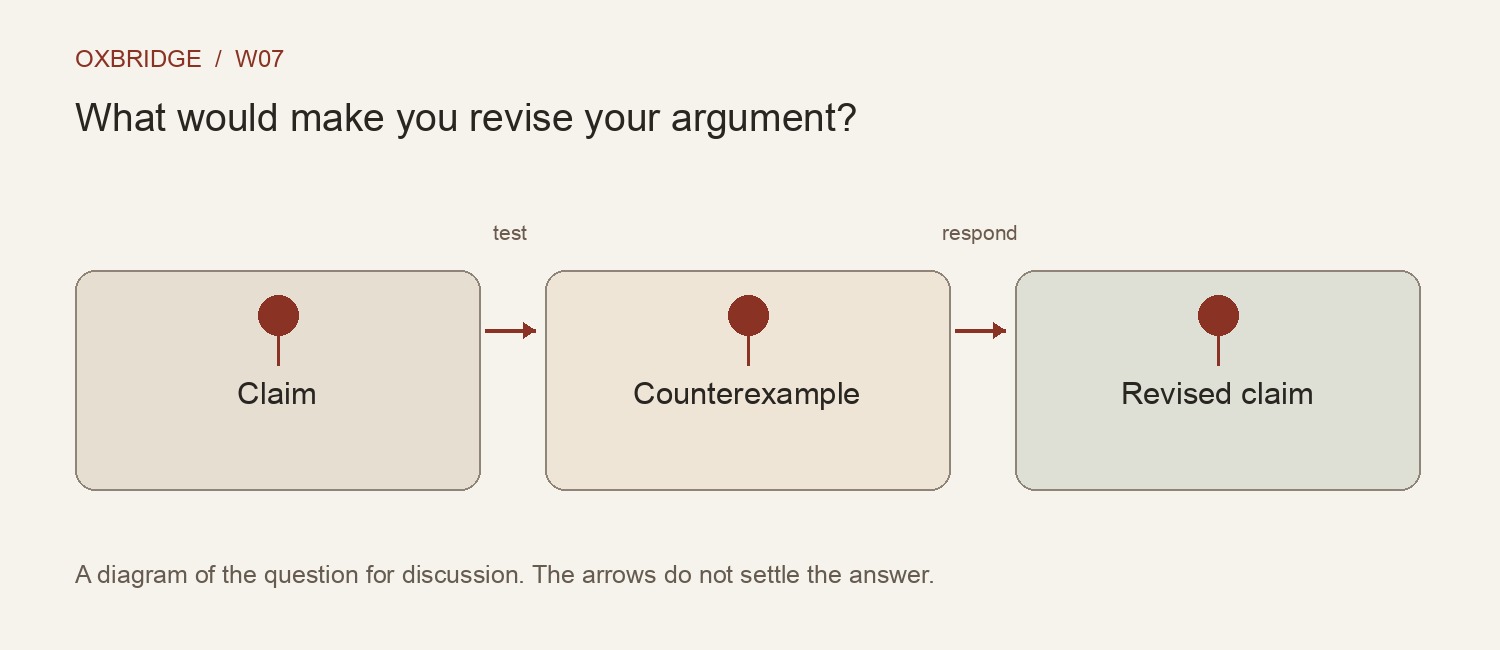
- Argument and Conceptual Revision: This is the midpoint. There is no new material. In pairs, you put six weeks of discussion under interview pressure.
Concepts introduced
Naturalization · Framework (introduced in Unit 1 and developed here through its defining property: a framework can claim not to be one)
Preparation
Neither session sets a reading. You do not need to prepare W06’s three artifacts. See the reading list.
There is no written submission (discussion only). In W07, you write four lines on paper during the session. These support your speaking and are not a submission.
Why the workshop is inside this unit rather than between units
W07 introduces no new content. You use the framework question and the example you developed in W06. You leave W06 having named a framework you use every day that claims not to be one. In W07, you test that statement under interview pressure.
Hedging can feel safe and polite. In an Oxbridge interview, it can read as having nothing to say. Practice this speaking order: claim first, qualification second, never the reverse.
Teaching notes
Both answers to the unit question remain possible. “We were wrong then” preserves a stable reality and makes knowledge historical. “reality changed” makes reality historical. This is harder to defend, but what counts as a disease, a species, or a nation does change. Examine what each answer requires you to accept.
Distinguish factually wrong beliefs from changed categories. Use the opening examples to explain the difference.
Bridge to Unit 4
The body may seem to stand outside history: cold is cold in any century.
W06 closes with a Merleau-Ponty quotation to introduce this question. Embodiment and Machine Cognition tests whether the body stands outside history.
Lessons
Unit gallery