Bruegel’s Proverbs: Language and Collective Belief
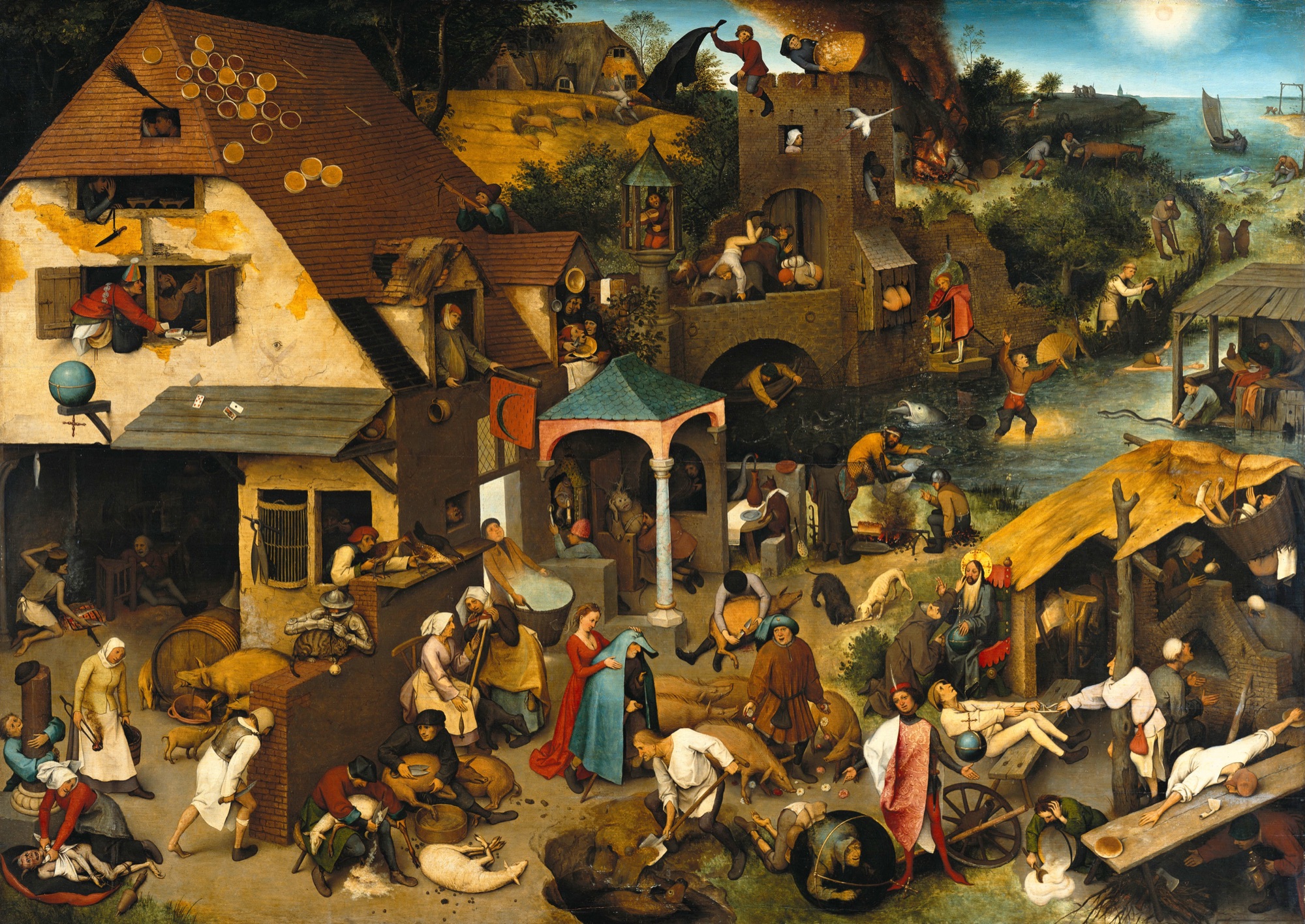
At a glance
| The work | Pieter Bruegel the Elder, The Dutch Proverbs (also called Netherlandish Proverbs), 1559, oil on oak panel, 117 by 163 cm, Gemäldegalerie, Berlin. You work from a print the same size as the painting |
| Days | As many sessions as the painting needs |
| Dates | Mon 21 Sep P4 |
| Deliverable | You put three Post-its on the print: one thing you can see, one thing you think it means, and one question. |
| Feeds | The satire lessons, which start from this painting. A2, because you practice telling apart what is shown and what it means. |
| Homework | None |
Objectives
By the end of this lesson you can:
- Tell apart three kinds of statement about a picture: what is there, what it means, and what you still want to know.
- Explain what a picture needs its viewer to know already, using a painting made for people who knew a hundred sayings that you do not.
- Say what allegory is, with one figure from this painting as your example.
- Name who or what Bruegel is laughing at, and point at your evidence.
Goal
Compare Johns’s sparse surface with Bruegel’s busy village, where figures act out sayings: a man hits his head against a wall; another carries daylight in a basket. Examine what viewers in 1559 needed to know to read these figures, as viewers need shared knowledge to read memes. Use that knowledge to identify the humor and its target.
How it runs
- Look first. You stand at the print. Nobody tells you the title or anything else. Look for a long time, then look somewhere you have not looked yet.
- The painting and its painter. Doğan talks about Bruegel, why he painted this, what a genre painting is, and what the painting has to do with narrative, myth and allegory.
- Three Post-its. Each color has one job.
- One color is for inventory: one thing you can see, written as a plain fact. “A man is lying across a table of pies on a roof.”
- One color is for meaning: what you think one figure is saying about people. “He has so much that he cannot see it is strange.”
- One color is for a question: something you cannot work out by looking. Put each one on the print, next to the thing it is about.
- Discussion. We read the Post-its together and talk. The questions below guide it.
- Into satire. We take one figure and ask three things about it: how is the joke built, who is it aimed at, and what do you see afterwards that you did not see before? Those three questions are the start of the next lessons.
Questions for the discussion
Five questions. The first two are about proverbs and about this kind of painting in general. The last three come back to the print and the Post-its.
- What is a proverb for? Nobody wrote it and everybody trusts it. Why do people hand their thinking over to a sentence with no author? When did someone last use one on you, and did it end the argument?
- Why would anyone paint ordinary people? Until about this time a large, expensive painting showed a saint, a ruler or a god. This one shows villagers, and it hung in a rich person’s house in the richest city in Europe. What can a picture of ordinary people do that a picture of a saint cannot? And look where the painter has put you: above the village, looking down. What does that make you?
- What does this picture need you to know? The man hitting his head against the wall still speaks to you. The woman putting a blue cloak on her husband does not. The paint is the same age. What is the difference? Is there a saying in Chinese that one of these figures could be? What happens to a picture, or a meme, when the people who got it are gone?
- Where does the inventory stop and the meaning begin? Take one figure that has both colors of Post-it on it. What is shown? What does it stand for? That gap is allegory, the third word of this unit. Could you have found the meaning from the picture alone?
- Proverbs are supposed to be wisdom. Why has he painted them as foolishness? Everyone here is acting out a wise saying, and everyone looks like a fool. Is he laughing at the villagers, at the sayings, or at you? Could he have said this in a serious painting?
Assessment
Nothing is graded. The Post-its stay on the print as the record of the lesson.
Practice
Try each question before you open its answer.
1. What is the difference between an inventory note and a meaning note?
Answer: An inventory note says what is there, and anyone looking would agree with it. A meaning note says what it stands for, and someone could disagree. Most mistakes in writing about pictures come from mixing the two.
2. Why can you still read some of these figures and not others?
Answer: The picture depends on sayings its first viewers already knew. Some of those sayings are still alive, such as banging your head against a wall or swimming against the current. Others have died, and their figures have gone silent. The paint has not changed. The viewers have.
3. Give one figure from the painting as an example of allegory.
Answer: A man sits on a roof that is tiled with tarts. What is shown is a man and some pies. What it stands for is being very rich. Any figure works, as long as you say both halves.