How Does the Joke Work?
At a glance
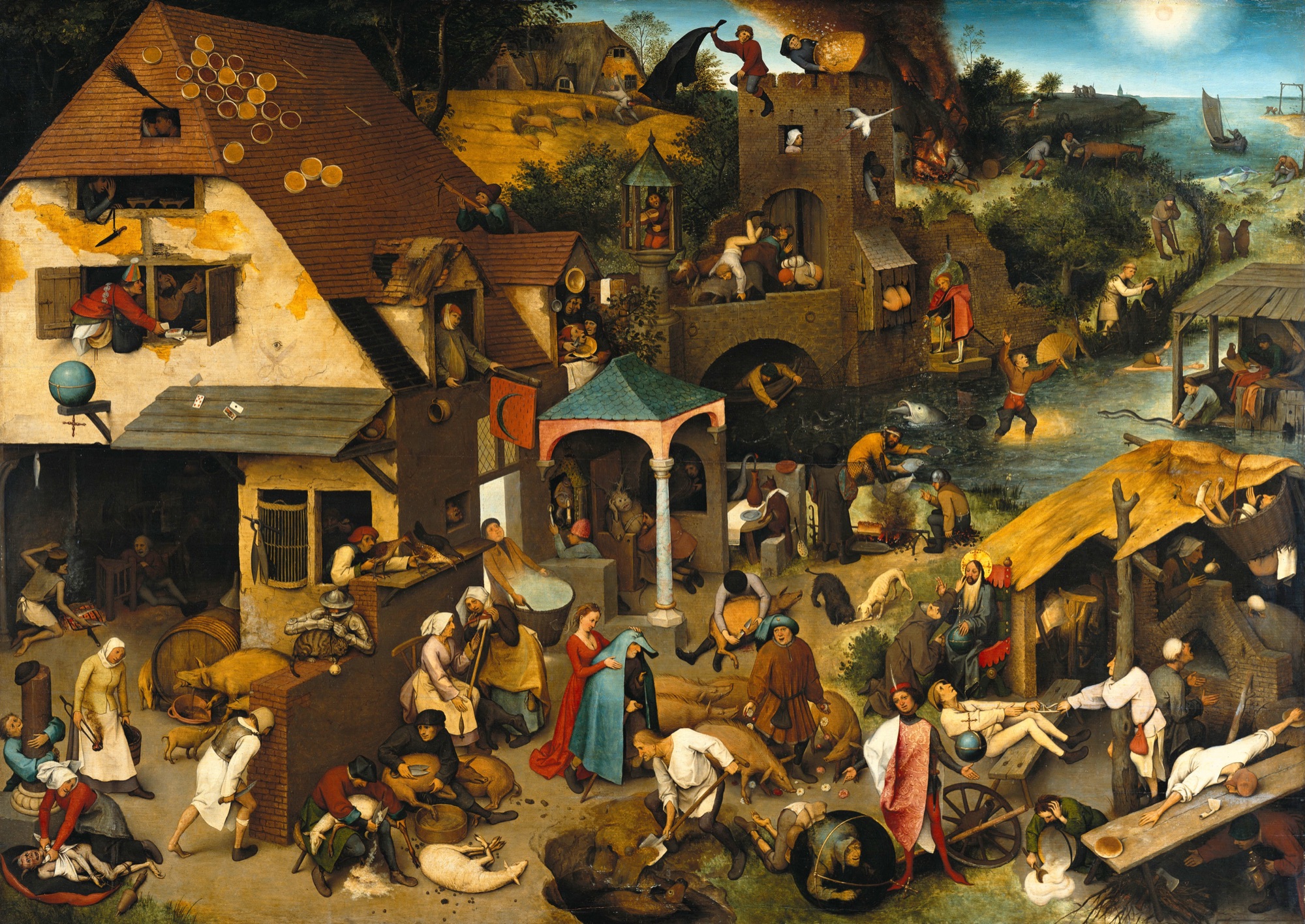
| The works | The things you brought. Don Rickles. Franz Kline against Paul McCarthy’s Painter (1995). Andy Kaufman and Bas Jan Ader. Then, if there is time, the Satirical Papyrus (Egypt, about 1250 to 1150 BCE), Bruegel’s Dutch Proverbs (1559), Duchamp’s L.H.O.O.Q. (1919) and Fountain (1917), then Oldenburg, Warhol and Broodthaers |
| Days | One period of 45 minutes |
| Dates | Tue 22 Sep P6 |
| Deliverable | You ask three questions of one joke, out loud: how it is built, who it is aimed at, and what it shows you. |
| Feeds | The next two satire lessons use the same chart and the same grid. |
| Homework | None |
Objectives
By the end of this lesson you can:
- Tell apart six ways a joke is built in art: satire, parody, irony, deadpan, repetition and inversion.
- Take one artwork and name its device, its target and its effect.
- Connect a joke made three thousand years ago to a joke made in the last hundred years.
Goal
Extend the unit’s study of visual storytelling to humor. Examine how an artwork builds a joke (device), who or what it addresses (target), and what it helps the viewer recognize (effect). Use these distinctions to explain why an artist uses humor.
How it runs
- What you brought (10 min) · Show the thing that makes you laugh. Explain why in one sentence. The class then asks who the joke is on.
- Don Rickles (4 min) · A room full of famous people, and he goes through them one by one. Who is the joke on? Why do the people he insults laugh hardest?
- Three questions (3 min) · How is the joke built? That is the device. Who is it aimed at? That is the target. What do you see afterwards that you did not see before? That is the effect.
- Franz Kline (4 min) · Look at work by Kline, one of the New York School painters we discussed with Johns. Describe the large black-and-white marks and their apparent speed. What did we say marks like these were for?
- Paul McCarthy, Painter (6 min) · Watch the painter with a huge nose and hands using a giant brush in a studio. What is the device? Who is the target? Look back at Kline. What do you see now?
- The turn (2 min) · Satire is also a story an artist tells about himself. Compare Kline’s image of the heroic painter with McCarthy’s foolish painter. Then consider two artists whose jokes also shape the stories told about them.
- Andy Kaufman (8 min) · Mighty Mouse, then Kaufman begging from the audience on Letterman. Is he joking? How would you know? Who is the target when the audience cannot tell?
- Bas Jan Ader (8 min) · I’m Too Sad to Tell You, then a fall. He falls, he cries, and he never says it is a joke. Is it? Then you hear what happened to him, and one question: did the film change, or did you?
- Last question (2 min) · Kaufman and Ader: what is the joke, and who is it on?
If there is time, the Satirical Papyrus and four works (Duchamp twice, Warhol, Broodthaers) follow, with the three questions asked of each.
Here is one row of the chart, filled in, so you can see what a good row looks like.
| Work | Device: how does the joke work? | Target: who or what is it aimed at? | Effect: what does the joke show you? |
|---|---|---|---|
| Andy Warhol, Brillo Boxes | Deadpan repetition. The boxes are shown in rows, like stock | Consumer culture, and the idea that art must be original | Art and shop goods turn out to have the same surface |
Assessment
Nothing in this lesson is in the gradebook. The chart row and the grid are classwork.
Practice
Try each question before you open its answer.
1. What is the difference between a device and a target?
Answer: The device is how the joke is built, for example inversion or parody. The target is who or what the joke is aimed at. Two works can share a device and have different targets.
2. Duchamp’s L.H.O.O.Q. is a parody. What does it copy, and what does it question?
Answer: It copies the Mona Lisa, on a cheap postcard. It questions the idea that one painting is sacred, and the idea of the artist as a genius.
3. Why is a cat serving a mouse an inversion?
Answer: A cat normally eats a mouse. In the papyrus the cat is the servant and the mouse is the lady. The order of power is turned upside down, and that lets the picture talk about power between people.