Trade as Composition in the Qingming Scroll
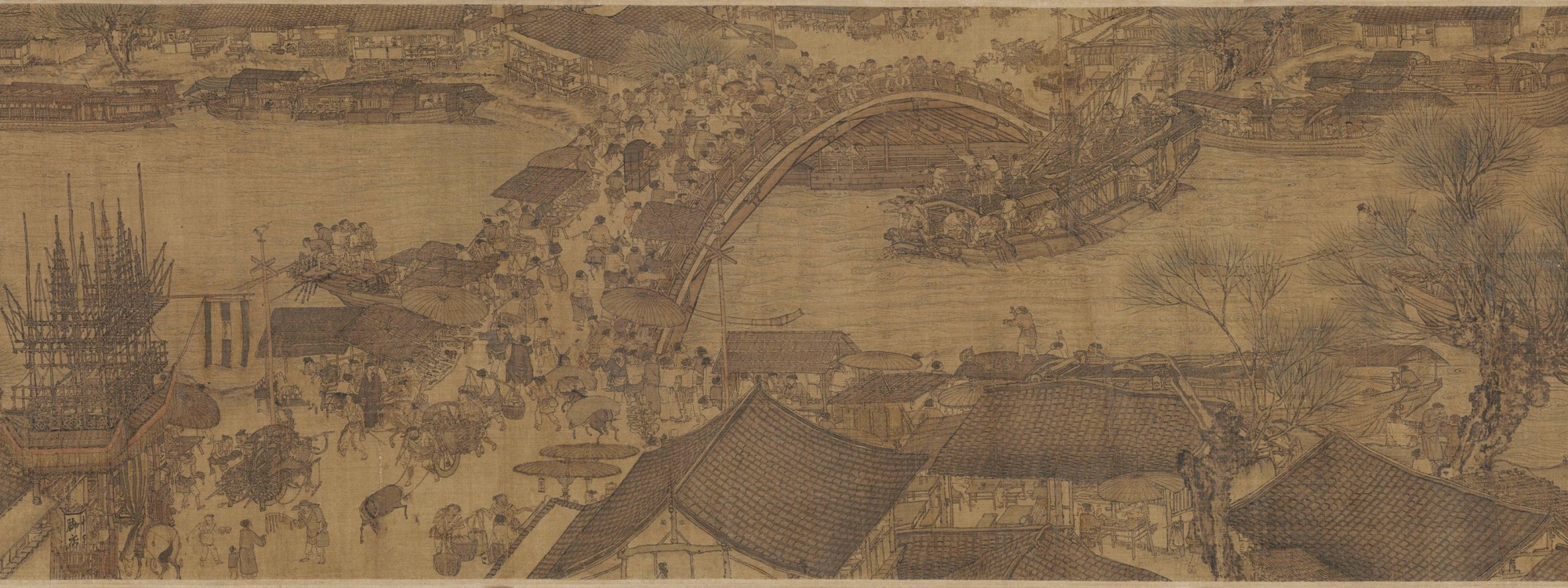
Lesson slides: Download the deck (PowerPoint, 2.5 MB) · image credits
At a glance
| Field | Details |
|---|---|
| Dates | If time permits after Leonardo’s Last Supper |
| Focus | Trade as Composition in the Qingming Scroll |
| Unit | The Table As Ethical Space |
Objectives
- Follow a continuous route from right to left through the handscroll.
- Use a change in viewpoint and a detail at the bridge to explain how goods move.
Materials and resources
- food-qingming-bridge.jpg
- food-qingming-detail.jpg
Use the works and source readings named below. Keep the full composition visible while looking.
Tasks
Qingming scroll walk · conditional closing study
Work right to left. Use the five looking steps in the dated study and an Inventory / Meaning chart. In neighboring groups share three or four located details; mark what each one lets you see and what remains an inference. End with one person at Bruegel’s wedding and one action in the scroll.
| Inventory: what we can locate | Meaning: a possible relationship | Evidence or uncertainty |
|---|---|---|
| A person carrying a load beside other travelers | People and goods depend on shared routes | Describe the load and location; identify its contents only when the image supports that claim. |
Assessment and homework
Ungraded class work. Use the existing response to check the evidence and reasoning; no additional submission is required.
Description
Unroll the scene from right to left. Follow a load, boat or figure across the bridge. Use an inventory and the earlier Bruegel wedding to explain how food reaches a table.
Zhang Zeduan: Along the River During the Qingming Festival · conditional closing study · 45 minutes
Follow the handscroll from right to left, revealing one continuous stretch at a time. Use the classroom reproduction or open the complete scroll and move through it at your own pace. A single projected detail cannot show the whole route.
- First Reaction · 3 min. Begin at the right-hand end. Let one detail catch your eye. Point it out before the group names a route.
- Content · 9 min. Continue from the outskirts toward the water, bridge and streets. In your group’s stretch, put people, buildings, loads and actions in the Inventory column. Locate one thing you might have missed if someone else had chosen where to look.
- Form · 11 min. Follow a boat or a person until the window moves and something disappears. At Rainbow Bridge, try the same passage following someone else. How does this changing viewpoint differ from the centered room in Leonardo or a cut made by Varda?
- Historical Context · 6 min. Rivers and markets supplied the Northern Song capital. Revisit a landing, crossing or stall using Columbia’s bridge study. Which connection does the picture support? Can you actually identify what a load contains?
- Personal Context · 4 min. A later inscription describes Zhang’s skill in depicting boats, bridges and buildings. Little else about his life is secure. Locate one construction detail that makes that account useful. Leave his opinion of the crowd open. Palace Museum, Beijing
Return and connect · 12 min. Complete the Meaning column for three or four entries. Give a neighboring group one route to follow and distinguish what you saw from what you inferred. Is the bridge a place of cooperation, congestion, or both? Return individually to the person you chose at Bruegel’s wedding. Use one detail from each work to explain what has to happen beyond a dining table for people to eat together. You may use this connection on your board.
Teaching reference
The Qingming teaching source expands the scale from the table to connected routes, services and exchanges. The scroll’s sequence matters: the viewer encounters relationships over time. The group’s Inventory → Meaning chart preserves a distinction between a visible action and an inferred social function. The completed walk should make those connections clearer without pretending the painted city is an exhaustive record of an entire society.