Creative Reflection and Production Evidence
Worksheets CCR decisions and evidence (PDF)
Media Studies · Individual CCR guide
Lesson slides: Download the deck (PowerPoint, 2.7 MB) · image credits
At a glance
| Teaching phase | March 15–26, after rough-cut screening and during final revision. Exact school slots follow the confirmed spring calendar. |
| Role | Reusable project guide, restored from the bank. No November teaching session is assigned to this page. |
| Bring | Your research, versions, production diary, feedback and current film. |
| Outcome | An individual creative critical reflection addressing all four 2027 questions with evidence. |
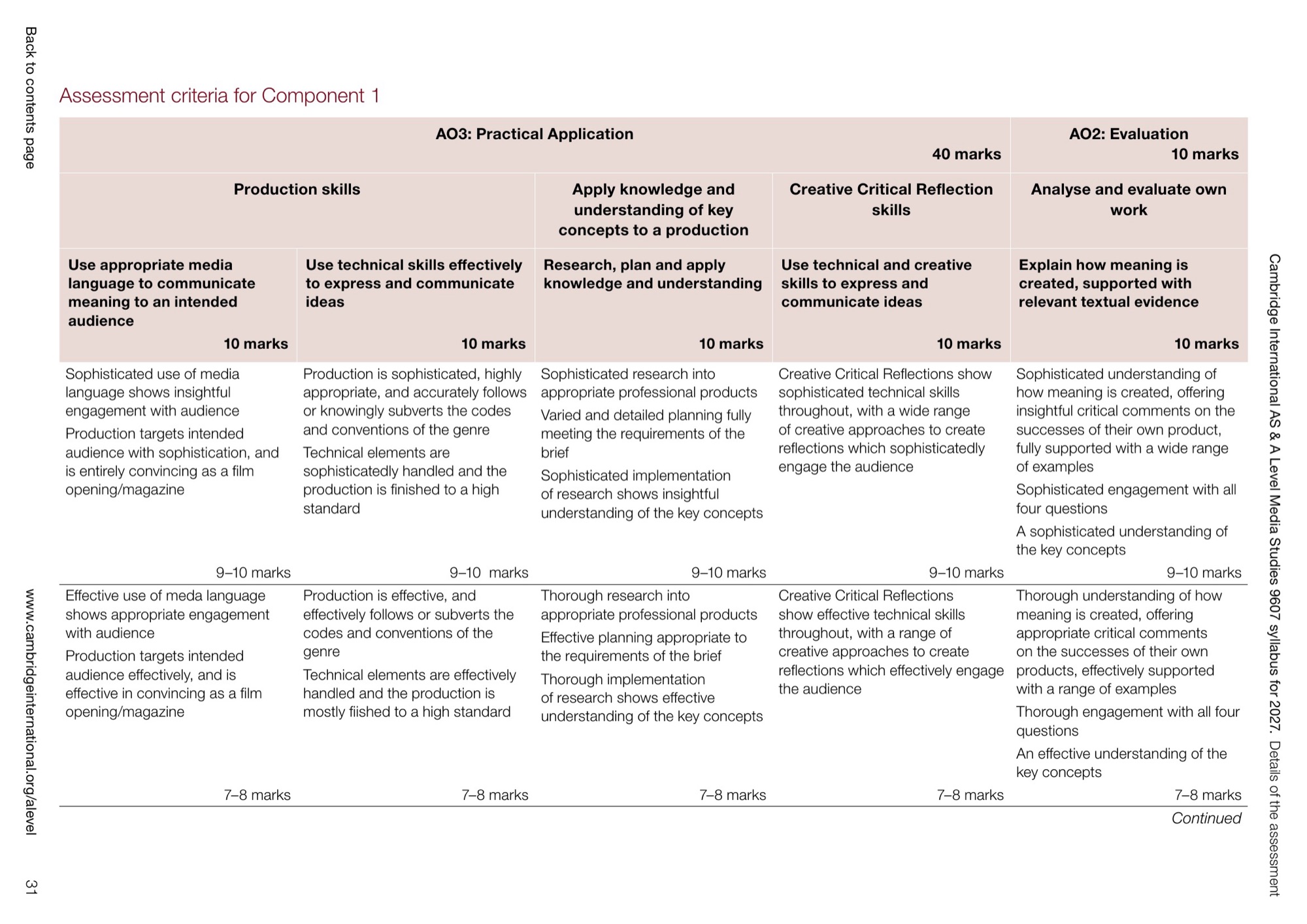
| Alignment | C1 AO2 analysis/evaluation (10 marks) and AO3 creative/technical CCR presentation (10 marks). The other three C1 strands assess production and its research/planning/application. |
Objectives
- Explain a production decision through intention, evidence and consequence.
- Address all four CCR questions using your own development and final film.
- Select creative presentation methods that help communicate the evaluation.
- Check that evidence is accessible and claims accurately describe the work.
Learn
Reflection explains why a decision was made, what happened and what you learned. Description can establish the necessary context, but it should lead to evaluation. A before-and-after frame, a short timeline comparison or a recorded audience response can support the explanation. Use evidence from your actual process; do not invent a change because it sounds more successful.
The four questions
The 2027 syllabus requires an individual creative critical reflection. Address each question:
- How does your product use or challenge conventions and how does it represent social groups or issues?
- How does your product engage with audiences and how would it be distributed as a real media text?
- How did your production skills develop throughout this project?
- How did you integrate technologies – software, hardware and online – in this project?
These questions concern your own work even when production is shared. Make your contribution and decisions clear.
Select evidence
For conventions and representation, compare a professional reference with a precise choice in the film. Explain whether you followed, adapted or challenged a convention and what the result suggests.
For audiences and distribution, use your intended audience, relevant research and actual feedback. Discuss a plausible distribution context with evidence. A hypothetical distributor is not an agreement that your film will be released.
For skills, compare early and later work. Name the problem, the action you took and the visible or audible improvement, including a limit that remains.
For technologies, explain how hardware, software and online tools worked together. A list of applications is insufficient without explaining their purpose and effect on the production.
Present the reflection
Choose methods that suit the evidence: a narrated comparison, screencast, commentary, illustrated presentation, podcast with accessible supporting material or another creative digital form. A varied approach can help communication, but four separate formats or two particular tools are local suggestions, not a Cambridge numerical requirement. Check that the presentation can be viewed or heard and that source material is credited.
Practice
Use the companion alongside the existing production diary. Keep the four official question stems unchanged. Link each explanation to an actual decision, reason, evidence and consequence.
Make an evidence table with four question headings. Under each, locate the existing post, image, timeline, recording or feedback that supports a decision. Select one useful comparison before drafting a long response. Rehearse the explanation aloud, then choose the presentation method.
For a practice explanation, ask a partner to identify the decision, reason, evidence and consequence. If one part is unclear, revise the explanation yourself. General peer/teacher guidance supports the process; the final reflection remains your own work.
Check your progress
Check all four questions, individual contribution, precise product examples, development evidence, clear presentation and accessible links. Confirm that your claims match the final film and the dated process. Keep original research and earlier versions visible where they show development.
Source quotation
How did your production skills develop throughout this project?
Cambridge International, Media Studies 2027 Syllabus, Component 1 creative critical reflection question 3; also reproduced in coursebook §6.7.
Suggested reading
Coursebook §6.7, “Reflecting on your AS Level production work,” and the 2027 C1 criteria. Review the published Cambridge portfolio comments as examples of evaluation and presentation choices, not fixed templates to copy.