Kehinde Wiley: Who Inherits the Grand Portrait?
At a glance
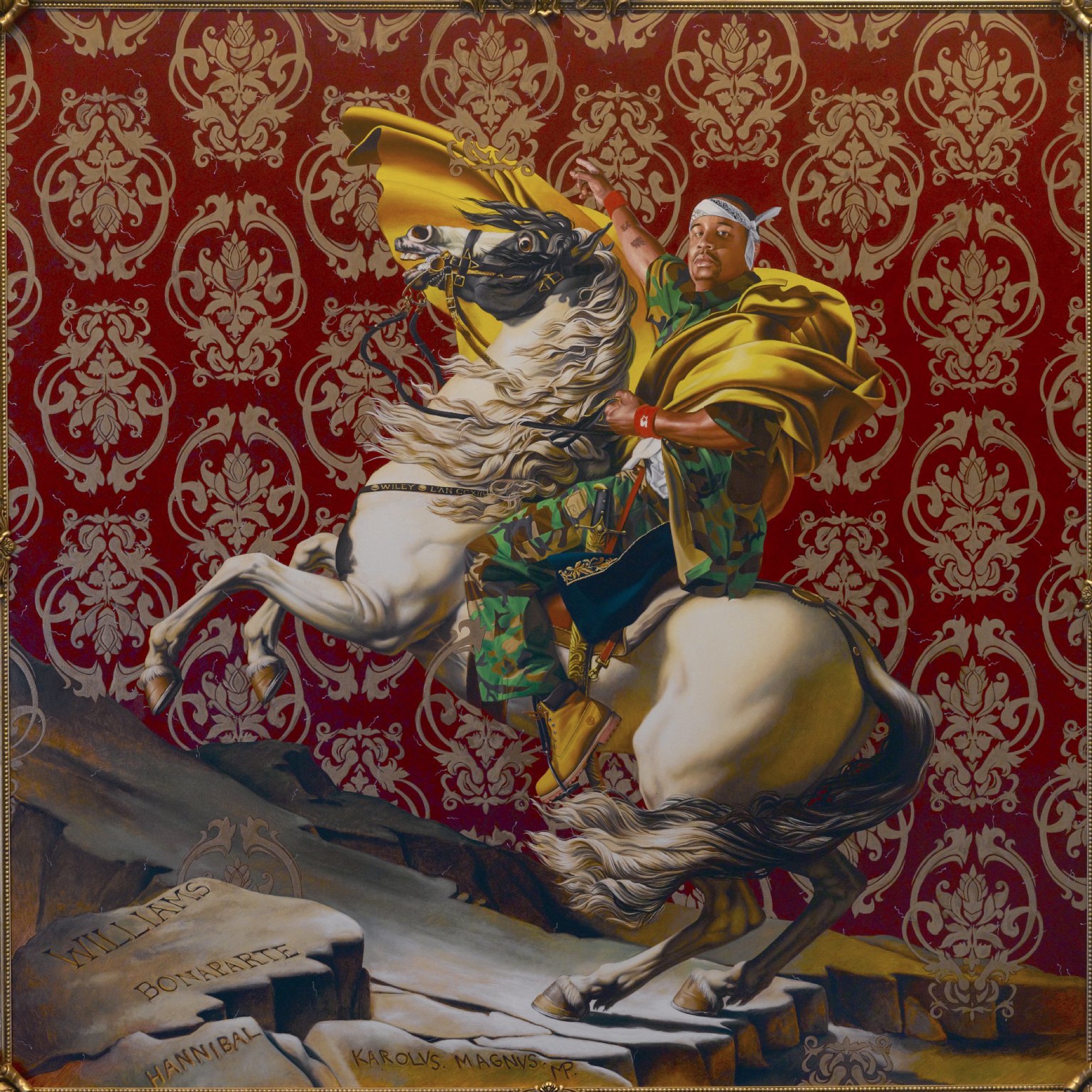
| The works | Jacques-Louis David, Napoleon Crossing the Alps, 1801, Château de Malmaison. Kehinde Wiley, Napoleon Leading the Army over the Alps, 2005, Brooklyn Museum. Wiley, Judith and Holofernes, 2012, North Carolina Museum of Art. Wiley, Rumors of War, 2019, Virginia Museum of Fine Arts, and the J.E.B. Stuart Monument it answers. The film Kehinde Wiley: An Economy of Grace, 2014, 40 minutes |
| Days | Two single periods. Friday is the film. Saturday is the discussion |
| Dates | Fri 9 Oct P2 · Sat 10 Oct P1 |
| Deliverable | On Saturday you take a position on one question and move it if someone gives you a better reason. Then you write one sentence saying where you ended up and why |
| Feeds | Monday’s comparison of the two Napoleons, and the essay on Tuesday 13 October |
| Homework | None |
Objectives
By the end of these two sessions you can:
- Say what Wiley keeps from an old painting, what he changes, and what each change does.
- Give two readings of the same painting, one that says it takes power apart and one that says it wants power, and say which one you hold and why.
- Use what you know about an artist’s life and studio without letting it stand in for what is in the picture.
Goal
Revisit your earlier reading of Wiley through evidence about his working process. He places young Black men and women in the poses of kings, generals and saints, including people excluded from older images of power. Test the museums’ reading of this as subversion.
Napoleon restored slavery in parts of France’s colonial empire and sent troops to regain Saint-Domingue, threatening re-enslavement. Examine whether adopting his pose challenges that power, seeks a place within it, or does both.
How it runs
Friday 9 October, P2, 45 minutes: the film
Land (3 min)
One question first, from last year’s plan: what do you expect when you hear the words “a portrait of power”? Two answers. Then the spoken opening, and three things to watch for go on the board. Two weeks ago you wrote about a painting by a man you knew nothing about. Today you watch him work, and you watch him choose. Watch how the people in his pictures come to be there, and watch whose hands hold the brush.
Three things to watch for.
How he finds the people he paints, and who chooses the pose. Who paints what: look for hands that are not his. What he says power is.
Watch (40 min)
Kehinde Wiley: An Economy of Grace (2014, directed by Jeff Dupre, 40 minutes). It follows his first series of women, from the street in Brooklyn where he finds them to the gowns made for them and the opening.
Close (2 min)
Each student says one image, sound or moment that stayed with them. Three or four go on the board for Saturday. No notes during the film, by last year’s rule: watch, do not interpret yet.
Saturday 10 October, P1, 45 minutes: the discussion
Return (5 min)
Your comparison of Klimt’s and Wiley’s Judiths comes back. Read the four criteria on the screen in silence. Identify one change to make in your next comparison. Then the question this course keeps asking: you wrote about his Judith knowing nothing. Now you know something. Did the painting change, or did you?
Four pairs from the film (6 min)
Compare four pairs from the earlier classroom plan: The Two Sisters beside Chassériau’s Two Sisters of 1843; Mrs. Waldorf Astor beside Gainsborough’s Mary Little of 1765; Dacia Carter beside David’s Madame Récamier of 1800; the Judith you wrote about beside Rubens’s Judith of about 1616. Look for retained poses in the Sisters and Gainsborough pairs. Compare the reclining figure and close portrait in the Récamier and Carter pair. Treat Rubens as a related Judith comparison, since Wiley’s direct source is Baglione. What story does each picture tell? Give brief answers based on what you can see.
The pair (6 min)
David’s Napoleon and Wiley’s, side by side. Fast, in pairs: what is kept, what is changed. Kept: the white horse, the yellow cloak, the arm, the rocks and the three names cut into them. Changed: the man, his clothes, the sky and the mountain, and one name added to the rock, WILLIAMS, above BONAPARTE. Both painters sign the horse’s strap.
Then Wiley’s own words about the picture he copied: “The scale of man to horse is a complete fiction. Men look a lot smaller on real horses… All those grand tableaux that you see on the walls of the Louvre are propaganda. They are designed to complete the narrative of domination of empire and control.”
Wiley recognizes how the original serves power. Why might he choose to paint it again?
The hard question (4 min)
Four sentences of history. In 1794 France ended slavery in its colonies. In 1802 Napoleon’s government restored slavery in parts of the colonial empire and sent troops to Saint-Domingue, the western part of Hispaniola that became Haiti, where enslaved people had won their freedom. Their general, Toussaint Louverture, was arrested by a trick, shipped to France, and died in a prison in the mountains in April 1803. This is the man on the horse.
Then the question goes on the board: why would anyone from the African diaspora want to be painted as Napoleon?
The line (18 min)
Two signs on opposite walls: He takes the myth apart and He wants the myth. Everyone stands somewhere on the line between them and must be able to say why, pointing at a picture or at something the film showed. Then four pushes, one at a time. After each, anyone may move, and says what moved them.
- The frame. The Brooklyn painting hangs in a gold frame taller than a door, in the same museum as the old kings. He did not refuse the frame. What does that tell you?
- The charge. Two forms of it. A critic wrote in 2015 that there is “nothing remotely ‘revolutionary’ or subversive in Wiley’s paintings”, and that the sitters go back to their streets while the portraits sell for tens of thousands of dollars; the film showed you a studio, and he has one in Beijing where assistants paint. And the older charge, Greenberg’s word for art that borrows the old masters’ tricks and sells the look without the work: kitsch. Is Wiley’s polish kitsch that flatters, or does he use kitsch as a Trojan horse to get critique onto the museum wall? Doğan posed this question last year.
- The defense. Wiley says the paintings are a demand, not a wish: “I’m demanding that we see and take seriously what heretofore had been considered marginal voices.” The sitter chose the pose. The name on the rock is Williams, a real man from the street, above Bonaparte. And in 2019 he put a young Black man in a hoodie on a bronze horse in Richmond, Virginia, a few blocks from the statues of the generals who fought to keep slavery, and said, “I want my statue to be speaking back to the people looking at those statues.”
- Fanon. A writer from Martinique, Frantz Fanon, wrote in 1952 that a colonized person can come to want the face of the one who colonized him. Is that what this painting does? Or is that what this painting is about?
Close (6 min)
Everyone looks at where they stand now. Who moved, and what moved you? Then one written sentence each, handed in: Wiley’s Napoleon takes the myth apart / wants the myth, because and one thing in a picture. If the room has landed on the flip, last year’s exit sentence does the same work: One myth that Wiley flips is ___, and he flips it by ___. On Monday we build a claim on these two paintings the way we did on the Judiths.
What a good reason looks like
A reason points at the picture. Here are two weak reasons and two strong ones.
- Weak: “I think he wants power because he is famous.”
- Strong: “I think he wants the myth, because he kept the gold frame. The frame is the museum’s way of saying this is important, and he did not refuse it.”
- Weak: “It is subversive because a Black man is in the painting.”
- Strong: “It takes the myth apart because the wallpaper takes the mountain away. Without the mountain there is no battle, so the pose is shown to be only a pose.”
Can you see the difference? The strong reasons name one thing you can see, and say what it does.
Assessment
Nothing here is in the gradebook.
A quotation
“Let us see, for example, what happens when an ignorant Russian peasant such as Macdonald mentions stands with hypothetical freedom of choice before two paintings, one by Picasso, the other by Repin. In the first he sees, let us say, a play of lines, colors and spaces that represent a woman. The abstract technique, to accept Macdonald’s supposition, which I am inclined to doubt, reminds him somewhat of the icons he has left behind him in the village, and he feels the attraction of the familiar. We will even suppose that he faintly surmises some of the great art values the cultivated find in Picasso. He turns next to Repin’s picture and sees a battle scene. The technique is not so familiar, as technique. But that weighs very little with the peasant, for he suddenly discovers values in Repin’s picture that seem far superior to the values he has been accustomed to find in icon art; and the unfamiliar itself is one of the sources of those values: the values of the vividly recognizable, the miraculous and the sympathetic. In Repin’s picture the peasant recognizes and sees things in the way in which he recognizes and sees things outside of pictures, there is no discontinuity between art and life, no need to accept a convention and say to oneself, that icon represents Jesus because it intends to represent Jesus, even if it does not remind me very much of a man. That Repin can paint so realistically that identifications are self-evident immediately and without any effort on the part of the spectator, that is miraculous. The peasant is also pleased by the wealth of self-evident meanings which he finds in the picture: ‘it tells a story.’ Picasso and the icons are so austere and barren in comparison. What is more, Repin heightens reality and makes it dramatic: sunset, exploding shells, running and falling men. There is no longer any question of Picasso or icons. Repin is what the peasant wants, and nothing else but Repin. It is lucky, however, for Repin that the peasant is protected from the products of American capitalism, for he would not stand a chance next to a Saturday Evening Post cover by Norman Rockwell.”
Clement Greenberg, “Avant-Garde and Kitsch”, 1939. The excerpt’s dashes are given here as commas. For push two: the peasant chooses the picture that flatters his eye and “tells a story”. Where does Wiley’s viewer stand?
Suggested reading
- John Berger, the Courbet chapter of Portraits: John Berger on Artists (Verso, 2015). Courbet took inherited forms, the nude, Spanish realism, the Dutch group portrait, and “stole the practice” for other ends. Berger’s account provides a comparison with Wiley’s use of the equestrian portrait.
Practice
Try each question before you open its answer.
1. What does Wiley keep from David, and what does he change?
Answer: He keeps the horse, the cloak, the raised arm, the rocks with their three names, and the size of the man against the horse, which David invented and Wiley calls “a complete fiction”. He changes the man, the clothes, the ground, which is wallpaper instead of a mountain, and he adds one name.
2. Why is the name on the rock a big deal?
Answer: David cut in three names of men who crossed the Alps with armies: Bonaparte, Hannibal, Charlemagne. Wiley adds Williams, a man from the street, above them. The picture says he belongs on that list. Whether that is a joke, a demand or a wish is the whole question of this lesson.
3. Can you use what the film showed you about his studio?
Answer: Yes, as evidence about how the paintings are made, and no, as a substitute for looking. “He has assistants” tells you about the making, not about what the picture does to you when you stand in front of it. Say both, and keep them apart.