Sharing a Class Lunch
Lesson slides: Download the deck (PowerPoint, 887 KB) · image credits
At a glance
| Field | Details |
|---|---|
| Dates | Mon 2 Nov P4 |
| Focus | Sharing a Class Lunch |
| Unit | The Table As Ethical Space |
Objectives
- Distinguish work visible at the class table from the preparation and delivery that happened elsewhere.
- Use a specific incident without speculating about another participant.
Materials and resources
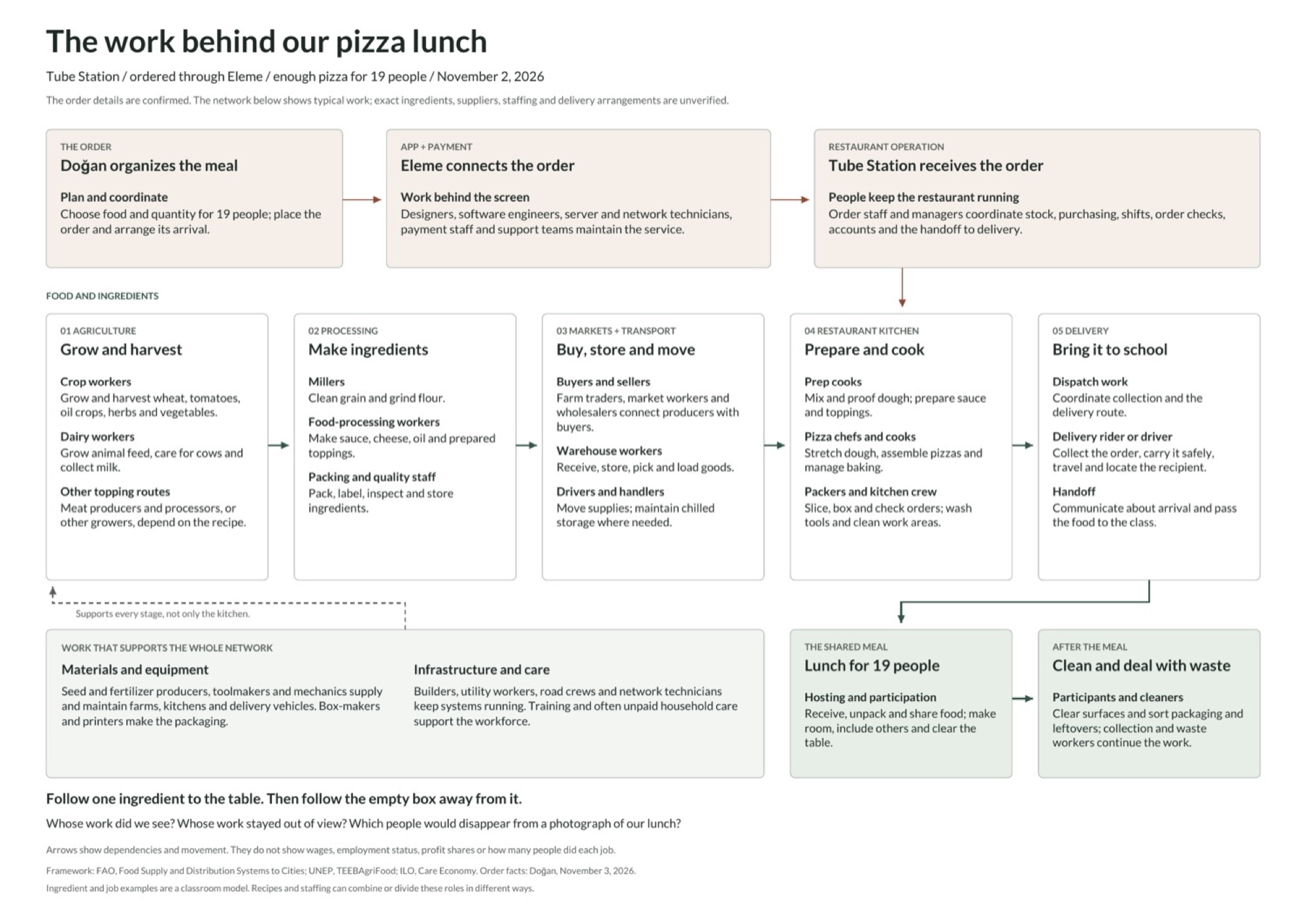
- pizza-labor-map.pdf
Use the works and source readings named below. Keep the full composition visible while looking.
Tasks
Actual class lunch · November 2, P4, 10:45–11:30. Take part in the timetabled shared meal. Observe one choice about sharing, serving, listening or clearing without turning other people into objects of judgment. After eating, compare observations in a small group. Write a brief reflection linking one actual incident to the film, Berger or a food-art work. Explain whether the experience supported or changed an earlier idea. Finish this reflection during the lesson. Eating a particular food or sharing personal information is not required.
Assessment and homework
Ungraded class work. Use the existing response to check the evidence and reasoning; no additional submission is required.
Description
The class shared pizza ordered from Tube Station through Eleme. The lesson asks whose work can be seen at the table and whose work brought the meal there.
Teaching reference
Source quotation: the dining room and its boundaries
One door connects with his own daily life; through it he has entered in order to be served with food. The second door connects with the kitchen; through it the food is brought out and the waste is taken away. Thus, in the dining-room, food is abstracted from its own production and from the ‘real’ world of his daily activities. Behind the two doors lie secrets: secrets of recipes behind the kitchen door; professional or personal secrets, not to be discussed at table, behind the other.
John Berger, “The Eaters and the Eaten,” Selected Essays, p. 372.
The passage describes Berger’s model of the bourgeois dining room. “Abstracted” means separated from production in the diner’s experience. Use it to notice boundaries between eating, preparation and cleanup. Do not turn his categories into labels for classmates.
Culinary Aesthetics and the Ethics of Care
Care is attention and action directed toward another person’s needs. Hospitality is receiving and caring for a guest. Neither word guarantees how the guest experiences an encounter. Obligation is something a person is expected or feels required to do. A generous invitation can create a sense that the guest must eat, stay, speak or repay it. Agency is a person’s ability to make choices and act on them. Looking for the guest’s choices makes the discussion concrete.
In Rirkrit Tiravanija’s Untitled (Free/Still), preparing and sharing food helps form the artwork. The documented installation redirects attention toward people occupying the gallery together. It is an example of participatory art, art in which participants’ actions help form the work. Relational aesthetics is an approach to art that treats relations between people as artistic material. The label does not prove that every participant feels welcome. Look at how the setting permits or limits participation. MoMA PS1 account.
Lee Mingwei’s The Dining Project (1997–present) organizes a one-to-one meal. Its scale differs from Tiravanija’s collective encounter. Compare selection, attention, privacy and host/guest roles. A smaller encounter may allow careful listening; it may also heighten pressure on a guest. These are interpretations to investigate through the work’s arrangement. A documentation photograph cannot establish the whole conversation or how everyone felt. Artist’s project account.
Use a two-column comparison of an ordinary meal and a gallery meal. Food, utensils and conversation may remain familiar while expectations, selection and the status of an encounter change. Later, Hyperreality and Paratheatre will provide further terms for examining this change; those terms are not prerequisites for the November 6 task.