The Table as a Social Form: Ceremony, Labor, and Belonging
Study slides: The Table as a Social Form: Ceremony, Labor, and Belonging (study slides, PDF)
At a glance
| Field | Details |
|---|---|
| Dates | Mon 9 Nov P4 · 10:45–11:30 |
| Focus | The Table as a Social Form: Ceremony, Labor, and Belonging |
| Unit | The Table As Ethical Space |
Objectives
- Compare who serves and who rests in Bruegel’s two paintings.
- Use Berger to test what a viewer can infer about the people who worked and the people who could buy the picture.
Materials and resources
-
the-table-as-a-social-form.pdf
-
gilded-age-a-matter-of-taste.mp4
-
home-alone-family-orders-pizza.mp4
-
peasant-wedding.jpg
-
food-harvesters.jpg
-
classroom PowerPoint
-
Classroom reading pages
Tasks

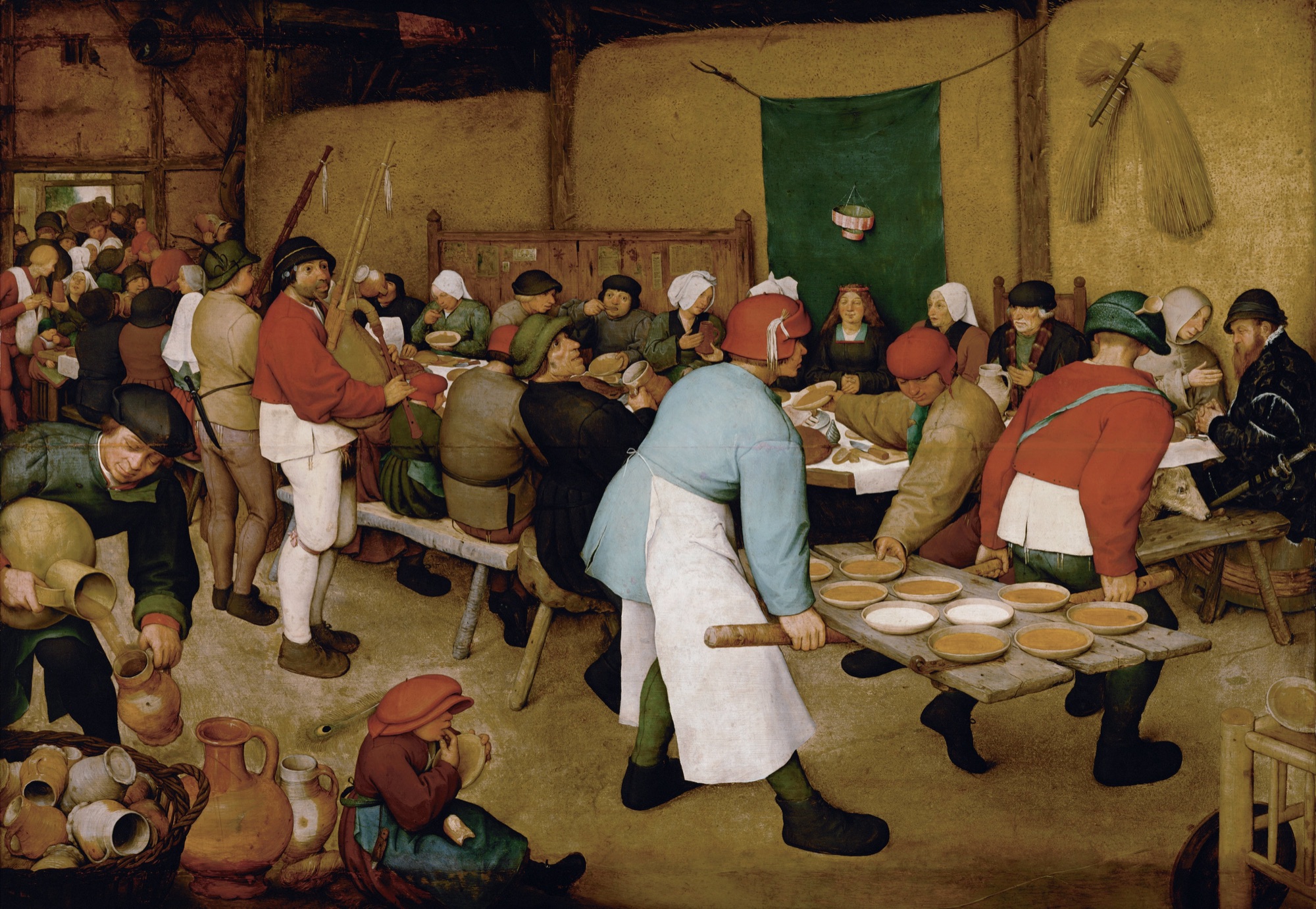
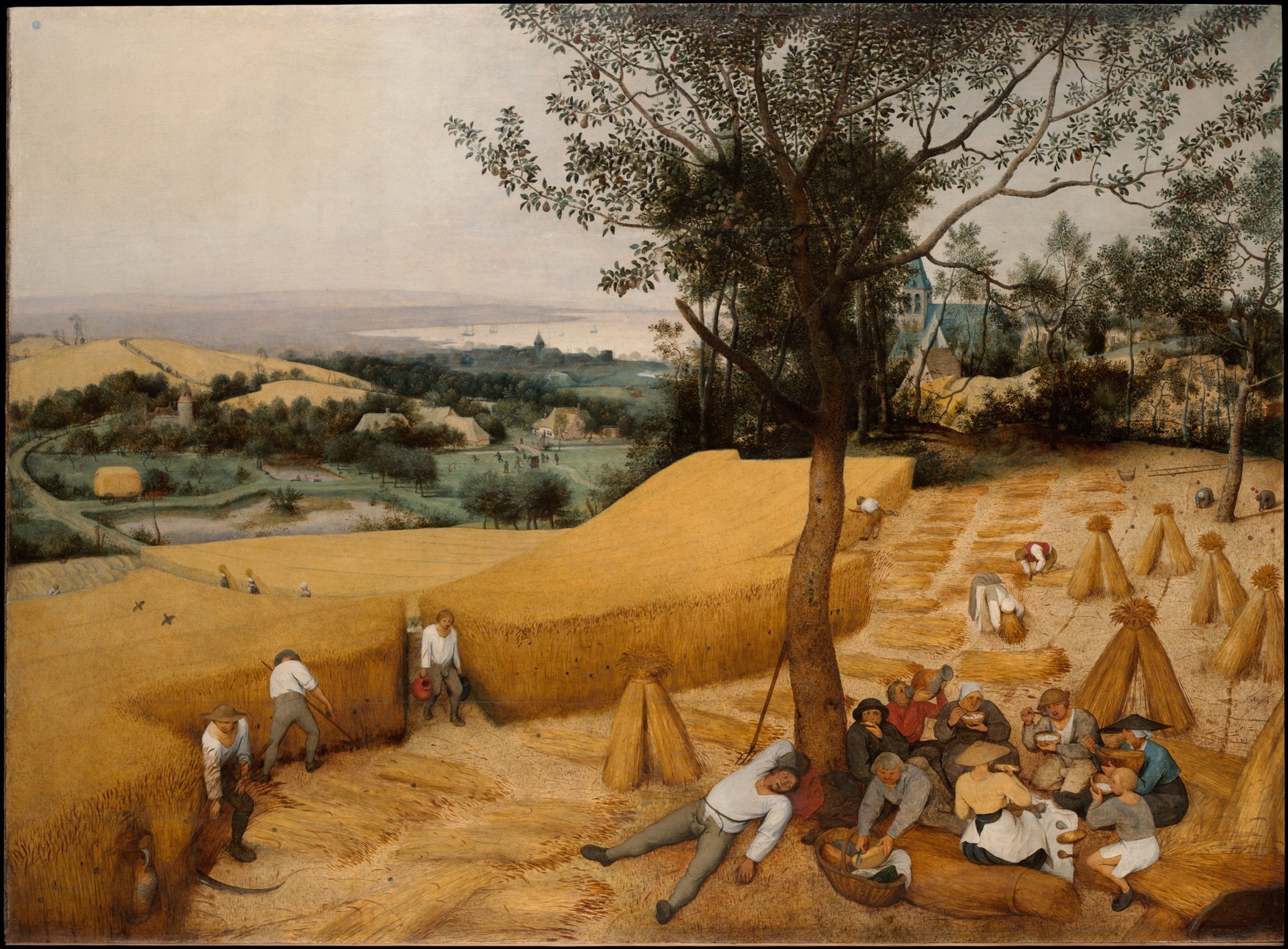
Both paintings appear in full before the readings. The deck moves between Bruegel’s figures, the films and Berger’s writing about how people attend to what happens around them.
The merchant’s view in The Harvesters
Niclaes Jongelinck commissioned Bruegel’s seasonal cycle for his country dining room. As he ate, he could see workers eating under a tree and other workers still cutting the grain. The painting records his purchase of a view. It leaves open who received the crop. The Metropolitan Museum of Art
Assessment and homework
Class discussion and any notes made in class are ungraded.
Description
In The Peasant Wedding, a pair of servers carry the dishes on a door lifted off its hinges. The bride sits under a paper crown with her hands folded. The feast honors her, but the serving, eating and waiting belong to different people. Kunsthistorisches Museum, Vienna
In The Harvesters, a man lies at the foot of a tree while others eat bread and cheese. Beyond the shade, the cutting continues. The painting belonged to a six-part seasonal cycle that the Antwerp merchant Niclaes Jongelinck commissioned for his country dining room. From his table he could see the workers taking their meal in the field. The Metropolitan Museum of Art, collection and audio guide · Jacob Wisse on the commission
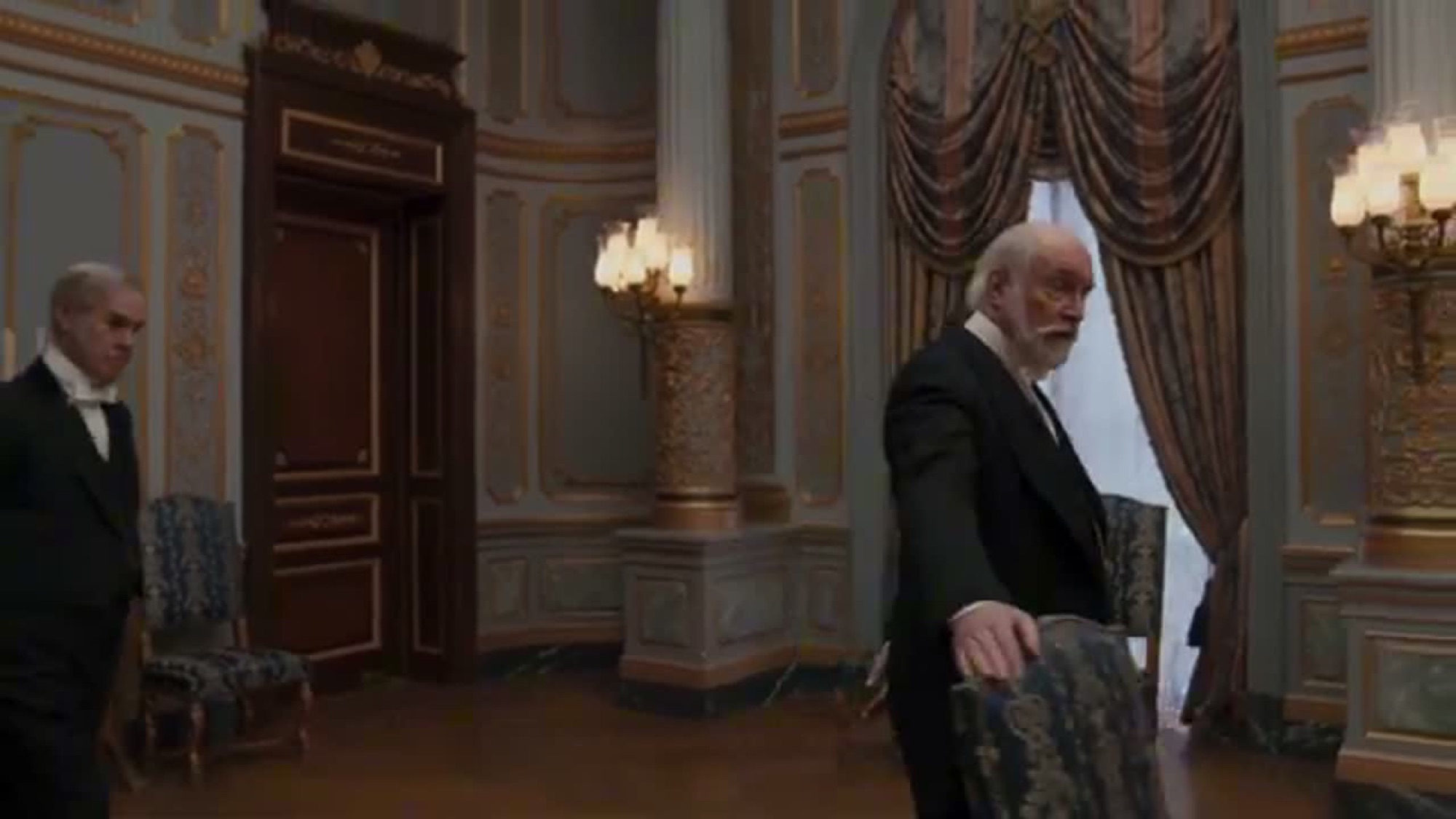
The English place setting in The Gilded Age and the pizza boxes in Home Alone give the comparison a contemporary point of entry. All four works show who handles the food and who has the chance to sit down.
Teaching reference
The shared meal: order, narrative and participation
The Shared Meal source connects sacred gathering, household behavior and public exchange. Castagno and Leonardo give the same religious subject different arrangements. In Castagno, Judas is physically separated on the near side of the table. Leonardo places the disciples in reacting groups around the central Christ. The placement of Judas changes what it feels like to look across the table at him.
Leonardo’s chosen announcement makes a shared meal the setting for a break in trust. The painted room also addresses a real refectory in which people ate together. People eating in the refectory faced a painted meal at the moment the disciples learned that someone at their table would betray Christ.
In Bruegel, celebration depends on serving as well as eating. Following the food makes both visible within one gathering. Steen’s family scene invites attention to repeated behavior and the relationship between generations. A scene may offer pleasure while also warning about conduct. The same gesture can look affectionate to one viewer and careless to another.
Jean-François de Troy, Luncheon with Oysters (1735) provides a comparison with Bruegel’s serving routes. Hands and plates carry food around both tables. In de Troy, the dress of the diners, their tableware and the room itself make the meal a display of wealth. Musée Condé teaching resource.
William Hogarth, Marriage A-la-Mode: 2, The Tête à Tête (about 1743) places the table within a narrative of marriage. The work is the second painting in a six-part series. The furnishings can convey the couple’s wealth even as their positions in the room suggest distance between them. National Gallery collection record.
Castagno, Steen, de Troy and Hogarth are reference comparisons from the original Shared Meal. The dated studies above identify the works used in these classes.
Berger on the ploughman and the wedding guest
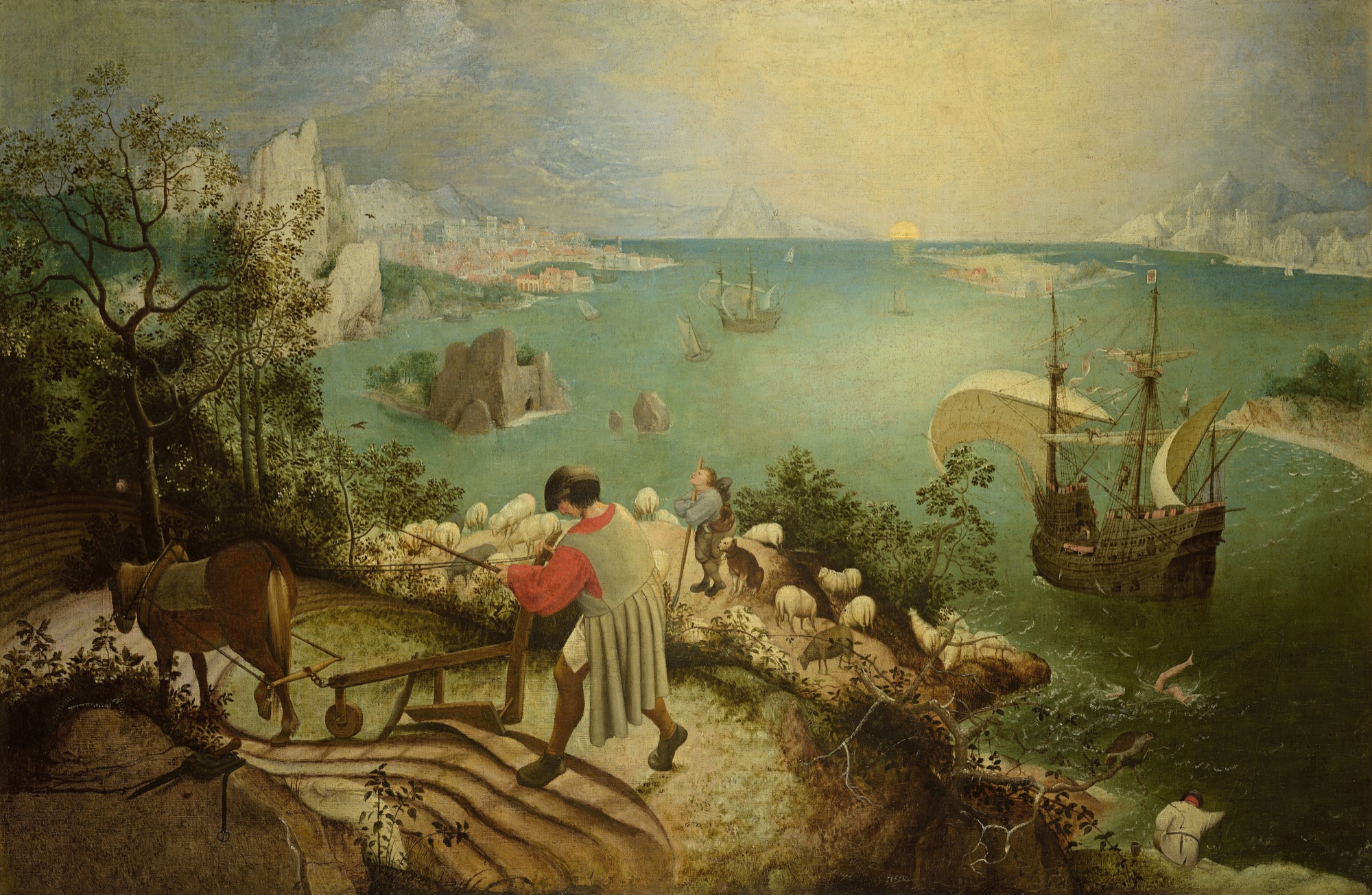
In “The Case Against Us” (1962), John Berger writes, “The charge he wanted brought was that of indifference.” His example is the ploughman whose work continues as Icarus falls into the sea. From above we can see the worker at the plough and the legs disappearing beside the ship. The worker has a different view. Berger adds, “The peasant bent over his plough could not be held entirely responsible for failing to notice Icarus.” The attribution of the surviving Brussels painting remains uncertain. Portraits, pp. 41–42. Royal Museums of Fine Arts of Belgium
Of Bruegel’s figures Berger writes, “He made no neat division between the innocent and the guilty. He refrained from moralising. He set no single figure up as a bad or good example.” (Portraits, p. 43.) At the wedding, a seated guest turns to pass a dish along the table. The same person can take part in the feast and do some of the work that sustains it. This application to the wedding is ours.
The whole picture and the drawn line
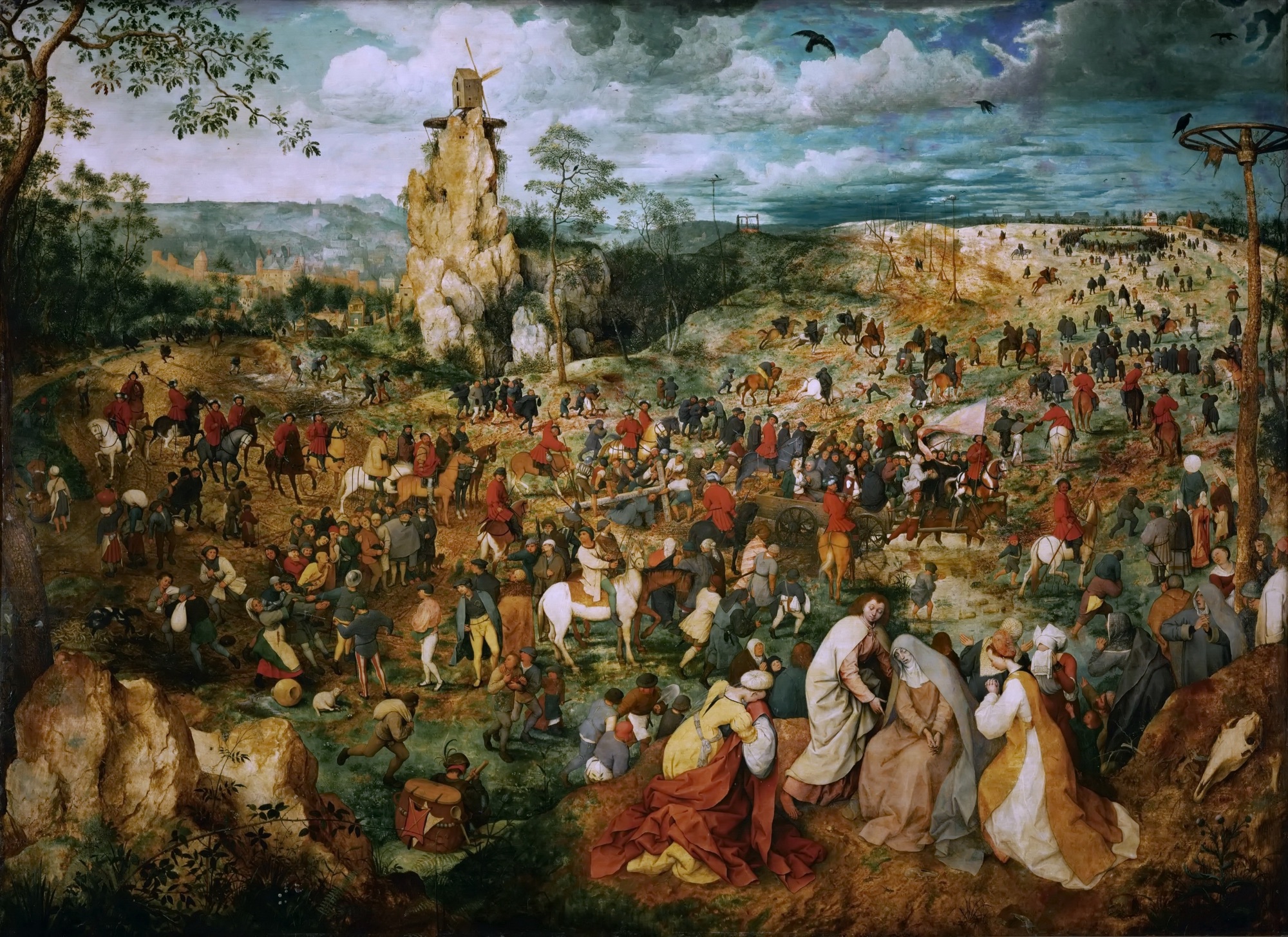
In Ways of Seeing (1972), Berger and his collaborators reproduce successive details of Bruegel’s Christ Carrying the Cross. “In a painting all its elements are there to be seen simultaneously.” (p. 26.) A film chooses the order in which we encounter the crowd. In the whole painting, the tiny figure of Christ near the center and the mourners in the foreground are available at once. Vienna collection and exhibition account
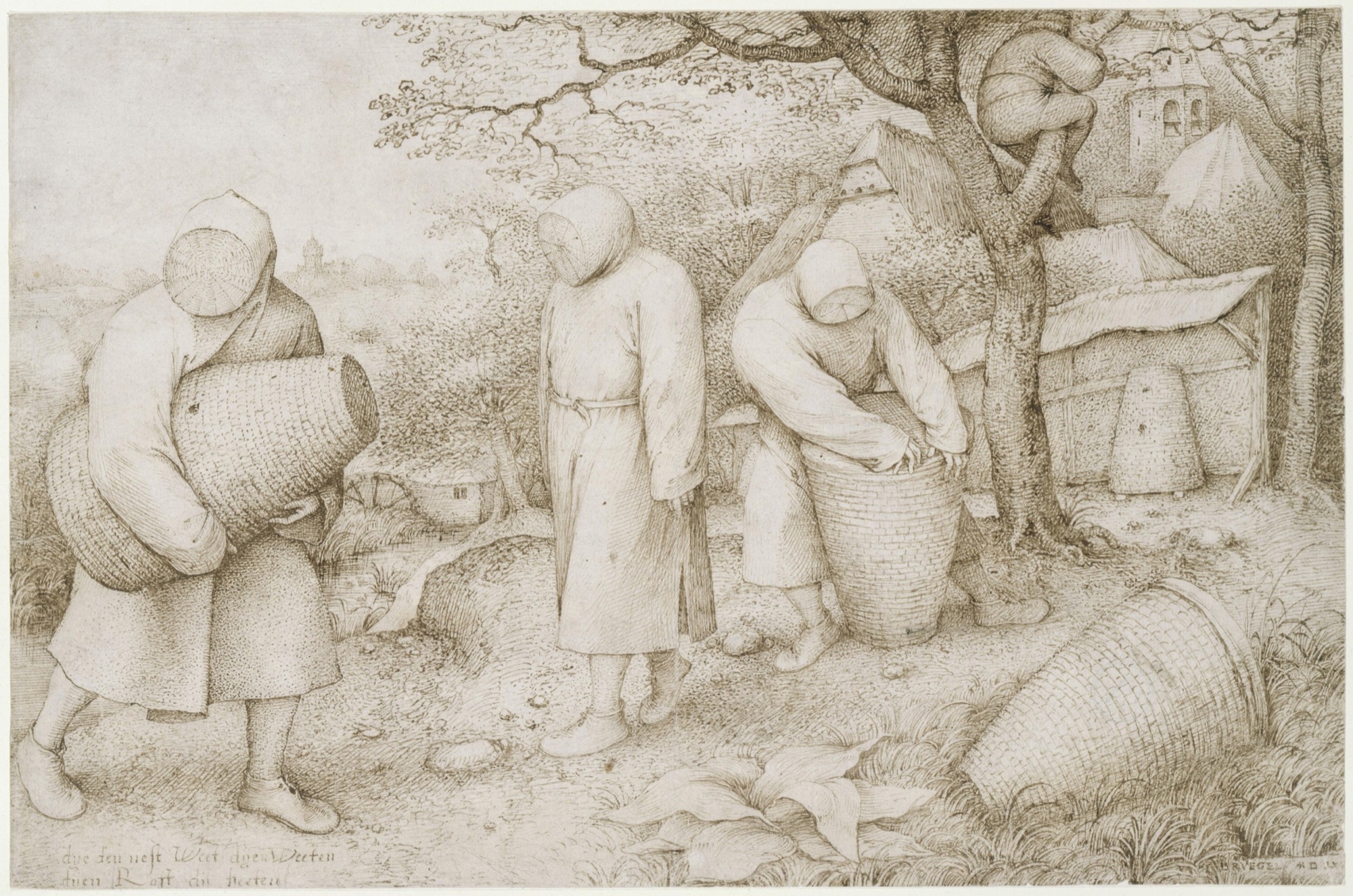
In “To Take Paper, to Draw,” Berger writes about a mountain landscape then associated with Bruegel. “The paper lends itself between the lines to becoming tree, stone, grass, water, cloud.” (Landscapes, ch. 2, PDF p. 40.) The Morgan lists the mountain sheet as attributed to Bruegel. The drawing shown in the deck is a different work, The Beekeepers. Bare paper suggests the pale sleeves, while repeated strokes make the weave of the hives visible. Morgan collection · Berlin drawing
Reading excerpts for the Monday discussion
John Berger’s “The Eaters and the Eaten” (1976), in Selected Essays, pp. 370–374, compares two historical ways of valuing food. He begins with what a meal means to the eater, rather than the difference between hunger and plenty. A worn pocketknife, bread passed on and a meal in the middle of the working day connect eating to handling familiar things (p. 371). In his bourgeois dining room, purchased food and separate cutlery arrive in the right order. A door keeps the kitchen out of the diners’ sight (pp. 371–372). Of that setting he writes, “The theatrical invitation of the scene often provokes family dramas at meal times.” (p. 372) The field meal gives time back to a worker as rest. A feast, by contrast, marks “a special recurring moment or an unrepeatable occasion” (p. 373) and uses food saved for it. On p. 374 he asks what one can possess through eating and cautions against idealizing peasant life. The bought pizza can feel familial. Bruegel’s wedding can feel generous while the carriers work and the bride waits. Those are readings of these scenes, not Berger’s verdicts on them.
In chapter 24 of Portraits (class PDF p. 203), John Berger describes Bruegel’s figures as part of a crowd. The bagpiper watching the dishes and the child licking a finger give that crowd different points of attention. Berger makes this observation while writing about Millet. His argument offers one way back into the wedding.
Working bodies at the wedding. In “The Suit and the Photograph” (1979), p. 34, Berger considers August Sander’s photograph of three young men dressed for a dance. He asks what kind of body a professional suit is cut for. “The physical contradiction is obvious. Bodies which are fully at home in effort, bodies which are used to extended sweeping movement: clothes idealising the sedentary, the discrete, the effortless.” Bruegel gives the carriers room to reach and turn while the guests sit shoulder to shoulder.
Who learns the rules of dress. Veblen writes about dress in chapter VII of The Theory of the Leisure Class (1899). “Elegant dress serves its purpose of elegance not only in that it is expensive, but also because it is the insignia of leisure.” An insignia is a visible sign. John T. Molloy’s 1988 dress manual asks this question.
For which professionals are bow ties acceptable—and often preferred—attire?
Molloy’s question assumes that his reader recognizes a professional code. The butlers inspecting the glasses also recognize a convention that a guest might never have learned. The quotation and the separate quiz appear together in Lapham’s Quarterly, Fashion (Fall 2015), p. 154.
Two further voices on table manners. Pierre Bourdieu writes, “Taste classifies, and it classifies the classifier.” The butler who judges the glasses reveals his own training as he judges the setting. Thorstein Veblen says that “good breeding requires time, application and expense”. At a formal table, the host may receive credit for a setting that others spent time arranging. Bourdieu, Distinction, trans. Richard Nice, introduction to the first edition, p. xxix in Routledge Classics (2010) · Veblen, The Theory of the Leisure Class (1899), ch. III, “Conspicuous Leisure”
Berger: food and the work that makes it possible
John Berger, “The Eaters and the Eaten,” in Selected Essays, p. 371, three consecutive sentences from the assigned text:
To the peasant all food represents work accomplished. The work may or may not have been his own or that of his family, but if it isn’t, the work represented is nevertheless directly exchangeable with his own work. Because food represents physical work, the eater’s body already ‘knows’ the food it is going to eat.
Reading support: Berger is connecting eating to an embodied understanding of physical work. His peasant/bourgeois comparison is broad and historical. It does not establish that all agricultural workers grow everything they eat, or that food preparation belongs to one social group. At the wedding, a diner can see the people carrying a dish even when the kitchen stays out of view.