The Milkmaid
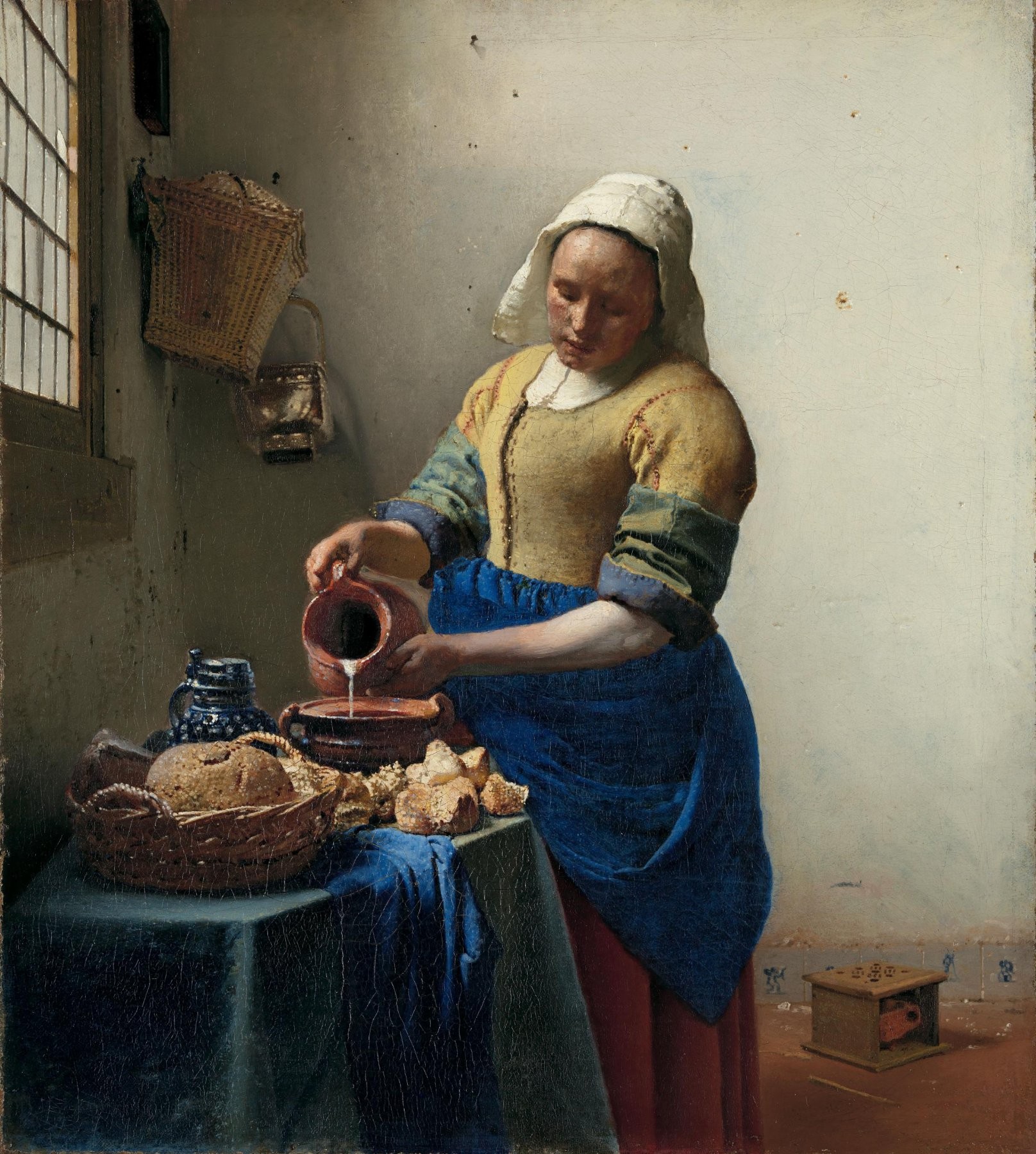
Study slides: The Milkmaid (study slides, PDF)
Lesson slides: Download the deck (PowerPoint, 16.3 MB) · image credits
At a glance
| Field | Details |
|---|---|
| Dates | Completed by Fri 13 Nov P2 · 08:55–09:40 |
| Focus | The Milkmaid |
| Unit | The Table As Ethical Space |
Objectives
- Compare how Millet and Vermeer give pictorial dignity to a worker, while distinguishing that treatment from the person’s social power or feelings.
- Explain how The Milkmaid’s figure, action and surroundings support a reading of absorption, and assess what a claim of devotion would add.
- Reconstruct Berger’s account of intimacy, the world beyond the room, living presence and unrepeatable time. Test it against The Milkmaid and other Vermeer paintings.
- Revise an interpretation using a visible relationship, a critic’s argument and a limit to what the image can establish.
Materials and resources
-
James Payne, The Milkmaid: Great Art Explained, 18:29. Optional context and further viewing; the study uses selected paintings and explanations rather than adding a full screening.
-
Netscher’s The Lace Maker, Wallace Collection · Vermeer’s The Lacemaker, Louvre · Maes’s The Idle Servant, National Gallery.
-
Rijksmuseum, September 2022 findings, updating the video’s earlier account of the painted-out objects.
-
John Berger, “The Painter in His Studio: Vermeer,” complete classroom extract, printed pp.122–125. Read selected passages together; further reading is optional.
-
Rijksmuseum Vermeer exhibition texts, historical context and the restored letter reader.
-
National Gallery of Art: Woman Holding a Balance, a different account of action and moral meaning.
-
The Milkmaid: teaching slides (editable PowerPoint)
-
The Milkmaid: study slides (PDF)
-
Walter Liedtke, The Met, “Johannes Vermeer (1632–1675) and The Milkmaid”, 2009. Optional fuller reading.
-
Musée d’Orsay, Des glaneuses. Optional reference for recalling the Millet comparison already studied.
-
John Berger, “Millet and the Peasant” (1976), Portraits, class PDF pp.202–208. Previously studied reading; the retained extracts support recall rather than another reading activity.
-
Rijksmuseum collection record. Use the supplied classroom reading, printed pp.122–125, beside the complete painting.
Tasks
Completed Vermeer study. Compare The Milkmaid briefly with The Gleaners, using the reading already studied. Explain how Vermeer gives importance to the worker. Read selected passages from Berger’s “The Painter in His Studio: Vermeer” and test them against The Milkmaid and the letter reader. Distinguish observation, context and interpretation.
Wider Vermeer comparison. Use The Art of Painting and Berger’s account of living presence and time to revisit the woman pouring milk. Revise your first claim with one visible relationship and one limit to what the image can tell you. You may retain an interpretation if you can support it.
Assessment and homework
Ungraded looking, reading and discussion in class.
Description
The Milkmaid extends the study of dignity and labor from Millet’s field into a domestic room. Vermeer makes a worker’s small action matter while leaving her life beyond the task partly unknown. Berger’s essay develops this problem across Vermeer’s paintings: surfaces can feel close, letters and maps refer beyond the room, and a fixed image can make us conscious of a moment passing. The letter reader, Woman Holding a Balance and The Art of Painting provide distinct ways to test that account.
Teaching reference
Vermeer beyond the single task
Millet and Vermeer both give ordinary work a place that demands attention. They do so differently. Millet sets large, bent bodies against a harvest extending behind them. Vermeer brings us into a small room and gathers the action around a vessel and a narrow stream. In both cases, the treatment can give the person dignity. That does not establish freedom, good conditions or pleasure in the task. The central question is what the painting enables us to know about the worker, and what it leaves open.
Vermeer lived in Delft from 1632 to 1675. He worked as an art dealer as well as a painter and served as a headman of the Guild of St Luke. His early religious and mythological pictures differ from the smaller domestic interiors for which he is best known. These rooms are constructed images. Rijksmuseum research identifies objects that he painted over in The Milkmaid, including a jug rack behind the figure and a fire basket below. Removing them changes the space around the worker. The room’s apparent simplicity is a pictorial decision, not evidence that the artist merely copied an undisturbed scene. Rijksmuseum exhibition text
Domestic painting, household ideals and the viewer
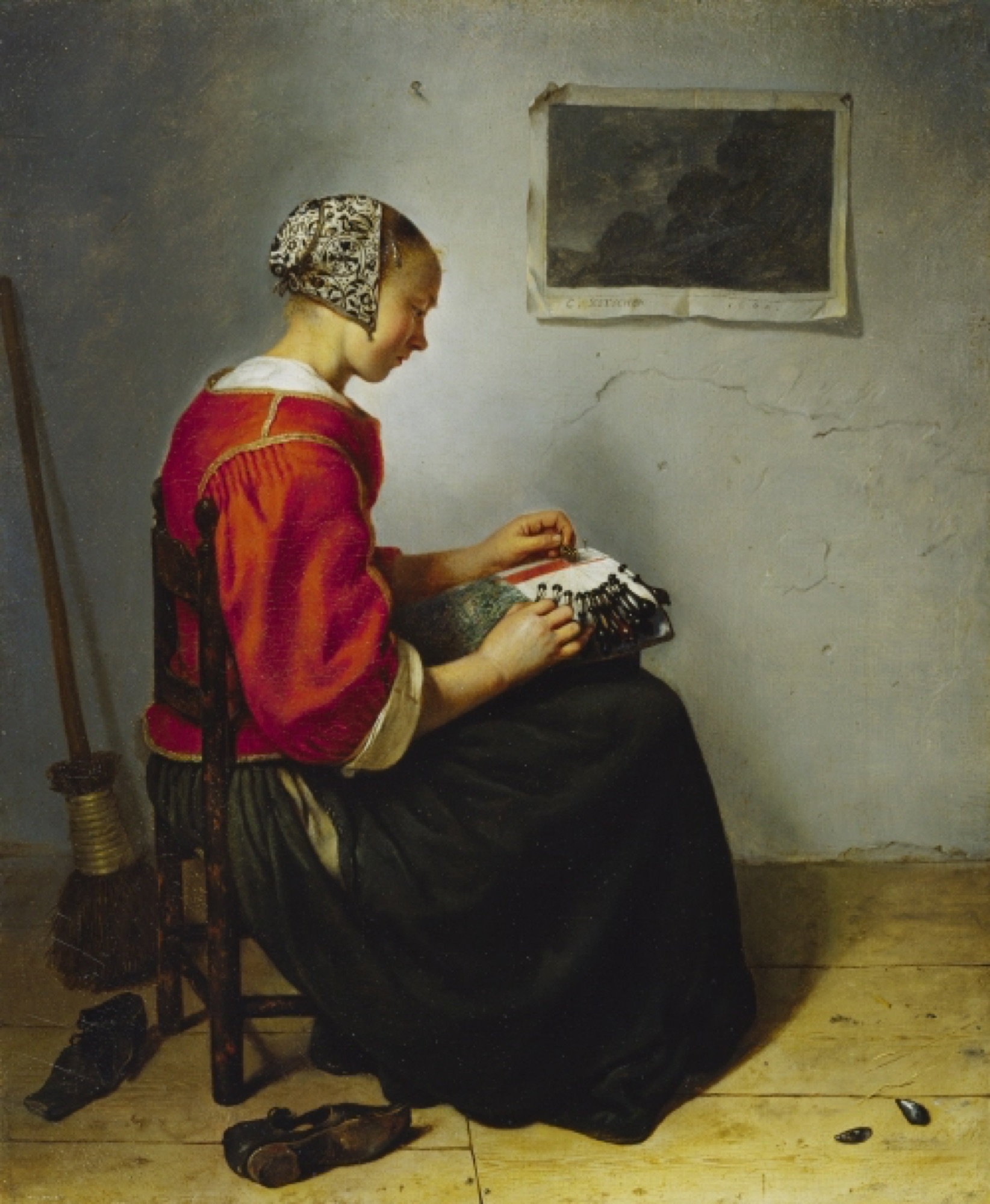
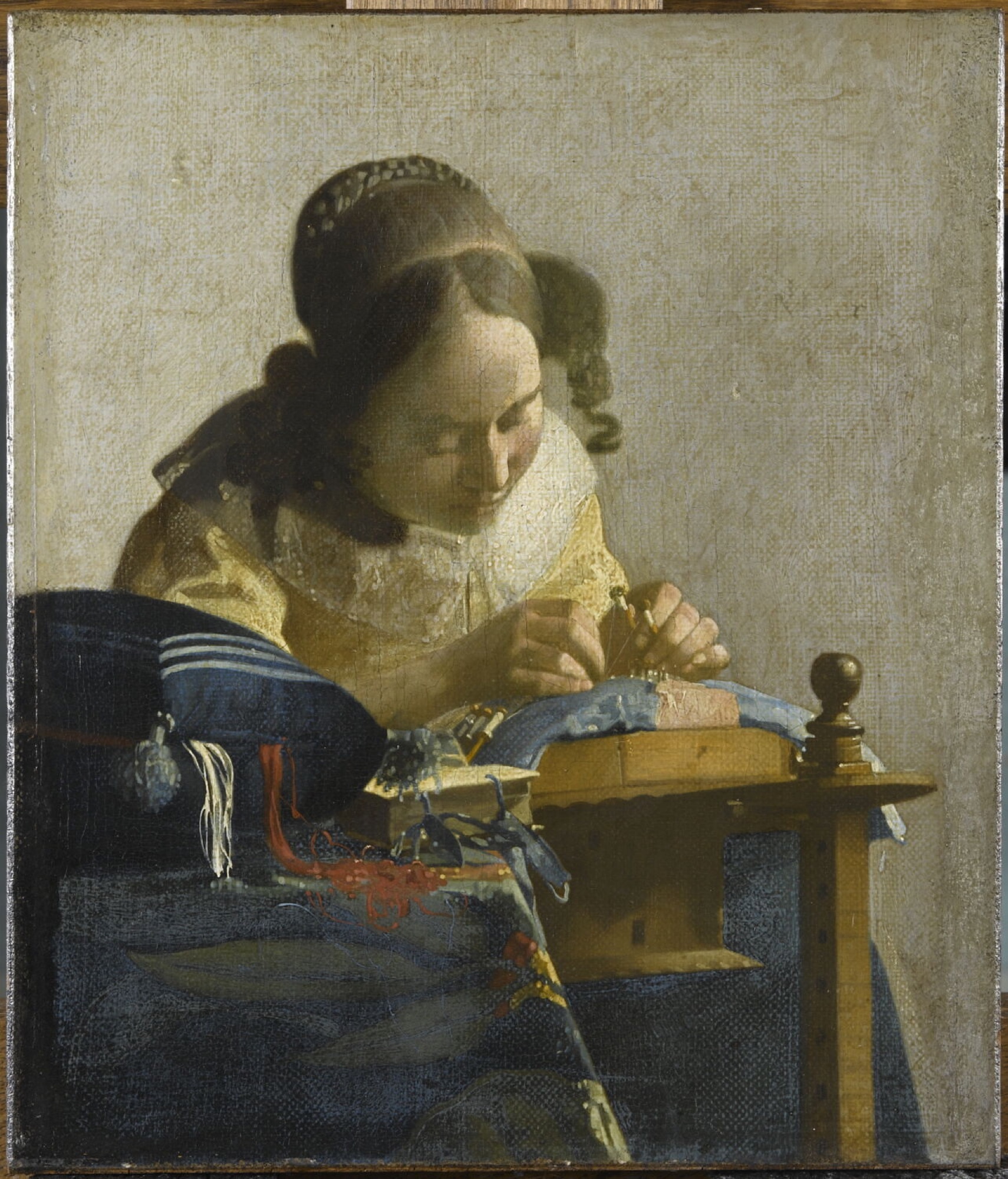
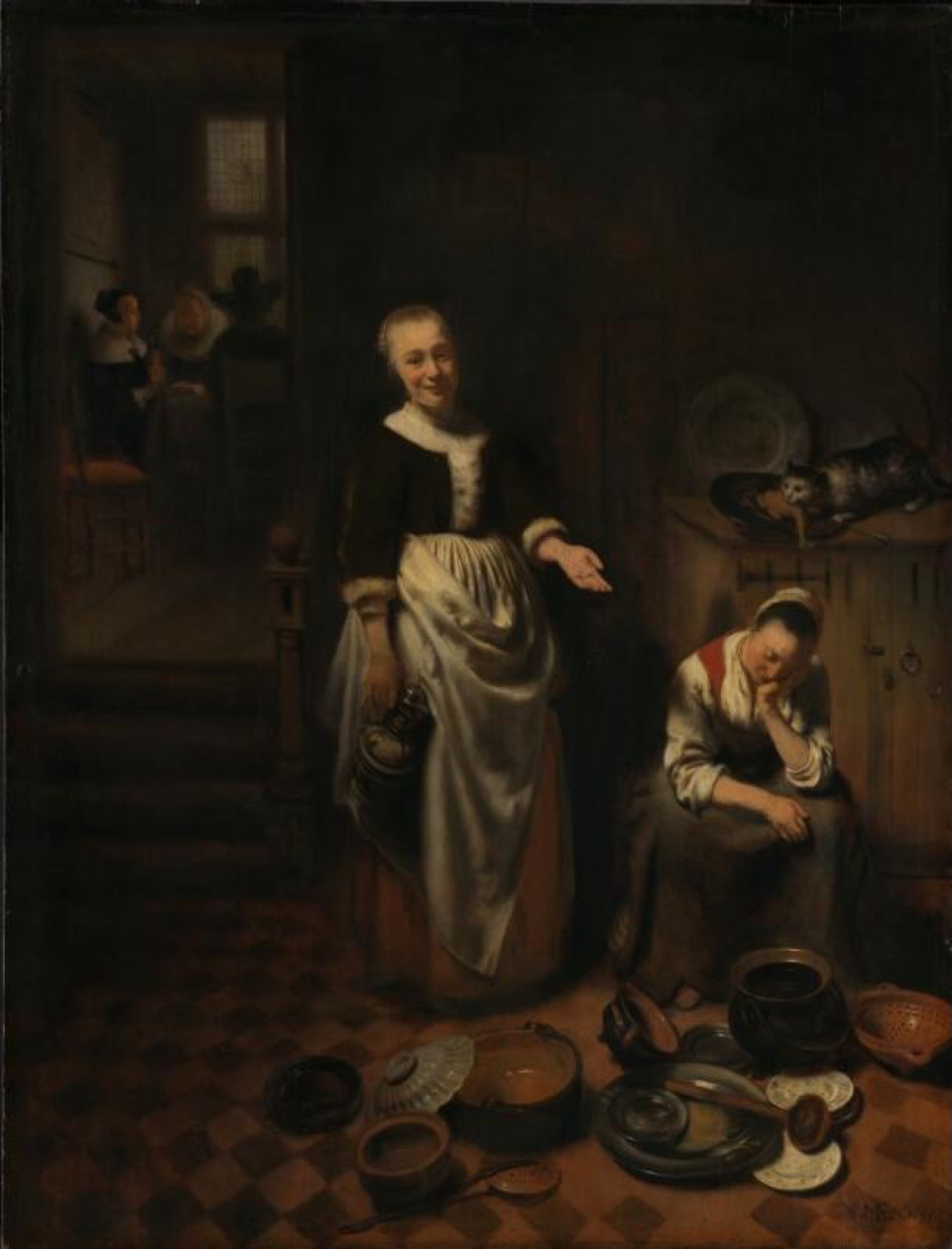
The video supplies a useful historical route into The Milkmaid. In the Dutch Republic, a market for paintings extended beyond church and court patronage. Domestic scenes could appeal to buyers through familiar activities while also presenting expectations about conduct. Genre painting means a representation of everyday life; it does not guarantee an unarranged record of what happened. The Republic’s public Protestant institutions did not end religious painting or make every household Protestant. Vermeer’s Catholic milieu and his religious subjects are part of that history. The Met, In Praise of Painting
Netscher’s The Lace Maker (1662) places the woman with a broom, shoes and chair. The Wallace Collection reads these surroundings, her dress and her concentration through an ideal of orderly household conduct. That tells us how an image could promote a social expectation. It does not establish the model’s character. Vermeer’s later Lacemaker (c.1669–70) brings the hands and threads much closer. The Louvre identifies the figure as a socially well-placed woman pursuing a domestic activity, rather than a professional lace worker. The comparison helps us distinguish absorption in a task from a claim about employment or class. It also gives a more precise way to return to the kitchen servant: similar concentration need not mean similar conditions. Wallace Collection · Louvre
In Maes’s The Idle Servant (1655), the standing mistress turns toward us beside the sleeping maid. The gesture offers a position from which to judge the household. Yet the National Gallery’s interpretation is less severe than the video’s: the utensils appear clean, the maid may be tired after preparation, and the mistress’s response may be amused. The pose and the cat still permit a reading about disorder. The picture does not require us to settle her character with the word lazy. Vermeer removes the intervening mistress and gives the kitchen servant sustained concentration. This changes our relation to the pictured worker; it cannot by itself establish kinder employment conditions. National Gallery
Preparing food, painting light and revising the room
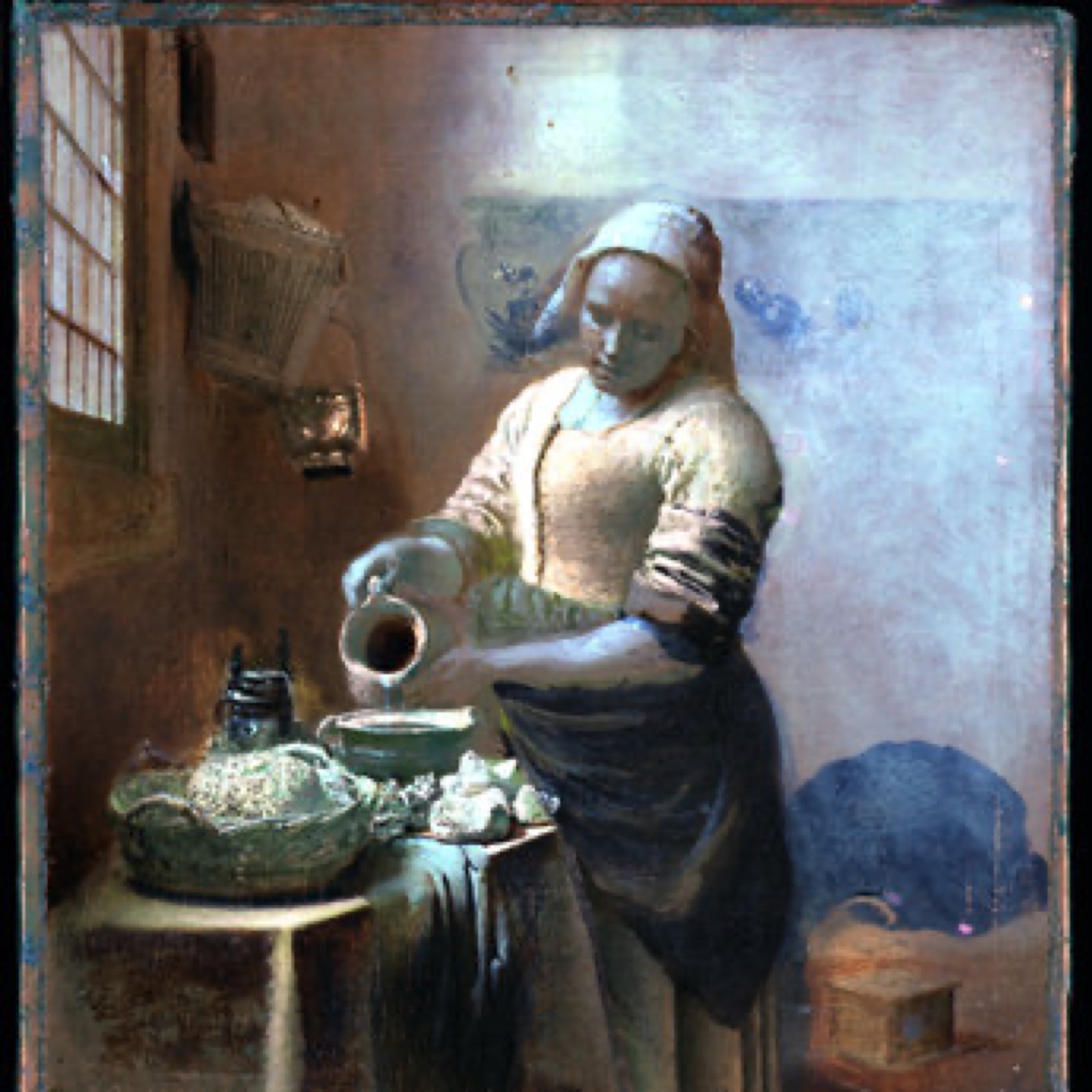
The practical action matters. The woman pours milk beside broken bread. A bread-based dish is a supported possibility, and would connect the task with avoiding waste and maintaining a household. It remains a proposal rather than a recovered recipe. Likewise, a cultural ideal of careful work does not prove the woman’s devotion. The painter’s attention and the character attributed to the worker are separate claims. Liedtke and the Rijksmuseum both retain uncertainty about the dish.
The bread’s bright dabs make light and rough texture legible together. From a distance they can seem like reflected daylight; close up they remain individual touches of paint. The technique is often called pointillé. It should not be confused with the later systematic color method of nineteenth-century Pointillism. The softly described edges and fixed stream contribute to a feeling of continuing action. These are relationships students can examine, rather than reasons to declare the entire picture mechanically copied. Liedtke, The Met
The video was published on June 24, 2022. Its account at 12:30–13:08 identifies a removed map and laundry basket. The Rijksmuseum’s September 8, 2022 research release reports a jug rack and fire basket instead, together with a quickly applied tonal underpainting. The new identification changes the contextual account while supporting the larger point that the finished room was made through decisions. Removing objects can make the figure more distinct. That effect is visible; the artist’s precise motive is not documented. The technical image in the slides is a false-color recording, not a reconstruction of the earlier painting’s colors. Rijksmuseum research release
Selected video references
| Video position | Painting or passage | Use in this study |
|---|---|---|
| 01:40–05:04 | Republic, Delft and the genre-painting market | Concise historical context, checked against the museum sources. Avoid a simple Protestant/Catholic division of all art. |
| 05:18–05:29 | Netscher and Vermeer, The Lacemakers | Compare the viewer’s distance, visible surroundings and the social reading of a task. |
| 05:48–07:04 | The practical task in The Milkmaid | Bread, milk and a possible recipe; keep the inference qualified. |
| 07:23–10:21 | Edges, marks and paint effects | Explain how materials produce light and texture. Exact production time and a patron’s pigment supply remain unverified. |
| 10:21–11:38 | Servants, desire and domestic virtue | Attribute the narrator’s interpretation. Weigh it against concentration and the whole composition. |
| 12:18–12:29 | The Milkmaid beside Woman Holding a Balance | A related pose can give presence to figures of different social positions. Update the balance painting’s caption to the NGA’s c.1664. |
| 12:30–13:08 | Earlier objects and Maes’s The Idle Servant | Use the later Rijksmuseum identification; compare judgment of a servant without making laziness a fact. |
| 14:31–17:01 | Camera-obscura debate and pinprick perspective | Optional further context. A possible optical aid is not established by photographic resemblance, and a pinprick does not exclude every aid. |
Berger’s question: nearness without full access
Berger begins with his own delayed recognition of Vermeer. Domestic subject matter alone cannot explain the paintings’ effect. On p.123 he asks why surfaces and light can feel intimate while the people remain remote. He considers a technical account involving the camera obscura, then a psychological account from Lawrence Gowing. He finds neither sufficient to explain the purpose he sees in the work. We should reconstruct that movement rather than repeat the camera-obscura claim as a settled account of Vermeer’s method.
The Milkmaid makes this problem concrete. The bread, vessel and folds can seem available to touch. The woman’s attention belongs to her action. She does not look back to explain herself. This is a limit to the viewer’s access, not proof that she has no personality. Her concentration may also resist the idea that the figure exists only for a spectator.
Signs of a world beyond the room
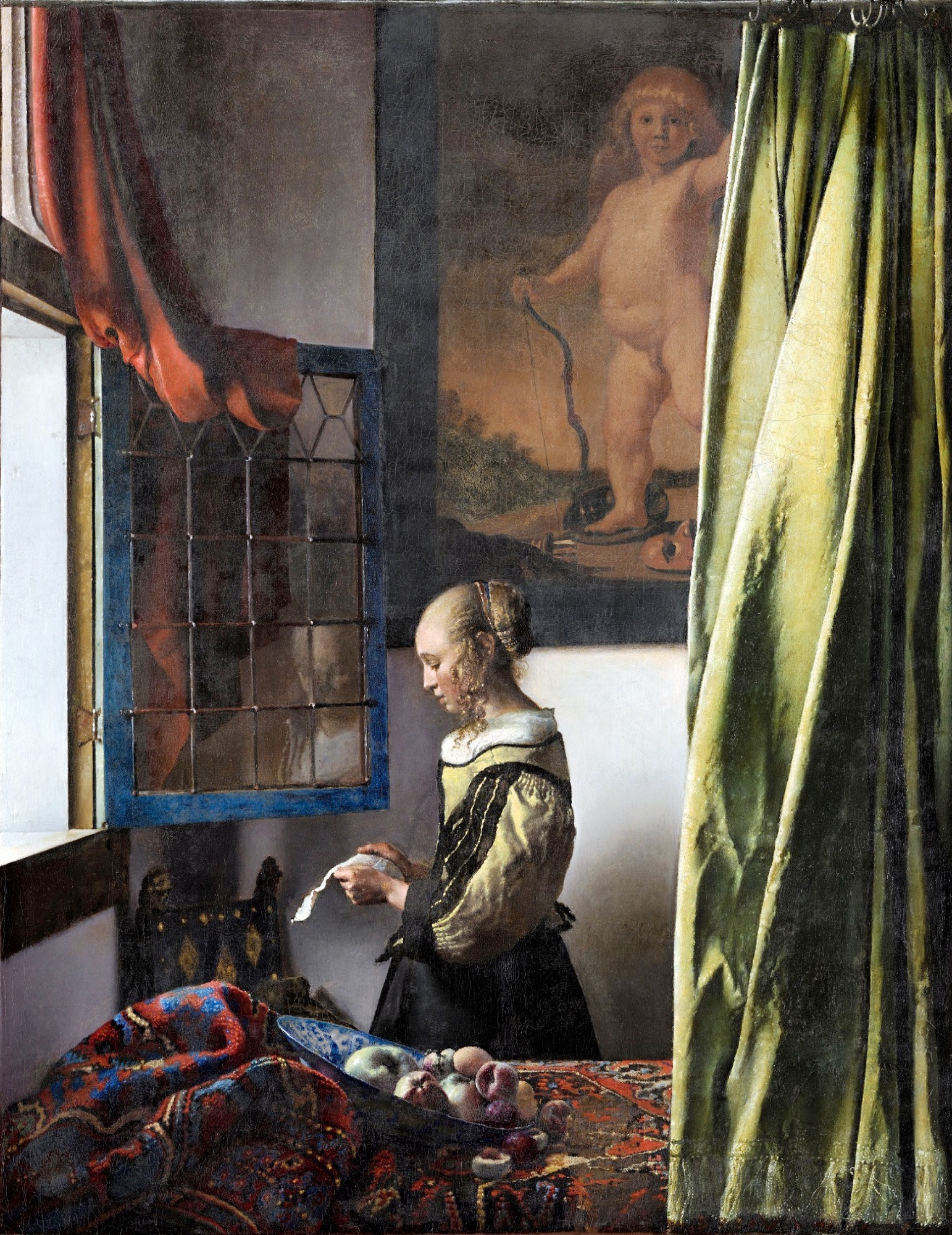
In nearly every interior he painted, there is either a map, a sheet of music, a letter, a chart, or a picture whose subject-matter functions like an ideogram.
John Berger, “The Painter in His Studio: Vermeer” (1966), supplied extract p.123. The publisher’s contents corroborates the essay’s title and author; the edition of the supplied scan remains unidentified. An ideogram is a sign that conveys an idea. Berger is asking how these pictured objects point beyond their immediate appearance.
In Girl Reading a Letter at an Open Window, we see reading without receiving the message. A writer and an exchange outside this moment must be imagined, but their particulars remain unavailable. The curtain and table position us outside the woman’s immediate space. The Cupid painting now visible behind her supports a love theme without supplying the exact letter or her response. The overpainting removed in the recent restoration was added after Vermeer. Berger’s 1966 essay predates that recovery, so the current object gives us evidence he did not have. His argument remains something to test, rather than an authority that settles every reading. Rijksmuseum, Gallery 4
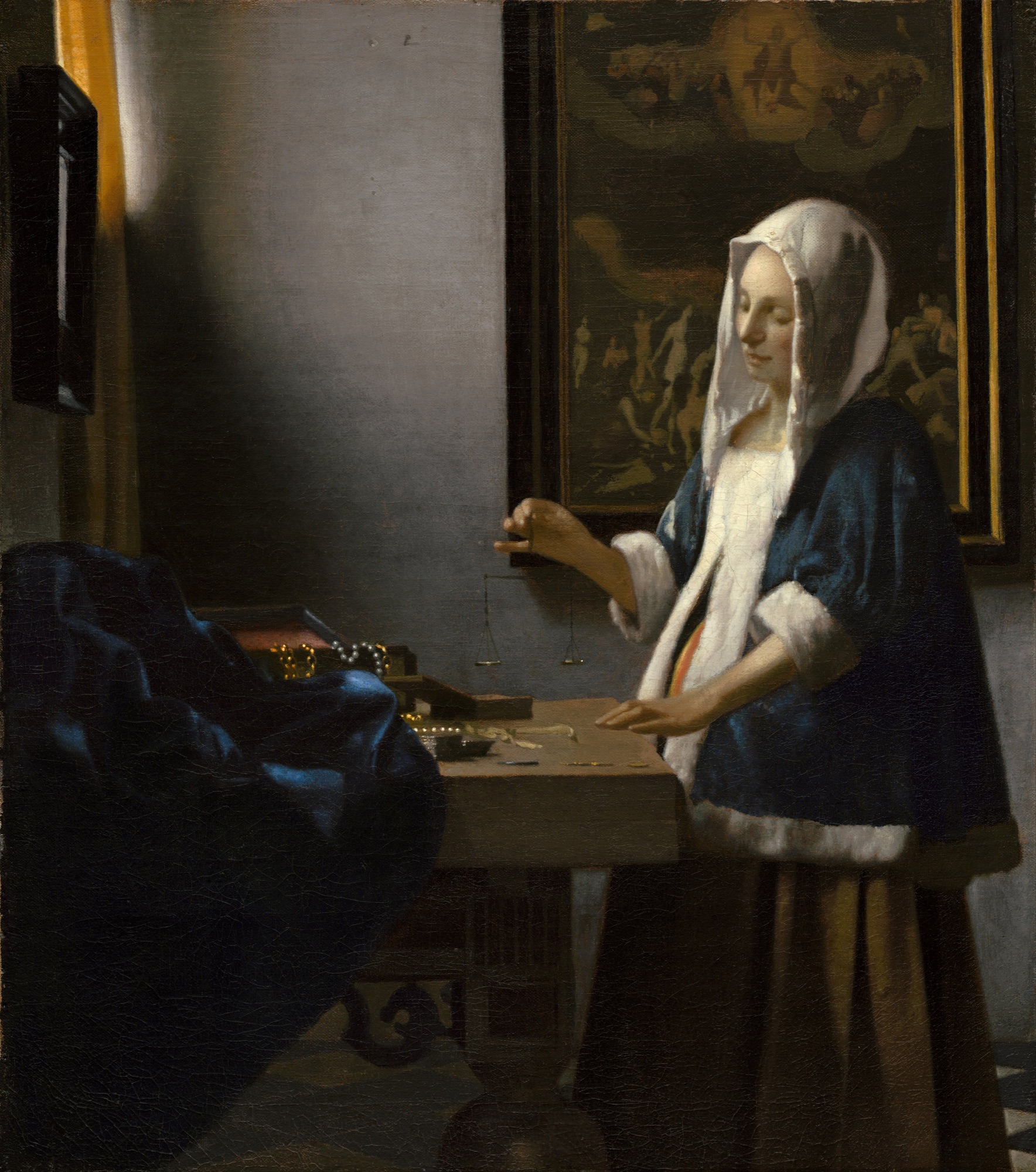
Woman Holding a Balance offers another kind of reference. The hand and small scales are placed beside the lower corner of a Last Judgment painting. The National Gallery interprets this relation through the connection between weighing and judgment. Its technical discussion identifies the pans as empty. The picture can support an allegorical interpretation without giving us the woman’s actual thoughts. Berger’s older description of her as weighing pearls must not become a fresh observation. National Gallery object interpretation · Wheelock’s entry and technical discussion
The Art of Painting: the living model and the image
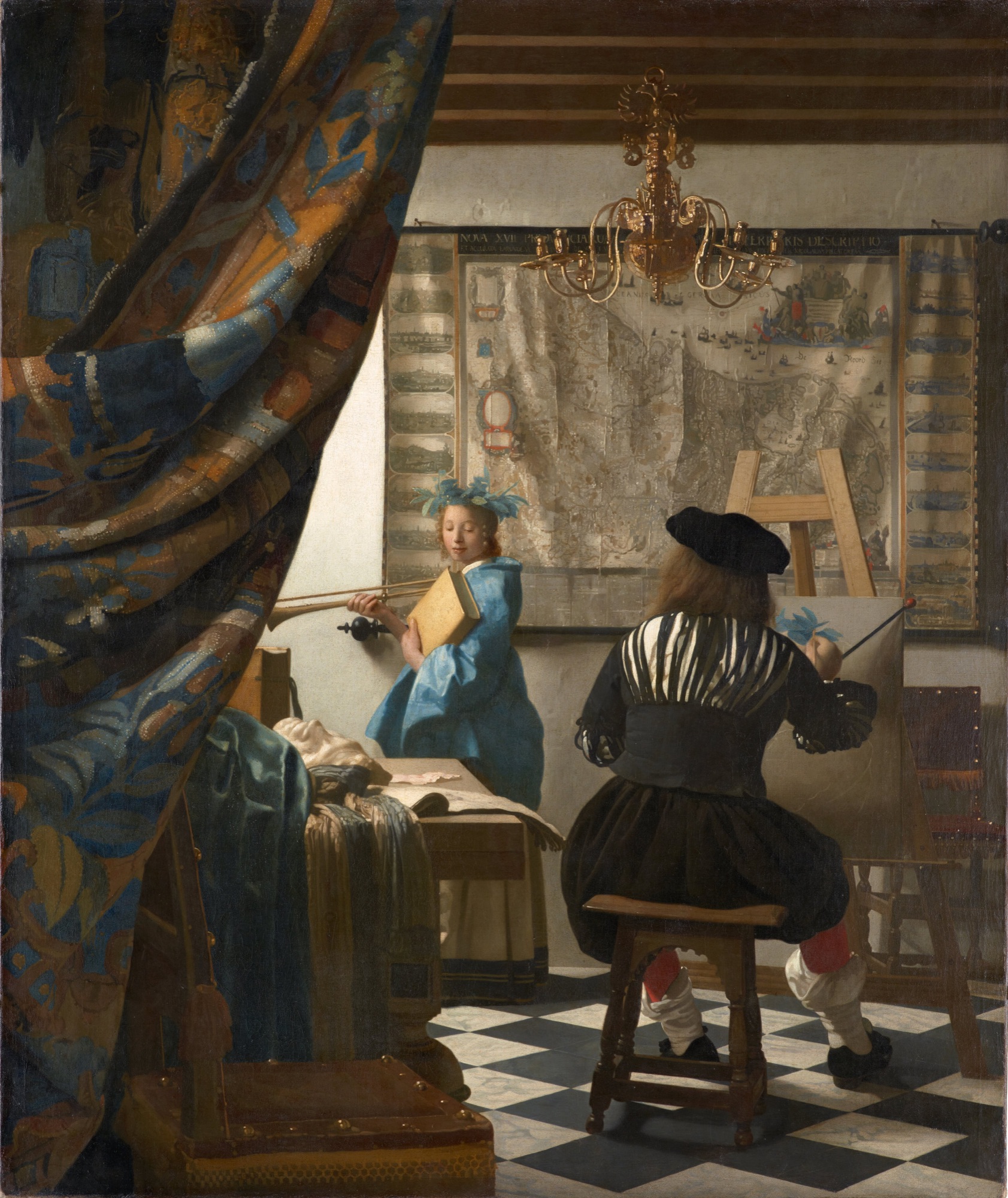
The point of the confrontation is to demonstrate the difference between the living and the inert: a difference which transcends all the common visual elements.
Berger, supplied extract p.124. He has just traced repeated colors and forms between the model, the table and the curtain. The museum identifies the model as Clio, the muse of history. Berger acknowledges that allegorical interpretation, then shifts his attention to the difference between a living person and the materials that resemble her. The book, fabric and leaf forms can recur without becoming equivalent to her life. His next sentence imagines Vermeer exclaiming “Breath is all!” Those are Berger’s words, not recorded speech by Vermeer.
The painter inside the picture turns the living appearance into marks on another canvas. Those marks are no longer alive, but they can carry the painter’s recognition that the model is more than an arrangement of visible parts. This is why the argument does not reduce painting to failure. Its limit can become part of what it lets us understand. The Clio reading remains a credible alternative emphasis: the painting can concern history and the status of the art while also asking what a representation preserves.
He was preoccupied, not by his limitations, but by those aspects of reality which by their nature defy visual representation.
Berger, supplied extract p.124. This follows his account of living appearance and its painted equivalent. It is a critic’s interpretation of Vermeer’s purpose. It is not an artist statement. The same distinction matters in The Milkmaid: giving the worker careful attention does not require inventing a complete account of her life.
An enclosed room and an unrepeatable moment
Berger’s account on p.125 connects maps, letters and incoming light with events outside the room. The map in The Art of Painting refers to a larger world while remaining a flat representation within another representation. His claim about the closed-in corner reminding us of the infinite concerns that tension. It should be tested against each work. The Milkmaid does not acquire a map or letter because those objects occur elsewhere in Vermeer.
He was able to portray with unique precision what constituted one moment because he was so keenly aware, objectively and without a trace of nostalgia, that each succeeding moment is unrepeatable.
Berger, supplied extract p.125. This precedes his comparison with the Impressionists. He treats the fixed image as a way of recognizing change. In The Milkmaid, the stream suggests an action continuing beyond the instant we see. The hands, vessel, milk and receiving pot make that moment depend on connected activity. This gives us something specific to weigh against the criticism of Millet’s held poses already discussed. A student can still defend a reading of an arranged or idealized figure, but should explain which relationship makes the action feel staged.
The new deck contains eight selected Berger passages, including the existing intimacy, outside-world and time passages. The full extract is available for further reading. The study uses selected passages in class; it adds no reading assignment or new submission.
The supplied Vermeer reading
The reading considers the closeness of Vermeer’s surfaces and the distance that remains between us and the people pictured. It connects the held moment to the passage of time:
In front of a Vermeer woman exactly turning her head, reading a letter, pouring milk, trying on a necklace in a mirror, raising a glass, we become aware of the flow of time itself.
“The Painter in His Studio,” section “Vermeer,” supplied scan, p.125, dated 1966. The publisher identifies this essay as John Berger’s; the supplied pages do not identify their edition. Test the claim against the narrow stream of milk. The reading offers an interpretation of pictorial time, rather than testimony from the pictured worker.
Attention and domestic work
Vermeer gives the stream of milk and the worn surfaces of the room sustained attention. The bread and the vessel catch light differently. Ask what makes the woman’s work feel deliberate and which details complicate a reading of calm. Her expression alone cannot tell us how she felt about her work.
Berger: the separation of dining from production
John Berger, “The Eaters and the Eaten,” in Selected Essays, p. 372, four consecutive sentences describing the bourgeois dining room or restaurant:
One door connects with his own daily life; through it he has entered in order to be served with food. The second door connects with the kitchen; through it the food is brought out and the waste is taken away. Thus, in the dining-room, food is abstracted from its own production and from the ‘real’ world of his daily activities. Behind the two doors lie secrets: secrets of recipes behind the kitchen door; professional or personal secrets, not to be discussed at table, behind the other.
Reading support: abstracted here means separated in the diner’s experience. This passage helps compare the visible worker, the serving route and the table where a meal is consumed. It also helps identify a limit: the absence of a worker from a painting is not proof of the artist’s motive, and the presence of a worker does not by itself establish fair social relations. A useful interpretation connects a visible choice with an ethical question and states what remains unknown.
Dignity, absorption and the limits of knowing the person
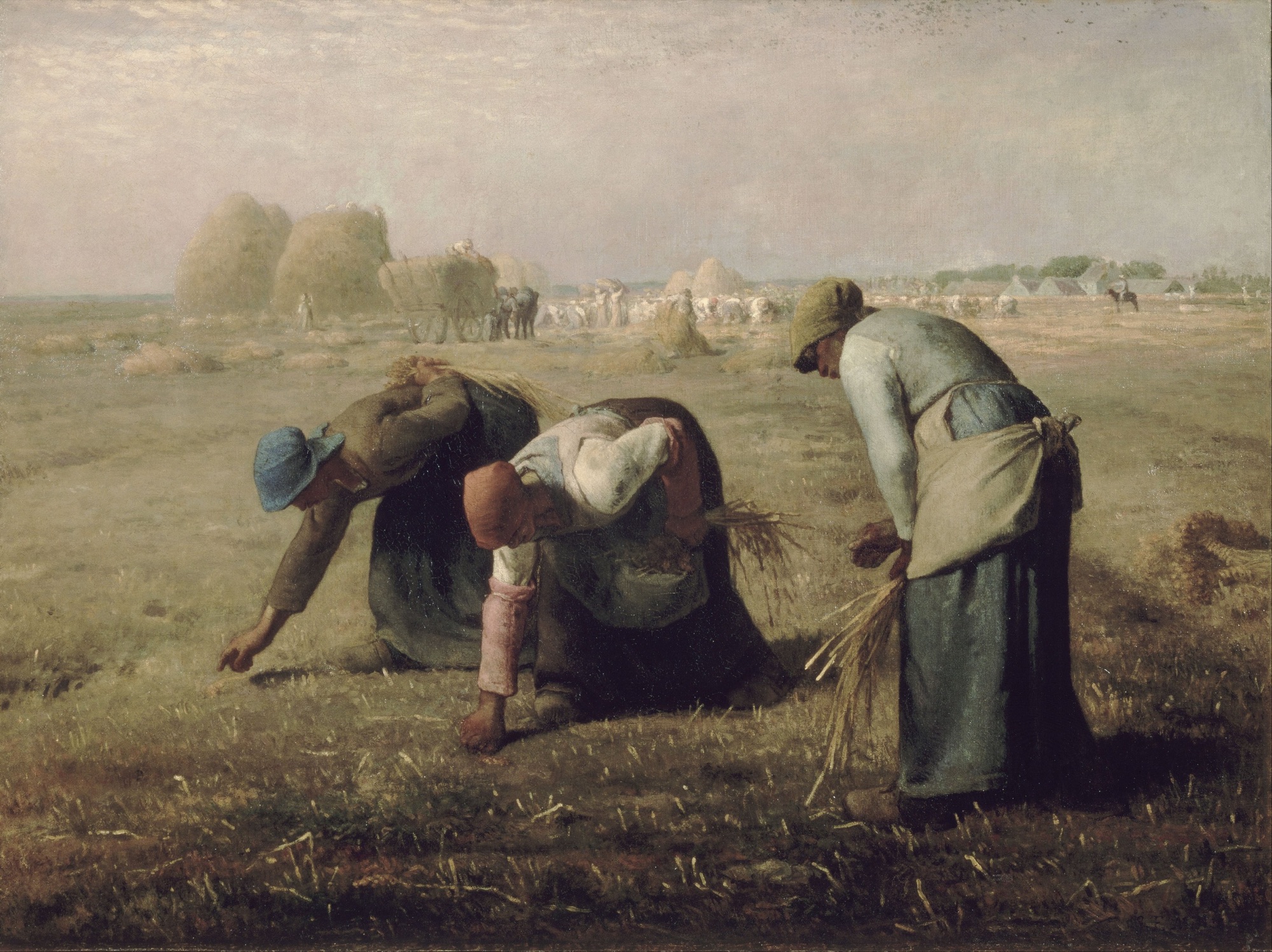
The connection with Millet is useful because both paintings ask us to take working bodies seriously. Their effects differ. Millet’s large foreground group is set against an extensive harvest. Vermeer concentrates attention in a close room, around the hands and a thin stream. Neither arrangement proves that a worker feels triumphant, welcomes the task or has control over her conditions. These are different claims and need different evidence.
Hardship and emblematic dignity
The Musée d’Orsay describes:
the back-breaking repetitive movement imposed by this thankless task
It later writes:
Millet gives these certainly poor but no less dignified gleaners an emblematic value
Musée d’Orsay, Des glaneuses, collection commentary. These are two extracts from different parts of the commentary. The first develops the repeated phases of gleaning. The second follows its account of light and substantial bodies; its complete sentence also rejects a treatment based on displaying misery.
Dignity here exists within difficult conditions. It does not require a victory over them. Emblematic means that the women can stand for a wider group. That gives us a reason to examine how individual presence becomes representative. It does not establish that the figures lack individuality. We can see differences in their postures and stages of movement even when their names and thoughts remain unknown.
Monumentality and the qualification “perhaps”
Walter Liedtke describes:
monumentality and perhaps a sense of dignity
Walter Liedtke, “Johannes Vermeer (1632–1675) and The Milkmaid,” The Met, 2009.
Liedtke reaches this phrase through Vermeer’s construction of the figure and space. The low viewpoint makes us look slightly upward. The broad body and arrangement from the foreground toward her head give the figure stability. Immediately afterward, Liedtke cautions against more speculative comparisons with saints or ancient heroines. His perhaps matters. Dignity is a possible effect of the arrangement, not a fact about the woman’s inner character.
Her body can be substantial without the act becoming triumphant. The lowered gaze and contained movement keep attention near the vessel. We are watching a continuing action rather than a completed achievement. Compare this with the bodily repetition and distant abundance in Millet. The common word monumental should not make us assume the same emotional effect.
Absorption, devotion and an ideal of service
Liedtke also writes:
The steady performance of domestic chores was often praised in Dutch literature and pictures of the period.
Walter Liedtke, The Met, 2009.
This gives a historical basis for asking whether the image values an ideal of domestic diligence. It tells us something about a culture’s expectations of a worker. It cannot establish that this worker accepts those expectations. Absorption stays close to the represented action: her attention appears concentrated on the pour. Devotion adds a claim about personal commitment. Calling her devoted may turn an ideal expected by others into a virtue we assume she possesses.
Liedtke’s broader essay also complicates a purely dutiful reading. He interprets the Cupid tile and foot warmer through contemporary conventions of desire, and discusses a male viewer’s fantasies about servants. That is an attributed iconographic argument. It does not disclose this woman’s actual private thoughts. The small objects deserve examination, but we should weigh them against the whole painting rather than allowing them to settle its meaning automatically. A competing account is that her concentration makes her less available to the spectator. The image may suggest a person whose attention has an existence beyond us.
Being close to surfaces and distant from a person
The supplied reading asks:
Why can we feel so near to them, our eyes taking in every intimate drop of light (as though by observing we were drying slightly moist surfaces), and yet at the same time be so remote from them?
“The Painter in His Studio,” section “Vermeer,” supplied scan, p.123, dated 1966. The supplied pages do not identify their edition. The publisher corroborates Berger’s authorship and the essay title.
Before the question, the writer asks about still rooms, light and Vermeer’s women. After it, the writer considers the camera obscura and Lawrence Gowing’s psychological account of the painter, finding both insufficient to explain the philosophical purpose. The later argument turns to living and inert things in The Painter in His Studio, signs of a world beyond the room, and the unrepeatable moment held in paint. The maps and letters discussed across Vermeer’s interiors are not objects to invent in The Milkmaid.
The bread, cloth and vessel can feel intensely present while the woman’s thoughts remain inaccessible. This supports the feeling that we cannot quite reach her. It does not support the stronger conclusion that there is no personality to reach. Distance can also preserve privacy. The claim that she exists only for her task remains worth testing, but her particular bodily presence and self-contained attention can challenge it.
Millet’s ambition and the distinction between subject and biography
Berger writes:
The language was that of oil painting; the subject was the peasant as individual subject.
John Berger, “Millet and the Peasant” (1976), Portraits, class PDF p.203. The final word subject is emphasized in the source.
This follows his account of Millet bringing rural labor into oil painting. He then distinguishes Millet’s project from Bruegel’s collective humanity and Courbet’s sensuous relation to the world. Berger is making a historical argument about the worker’s position within a tradition. We should not convert it into an uncontested claim that workers had never been painted before.
Later he writes:
Having chosen the peasant as subject, his life’s effort was to do him justice by investing him with dignity and permanence.
Berger, class PDF p.206.
This comes after his account of the pictures’ differing political and commercial receptions. It leads into figures moving from a marginal genre corner to the center of the represented world. Being an individual subject means that a worker can matter in their own right. It does not promise a biography or complete access to a mind. The ambition to give dignity also remains separate from whether a painting succeeds in doing so.
When a held moment becomes theatrical
Berger’s next criticism is:
They fail because no unity is established between figures and surroundings. The monumentality of the figures refuses the painting. And vice versa. As a result the cut-out figures look rigid and theatrical. The moment lasts too long.
Berger, class PDF p.206.
The judgment concerns Millet’s major figure paintings generally. Before it, Berger describes the ambition to make peasants central and monumental. After it, he contrasts drawings and etchings in which the figures seem alive and joined to their surroundings. He then argues that scenic landscape served a privileged onlooker, making the peasant’s practical relation to the land difficult to accommodate. This is a critical argument about a pictorial tradition, not a judgment we can transfer unchanged to Vermeer’s interior.
For The Milkmaid, trace a connected action through the hands, the tipped vessel, the stream, the receiving pot and the table. These relationships can make the held moment feel sustained from within the work. A competing reading might find the stable body overly arranged or idealized. Both need to explain how the body belongs to its surroundings. The supplied Vermeer reading values a held, unrepeatable moment; Berger objects when Millet’s moment seems to last too long. The comparison becomes useful when we explain how each painting creates its particular stillness.
A qualified reading: Vermeer gives the woman’s work sustained attention and her body substantial presence. Her absorption is supported by the action. Devotion remains an inference. Limited access to her thoughts does not establish that she lacks personality. The image can honor work while leaving the worker’s freedom and feelings unresolved.
The distinction between visible action and inferred motive is developed in Visual Evidence. The relation between bodily weight, action and surroundings is developed in Composition.