Mary Cassatt: Domestic Ritual and Tension
Class materials: Gender Space and Looking: questions and readings (PDF) · Mary Cassatt: The Tea (study slides, PDF) · Domestic Space and Social Ritual: Pollock, Veblen and paired questions (PDF) · Feminism and Visual Interpretation: numbered excerpts (PDF)
Lesson slides: Download the deck (PowerPoint, 29.7 MB) · image credits
At a glance
| Field | Details |
|---|---|
| Dates | Mon 16 Nov P4 · 10:45–11:30; Tue 17 Nov P6 · 12:35–13:20 |
| Focus | Mary Cassatt: Domestic Ritual and Tension |
| Unit | The Table As Ethical Space |
Objectives
- Locate the viewer’s implied position in Morisot, Monet and Cassatt using precise visual evidence.
- Explain how scale, overlap, boundaries or color affect our access to a scene.
- Distinguish historical access, pictorial space and position of looking in Pollock’s argument.
- Ask a follow-up that responds to another person’s answer, then revise or defend an interpretation with evidence and a limit.
Materials and resources
- Gender Space and Looking: questions and readings (PDF). Follow the Pollock excerpts and discussion questions; the final page supports the Child/Rosler comparison.
- Gender, Space and Looking: teaching slides (PowerPoint)
- Gender, Space and Looking: study slides (PDF)
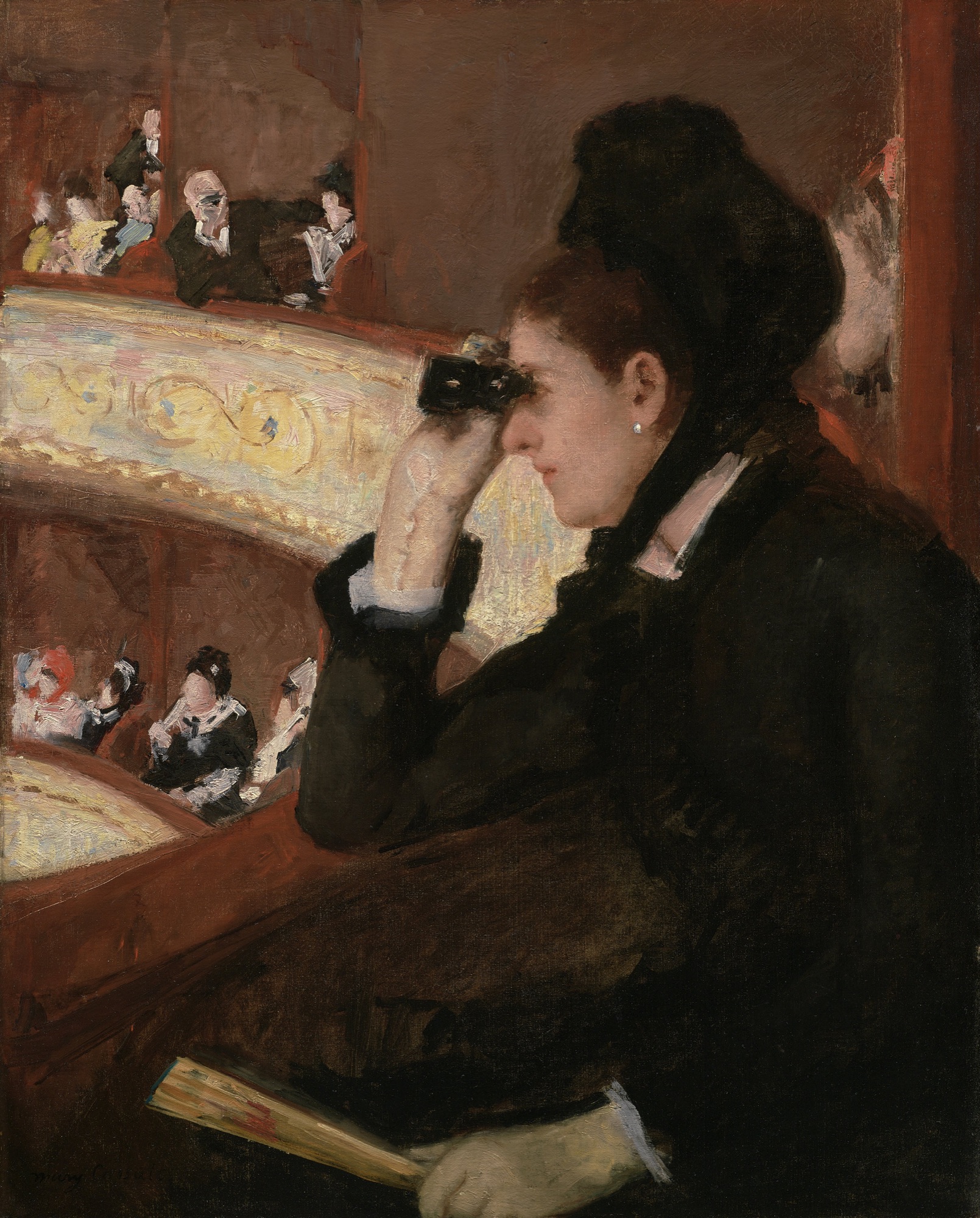
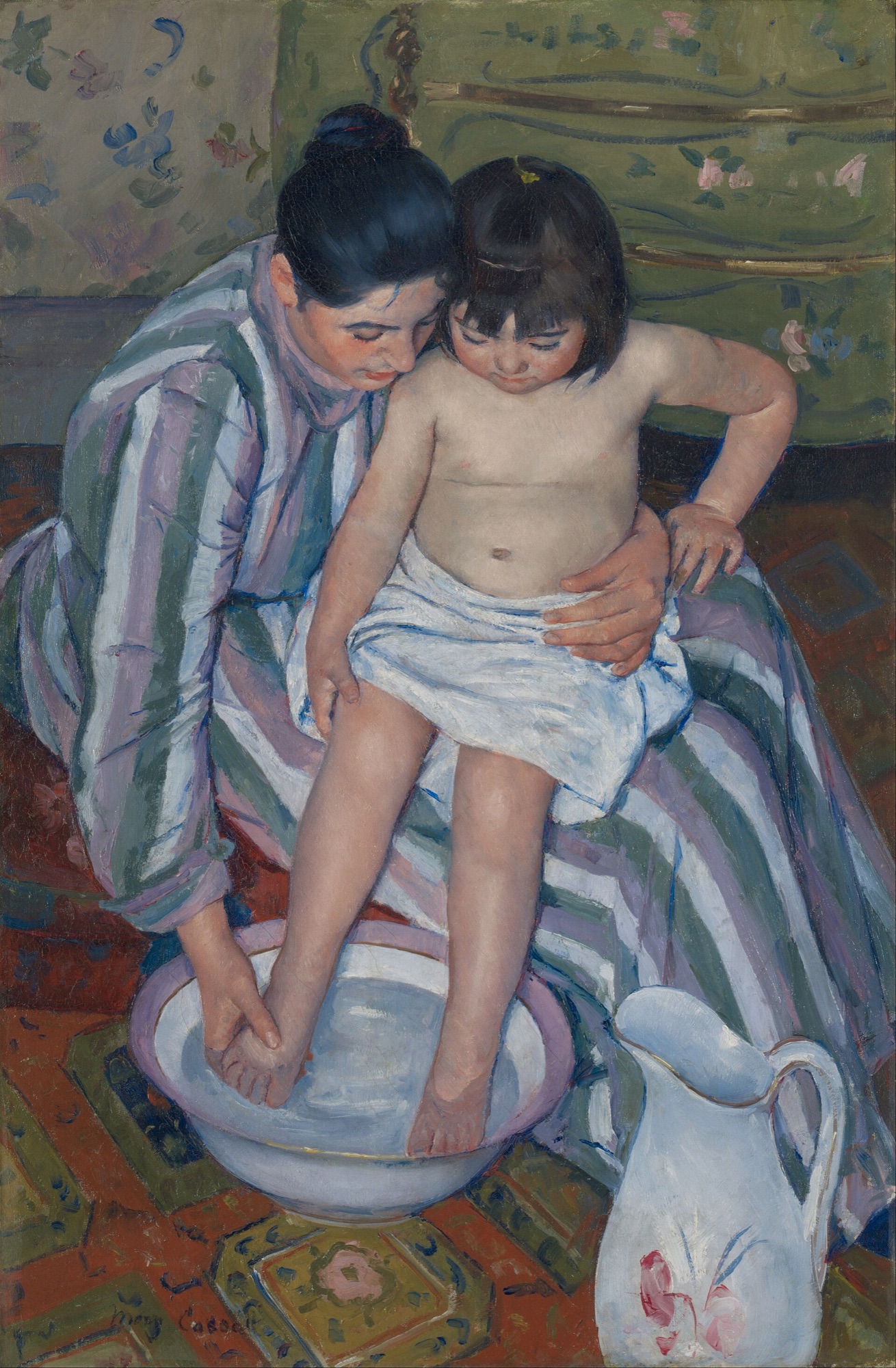
- Introductory works: In the Loge (1878); The Child’s Bath (1893); The Letter (1890–1891). Complete compositions; career context uses the supplied Cassatt portrait.
- Male-Impressionist context: Caillebotte, Paris Street; Rainy Day (1877); Degas, Dancers Backstage (1876–1883); Renoir, La Loge (1874). Whole compositions, with museum credits; the Renoir slide pairs Cassatt’s In the Loge.
- Whole comparison images: Morisot, Woman and Child on the Balcony; Monet, Garden of the Princess, Louvre.
- The classroom deck uses the approved shorter Pollock selections, with the named reference paintings beside their passages. Complete source paragraphs and the optional continuation are reproduced in Teaching reference below for context. No additional preparatory reading is assigned.
- Cassatt examples from Pollock’s self-critique: Lydia at a Tapestry Frame and Lydia Crocheting in the Garden at Marly.
- Optional continuation image: Little Girl in a Blue Armchair.
- Optional reference: Veblen source and question card; six numbered readings and follow-along reading sheet. These are not additional assigned work.
- The complete Tea remains the starting and returning image. The Coiffure and the longer criticism remain optional references below.
Tasks
November 17 · P6 · Gender, space and looking
Begin with the introduction to Cassatt’s training, Paris career, subjects and artistic experiments, illustrated by the portrait and three works. Then compare Caillebotte’s street, Degas’s backstage and Renoir’s theatre box beside Cassatt’s In the Loge before returning to The Tea and the main inquiry below.
How can a painting make social limits visible, and what can it tell us about the people within them?
- Begin each cycle with its main question. Read the Pollock selection in the study deck, using the reference painting shown beside a named example. Identify the relevant words for each reading check and explain the answer in your own words.
- For access and subject matter, consider How might the places women artists could enter affect what they painted? Use the p.56 passage and the whole Tea to connect a represented setting with Pollock’s account of places and activities.
- For viewpoint, consider How do Morisot and Monet give us different relationships to the people and city? Use the p.62 comparison, examine both complete paintings and explain how a detail produces closeness, distance or another effect. Ask a partner for the detail and how it supports their answer; swap roles.
- For interpretation, consider How convincing is the interpretation that compressed space represents women’s confinement? Use the p.63 reading checks to distinguish Pollock’s earlier explanation from her criticism of it. Test a claim against the Lydia works and Tea, hear supporting or challenging evidence and return to the main question.
- Answer What can we now argue about The Tea? Develop or revisit one claim, two visual details with their effects, and one limit. This remains the existing ungraded response; no new response is due.
Carry this question into Child/Rosler: What changes when someone demonstrates an everyday object to an audience? The longer reading bank remains available without additional homework.
Assessment and homework
Ungraded class work. Use the existing response to check the evidence and reasoning; no additional submission is required.
Description
Use three sustained passages from Griselda Pollock’s “Modernity and the Spaces of Femininity” to develop a feminist reading of space. Move from access to places, through the different positions of looking in Morisot and Monet, to Pollock’s reconsideration of compression and confinement. Each question leads into a complete passage, a visual test and a follow-up before returning to the claim. Apply the reasoning to Cassatt’s The Tea, keeping the women’s wishes distinct from what the picture can establish.
Teaching reference
Cassatt: career and selected works
The portrait and three works introduce the artist before the Pollock inquiry. They place The Tea within a professional career and a varied practice.
An American artist in Paris
Mary Cassatt (1844–1926) was an American painter and printmaker. She studied at the Pennsylvania Academy of the Fine Arts before continuing her training in Europe.
She settled in Paris in 1874. Degas invited her to exhibit with the Impressionists in 1877; she first showed with them in 1879.
She built a professional career within a society that offered men and women unequal access to artistic training and public life.
Career context: The Metropolitan Museum of Art. Collection record.
Painting modern women
The Impressionists made contemporary life a central subject. Cassatt brought women’s experiences into this modern art.
Her subjects included theater audiences, readers, social visits and the care of children. She worked in oils, pastels and prints.
Her care scenes give everyday actions sustained attention. Gesture, touch and the relationship between bodies make these subjects psychologically compelling.
Experimenting with form
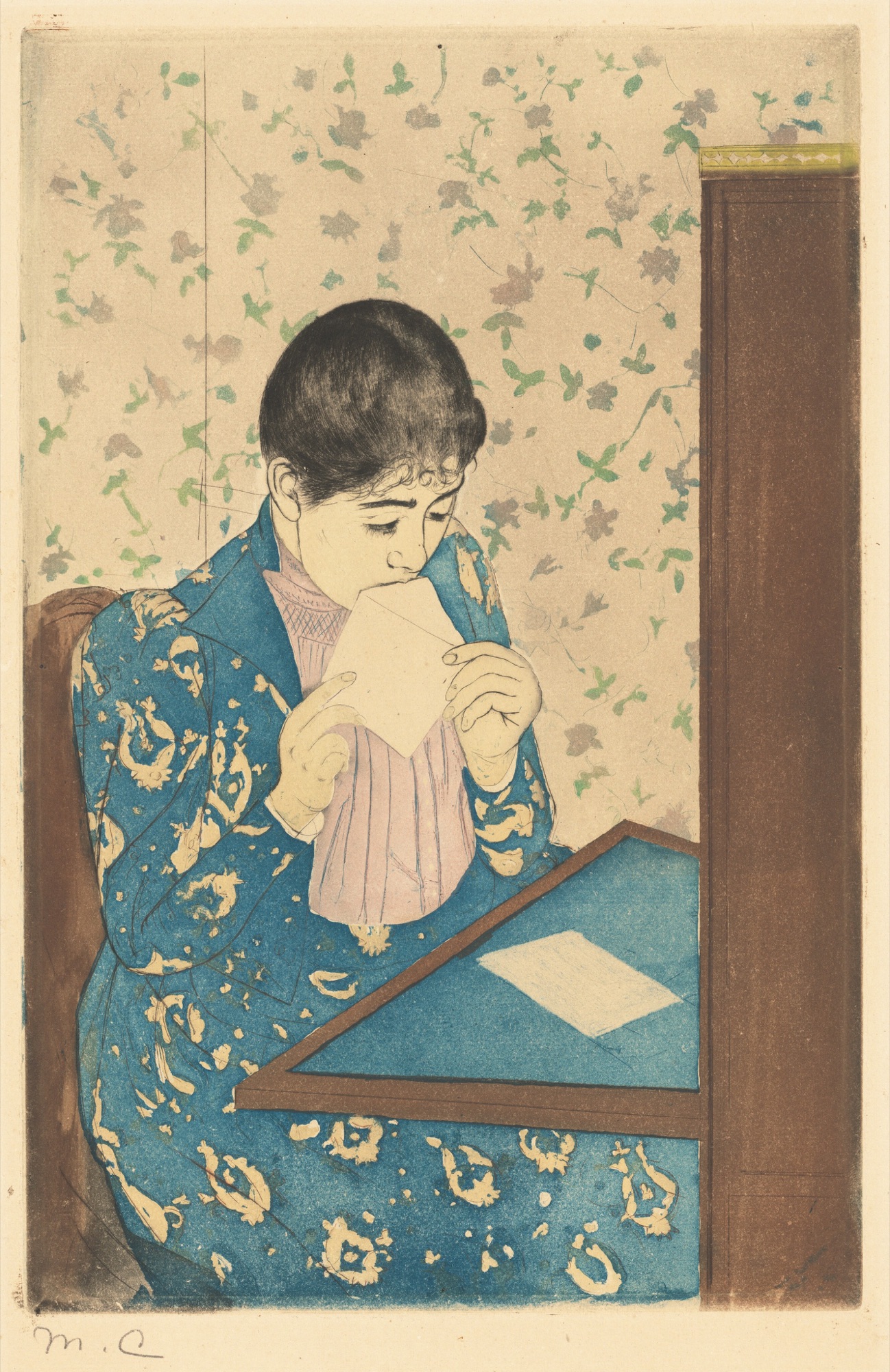
Cassatt was an experimental printmaker as well as a painter. Close framing, unusual viewpoints and broad areas of color shaped her modern style.
A Paris exhibition of Japanese prints in 1890 helped inspire her color prints of 1890–1891.
In The Letter, repeated pattern and an angled desk bring surface design and depth together. Familiar subjects became a means of formal invention.
These examples introduce Cassatt’s professional background, attention to everyday life and formal invention. Return to the full Tea to test a claim through the Pollock passages below.
Male Impressionists: comparative context
These works share the Impressionists’ interest in modern life. They introduce differences in available encounters, social position and the relationship between a picture and its viewer.
The modern city as a subject
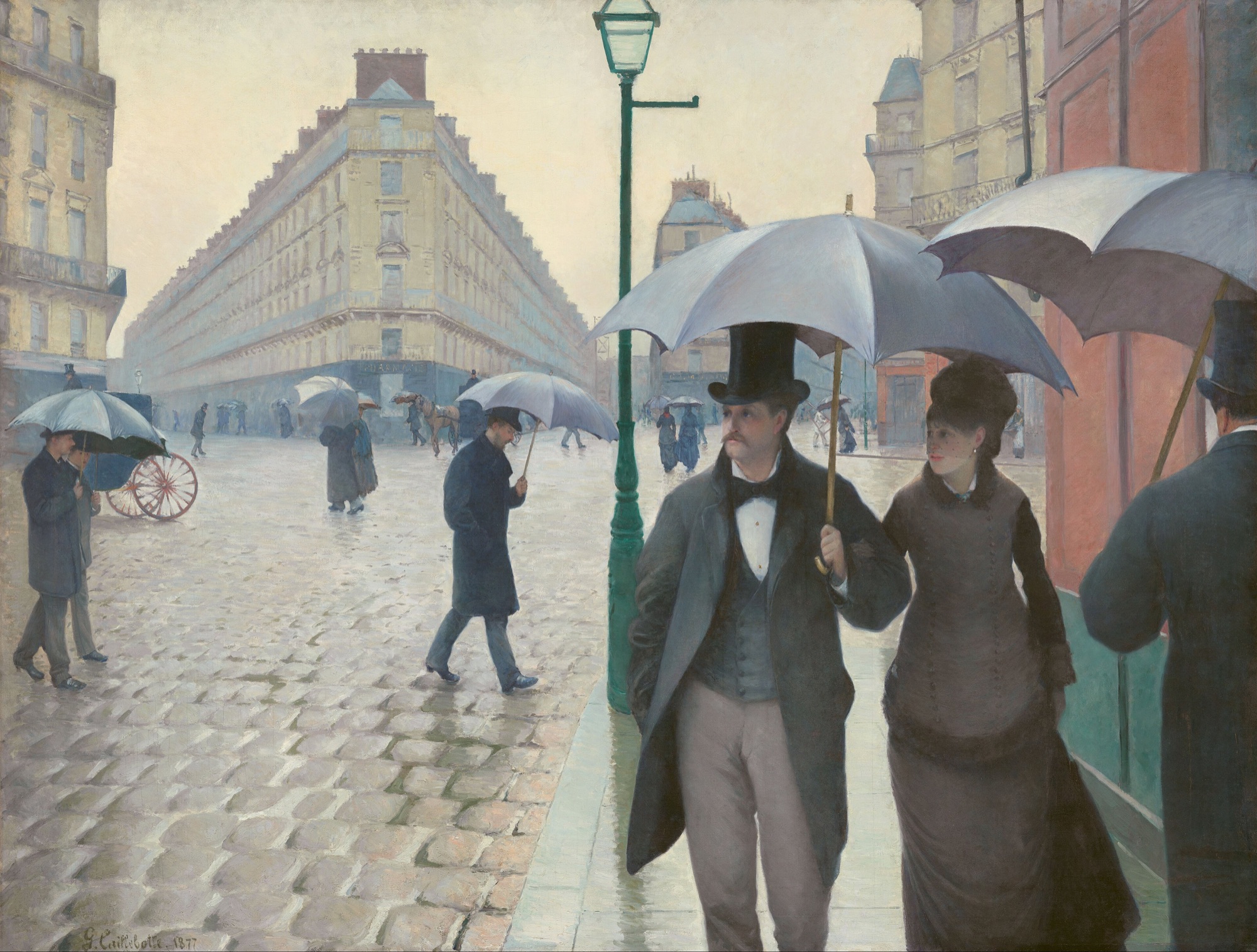
Gustave Caillebotte, Paris Street; Rainy Day, 1877. Art Institute of Chicago, Charles H. and Mary F. S. Worcester Collection. Public domain.
Caillebotte places us among strangers moving through a rebuilt Paris street. The broad intersection and receding buildings open a view into public urban life.
Cassatt’s The Tea brings us close to a domestic social visit. Both are modern subjects, shaped by different encounters and positions of looking.
Backstage: work and unequal access
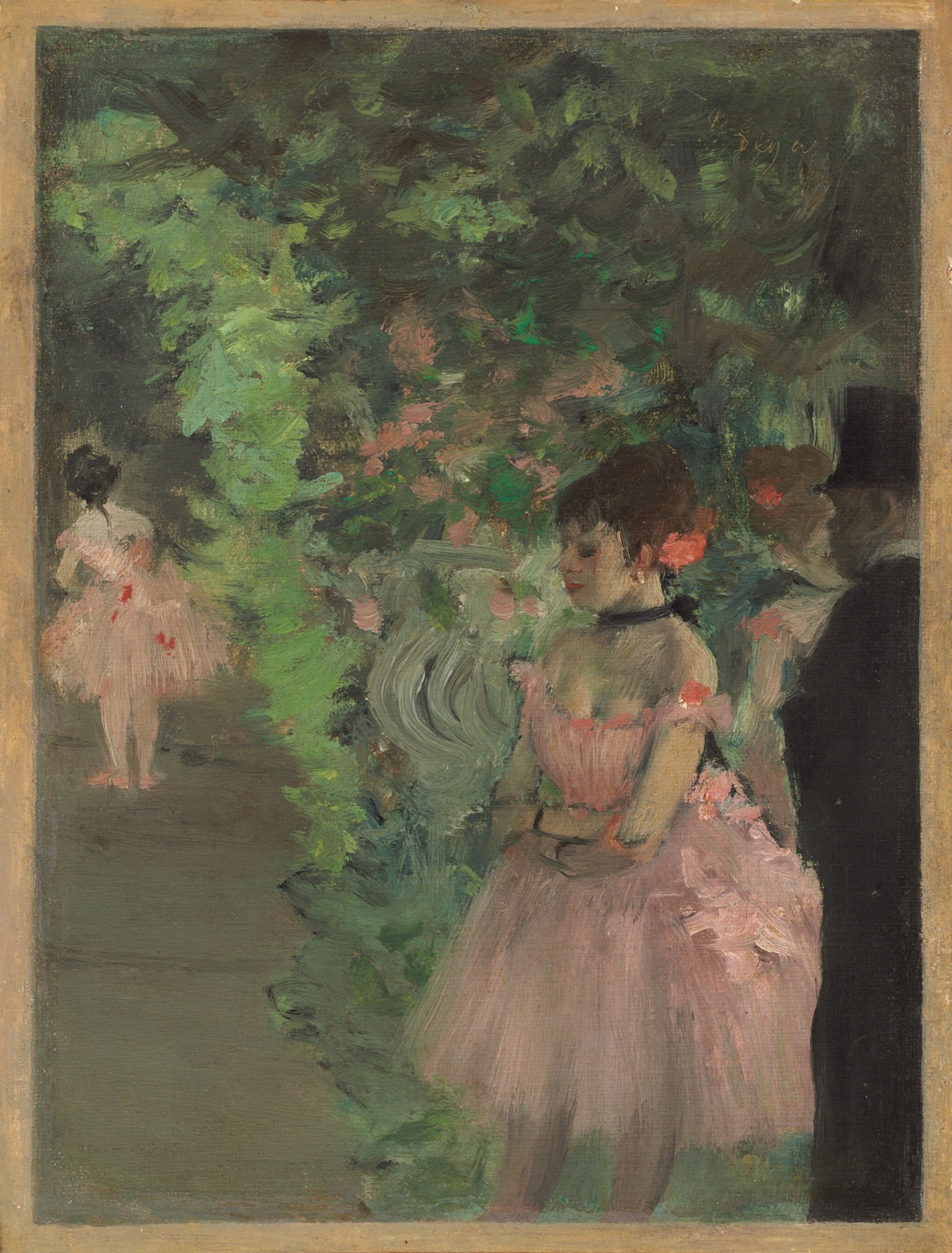
Edgar Degas, Dancers Backstage, 1876–1883. National Gallery of Art, Washington, Ailsa Mellon Bruce Collection, 1970.17.25. Public domain.
Degas shows dancers at work and a man in evening dress backstage. Wealthy male subscribers to the Paris Opéra had privileged access to this space.
Women were present in modern public life, but a working dancer and a bourgeois woman visiting the theatre occupied very different social positions.
Looking and being looked at
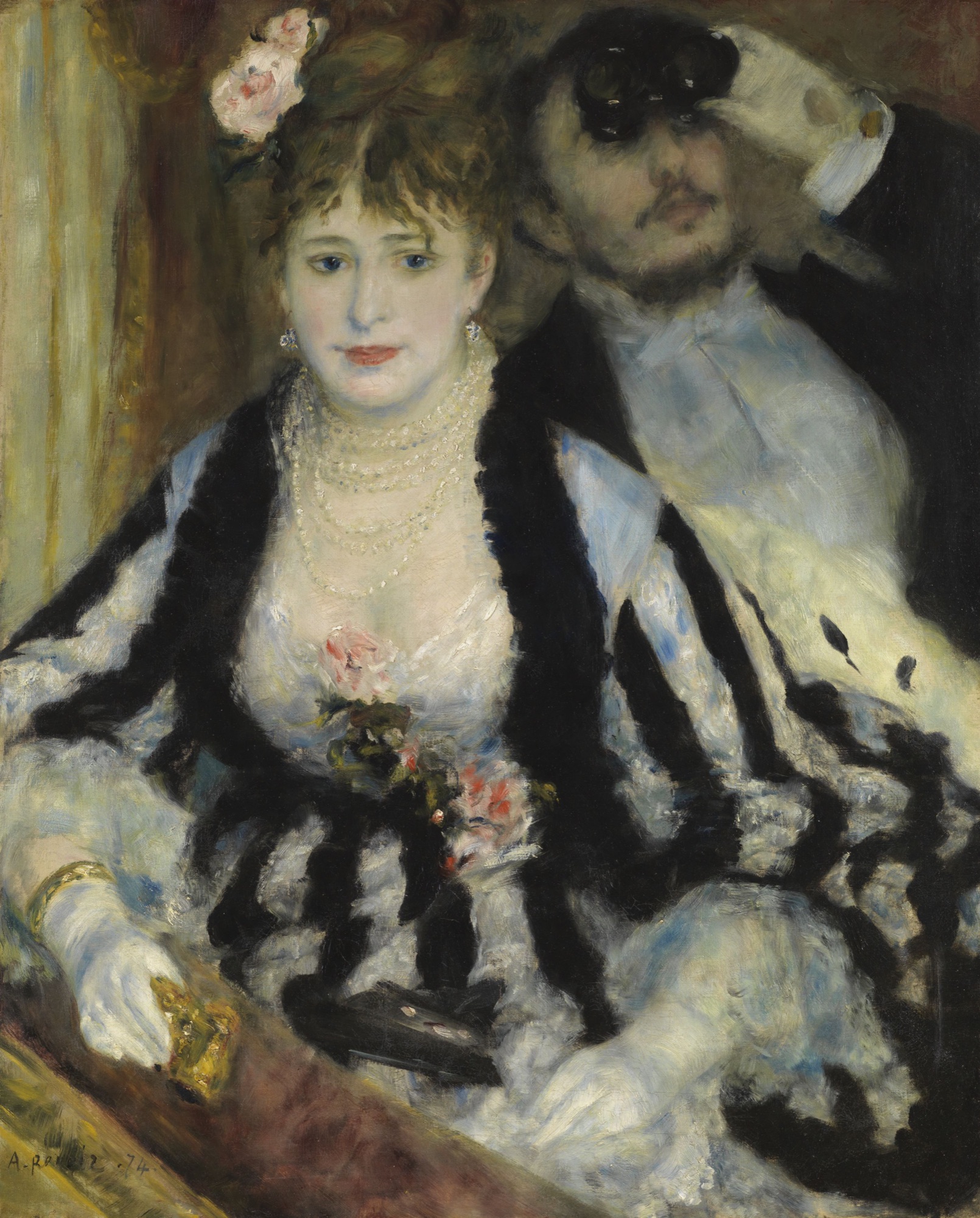
Renoir, La Loge (1874), beside Cassatt, In the Loge (1878).
In Renoir, the man scans the audience while the woman holds her opera glasses lowered. Her dress and frontal pose make her highly visible.
Cassatt makes the woman’s own act of looking central. A man in the distance also watches her.
The same public setting can give women different roles within the picture.
Collection record 1. Collection record 2.
Pollock develops these distinctions in her discussion of public modernity and the social position of looking, printed pp. 74–76. The examples establish context for the sustained reading cycles below. The museum records supply current titles and dates; the essay quotations retain their original wording.
Full readings: Gender, space and looking
The following complete paragraph units come from the supplied Vision and Difference chapter. British spelling and source punctuation are retained. Line-break hyphenation is rejoined, superscript note references retained, and no editorial ellipses inserted. The current classroom master uses the approved shorter selections with marked omissions and shows each named reference painting beside the relevant passage. The full paragraphs below preserve the source context for reference.
Reading I: Access and subject matter
Question: How might the places women artists could enter affect what they painted?
Starting point: What is one place you need permission to enter?
Source quotation: Griselda Pollock, “Modernity and the Spaces of Femininity,” printed p. 56
This is my project here. How do the socially contrived orders of sexual difference structure the lives of Mary Cassatt and Berthe Morisot? How did that structure what they produced? The matrix I shall consider here is that of space.
Space can be grasped in several dimensions. The first refers us to spaces as locations. What spaces are represented in the paintings made by Berthe Morisot and Mary Cassatt? And what are not? A quick list includes:
dining-rooms
drawing-rooms
bedrooms
balconies/verandas
private gardens (See Figures 3.4–3.11.)The majority of these have to be recognized as examples of private areas or domestic space. But there are paintings located in the public domain, scenes for instance of promenading, driving in the park, being at the theatre, boating. They are the spaces of bourgeois recreation, display and those social rituals which constituted polite society, or Society, Le Monde. In the case of Mary Cassatt’s work, spaces of labour are included, especially those involving child care (Figure 3.10). In several examples, they make visible aspects of working-class women’s labour within the bourgeois home.
Griselda Pollock, “Modernity and the Spaces of Femininity,” Vision and Difference (1988), printed p.56.
Reading checks:
- Which examples show women spending time outside the home?
- Which activities involve leisure, and which involve work?
Text evidence: Which part of the passage supports your answer? Can you explain it in your own words?
Visual example: The Tea
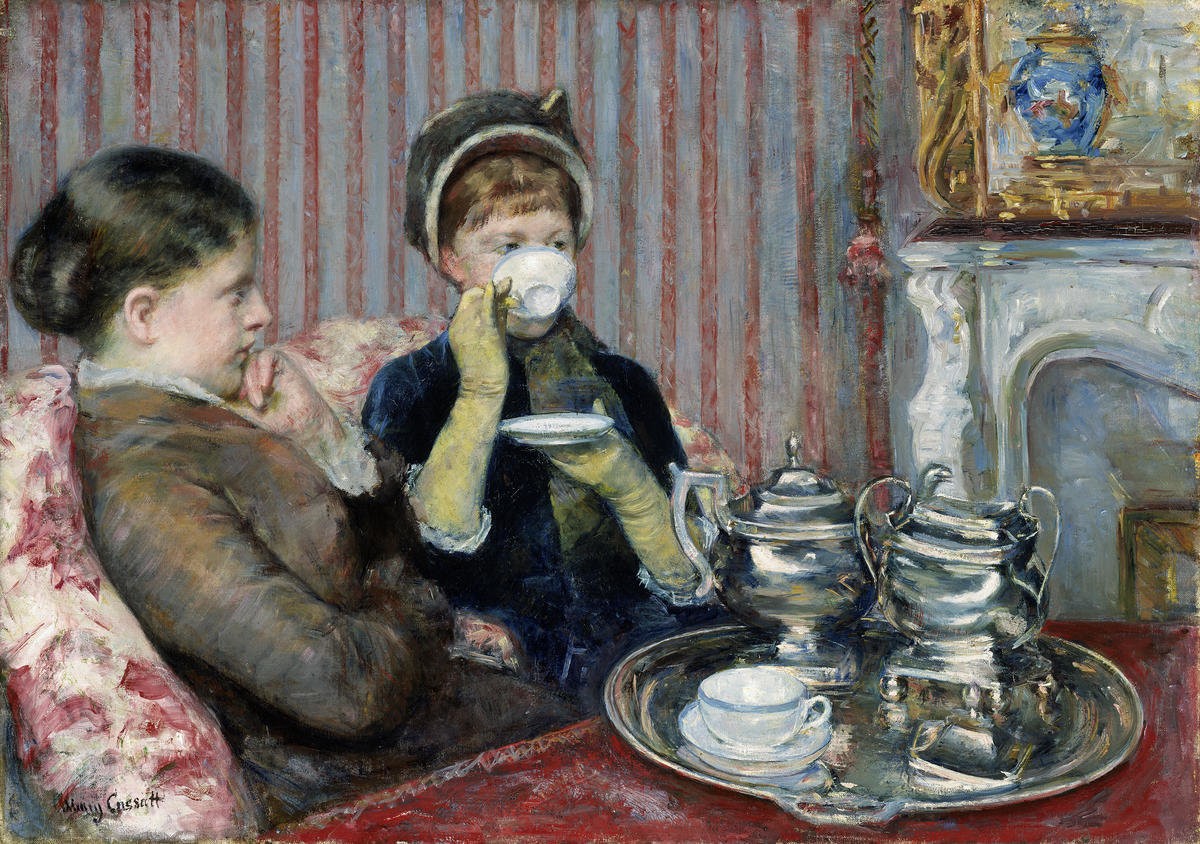
Examine the complete Tea. Distinguish the visible social ritual from what historical evidence might establish about the women’s opportunities. A domestic setting does not by itself establish their wishes.
Follow-up: Which details in The Tea connect it with her account?
Return: How might the places women artists could enter affect what they painted? Which detail makes you think that? How does it support your answer?
Reading II: Pictorial space and the viewer
Question: How do Morisot and Monet give us different relationships to the people and city?
Source quotation: Griselda Pollock, “Modernity and the Spaces of Femininity,” printed p. 62
A remarkable feature in the spatial arrangements in paintings by Morisot is the juxtaposition on a single canvas of two spatial systems – or at least of two compartments of space often obviously boundaried by some device such as a balustrade, balcony, veranda or embankment whose presence is underscored by facture. In The harbour at Lorient, 1869 (Figure 3.12), Morisot offers us at the left a landscape view down the estuary represented in traditional perspective while in one corner, shaped by the boundary of the embankment, the main figure is seated at an oblique angle to the view and to the viewer. A comparable composition occurs in On the terrace, 1874 (Figure 3.13), where again the foreground figure is literally squeezed off-centre and compressed within a box of space marked by a heavily brushed-in band of dark paint forming the wall of the balcony on the other side of which lies the outside world of the beach. In On the balcony, 1872 (Figure 3.14), the viewer’s gaze over Paris is obstructed by the figures who are none the less separated from that Paris as they look over the balustrade from the Trocadéro, very near to her home.¹² The point can be underlined by contrasting the painting by Monet, The garden of the princess, 1867 (Figure 3.15), where the viewer cannot readily imagine the point from which the painting has been made, namely a window high in one of the new apartment buildings, and instead enjoys a fantasy of floating over the scene.
What Morisot’s balustrades demarcate is not the boundary between public and private but between the spaces of masculinity and of femininity inscribed at the level of both what spaces are open to men and women and what relation a man or woman has to that space and its occupants.
Griselda Pollock, “Modernity and the Spaces of Femininity,” Vision and Difference (1988), printed p.62.
Reading checks:
- What does Pollock say interrupts our view of Paris in Morisot?
- How does she describe the viewer’s experience in Monet?
Text evidence: Which part of the passage supports your answer? Can you explain it in your own words?
Visual examples: Morisot and Monet
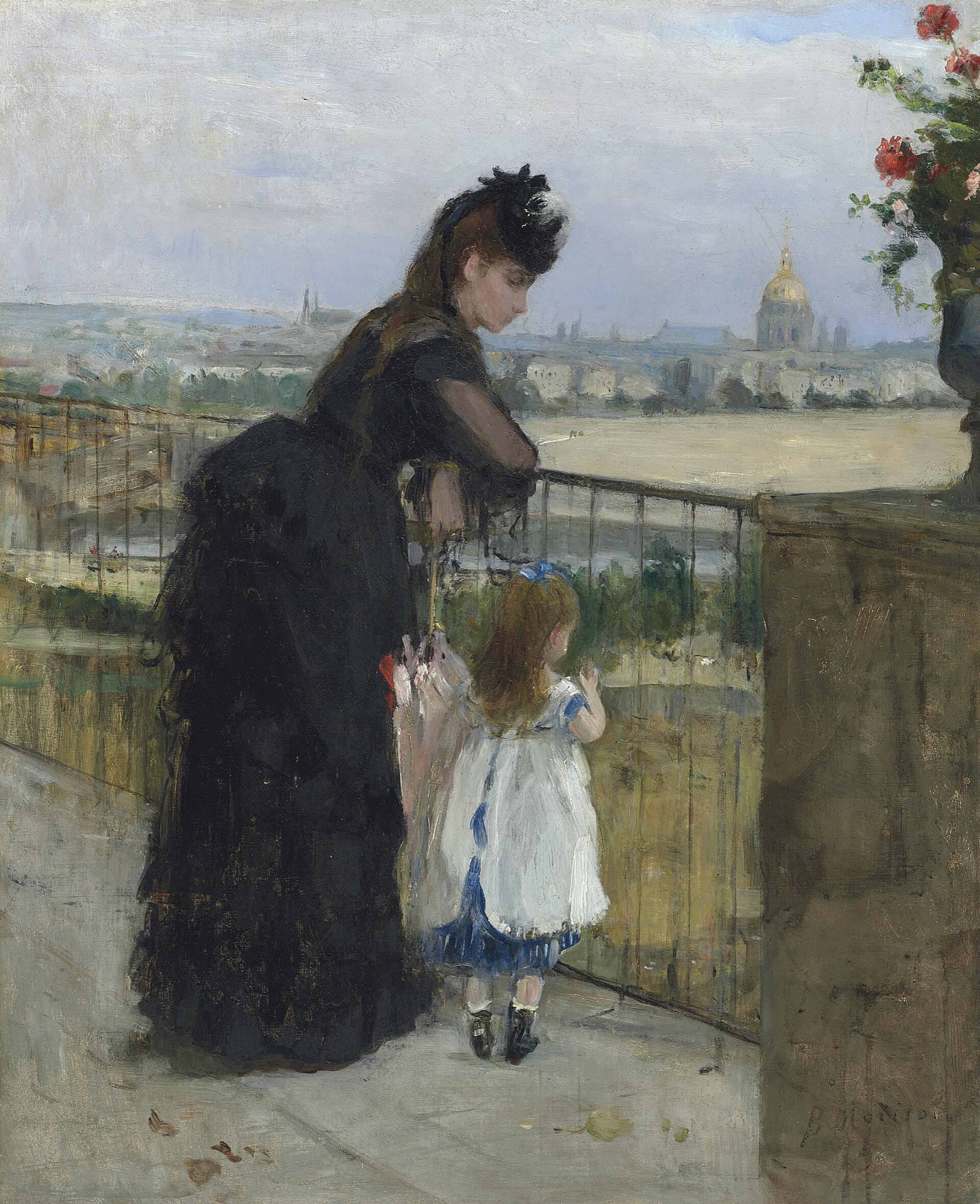
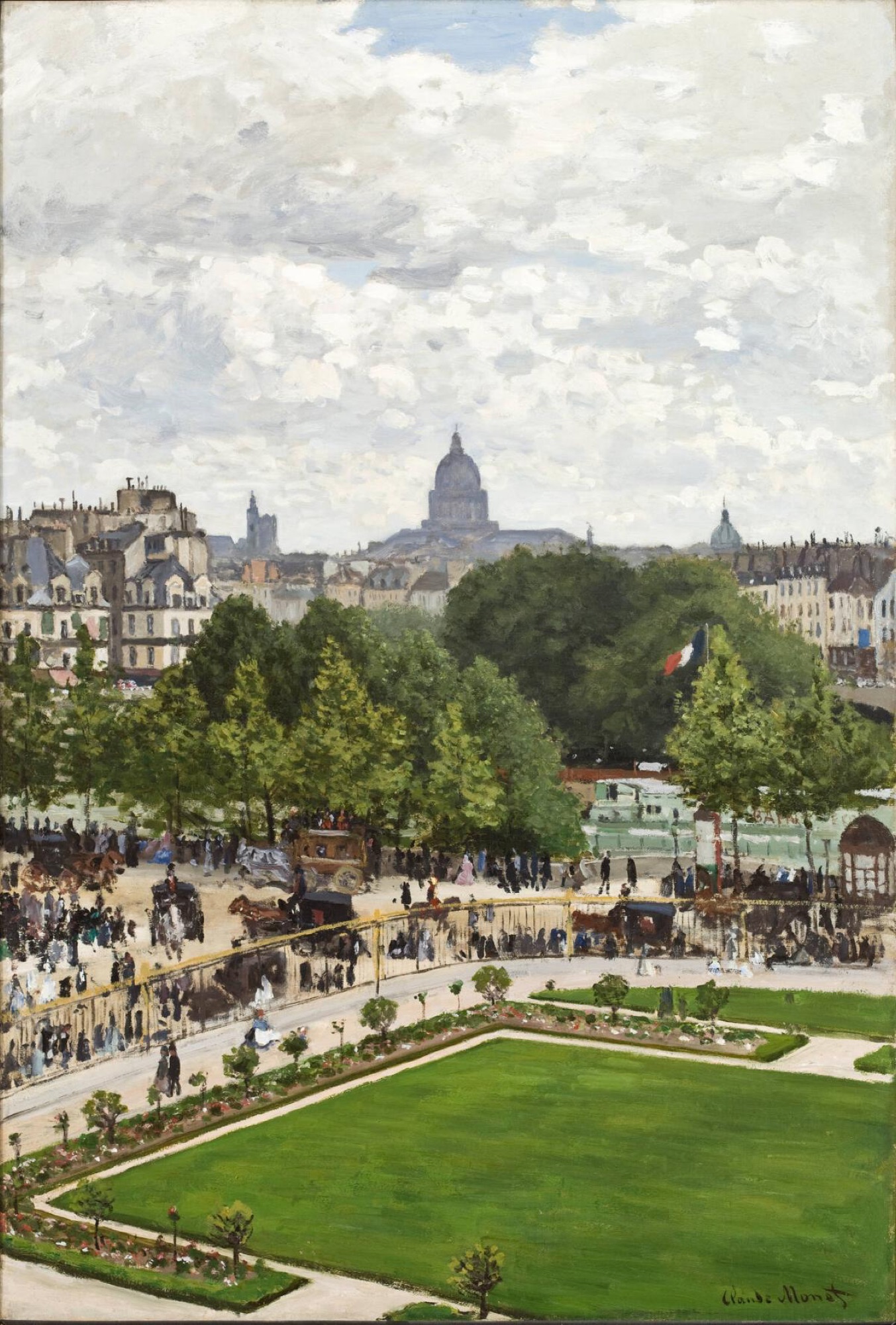
Compare the complete Woman and Child on the Balcony and Garden of the Princess, Louvre. The Artizon and Allen records identify the works. The Allen record documents Monet’s Louvre windows and special permission in April 1867, correcting the apartment-window setting in Pollock’s words above. Actual access and the pictorial effect of an unmarked viewpoint are different questions.
Follow-up: How close do the people seem in each painting? Which details create that difference? What does each viewpoint allow us to notice?
Return: How do Morisot and Monet give us different relationships to the people and city? Which detail makes you think that? How does it support your answer?
Reading III: Compression and confinement
Question: How convincing is the interpretation that compressed space represents women’s confinement?
Source quotation: Griselda Pollock, “Modernity and the Spaces of Femininity,” printed p. 63
In a previous monograph on Mary Cassatt I tried to establish a correspondence between the social space of the represented and the pictorial space of the representation.¹³ Considering the painting Lydia, at a tapestry frame, 1881 (Figure 3.8), I noted the shallow space of the painting which seemed inadequate to contain the embroidery frame at which the artist’s sister works. I tried to explain its threatened protrusion beyond the picture’s space into that of the viewer as a comment on the containment of women and read the painting as a statement of resistance to it. In Lydia crocheting in the garden, 1880 (Figure 3.9), the woman is not placed in an interior but in a garden. Yet this outdoor space seems to collapse towards the picture plane, again creating a sense of compression. The comfortable vista beyond the figure, opening out to include a view and the sky beyond as in Caillebotte’s Garden at Petit Gennevilliers with dahlias, 1893, is decisively refused.
I argued that despite the exterior setting the painting creates the intimacy of an interior and registers the garden, a favoured topic with impressionist artists, not as a piece of private property but as the place of seclusion and enclosure. I was searching for some kind of homology between the compression of pictorial space and the social confinement of women within the prescribed limits of bourgeois codes of femininity. Claustrophobia and restraint were read into the pressurized placement of figures in shallow depth. But such an argument is only a modified form of reflection theory which does not explain anything (though it does have the saving grace of acknowledging the role of signifiers in the active production of meaning).
Griselda Pollock, “Modernity and the Spaces of Femininity,” Vision and Difference (1988), printed p.63.
Reading checks:
- What connection did Pollock make between shallow space and women’s lives?
- Is she now questioning whether women faced restrictions, or how she explained the paintings?
Text evidence: Which part of the passage supports your answer? Can you explain it in your own words?
Visual examples: The two Lydia paintings
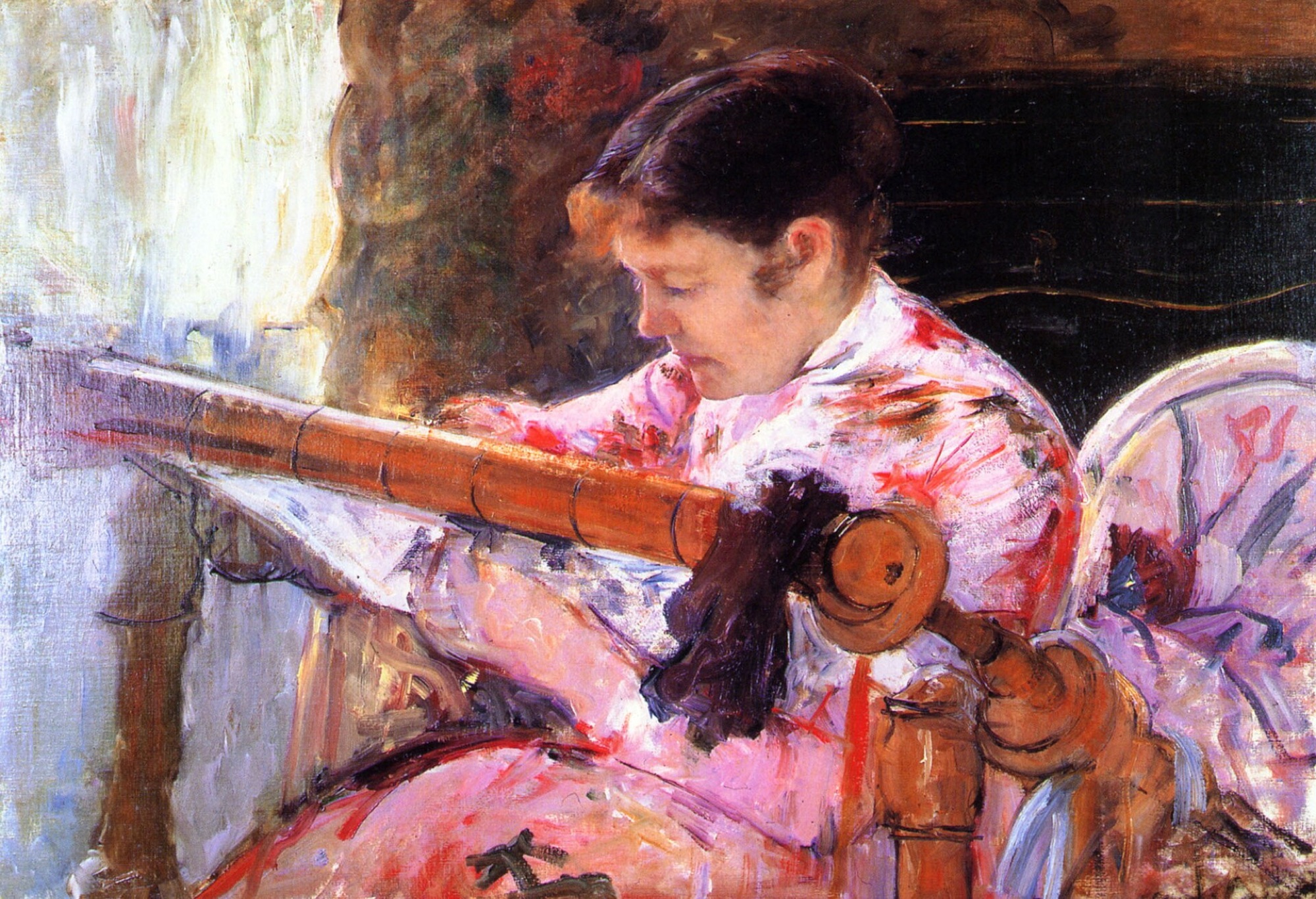
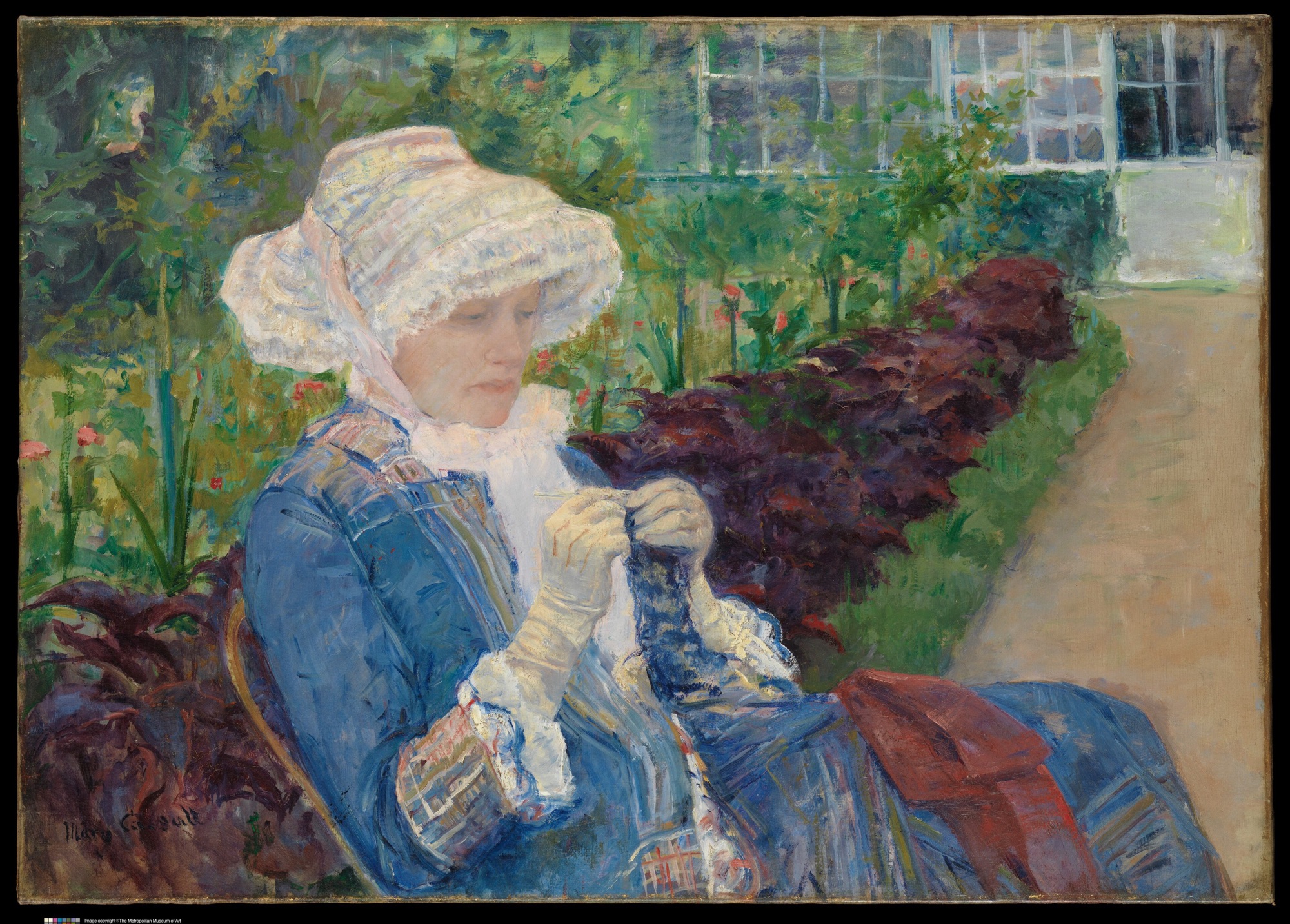
Examine the complete Lydia at a Tapestry Frame and Lydia Crocheting in the Garden at Marly, then return to The Tea. The first two are Pollock’s direct examples. The application to The Tea is ours: explain how the service, red surfaces and partly hidden face construct our access without assuming the sitters’ feelings.
Follow-up: Which details in The Tea support or challenge a confinement reading?
Return: How convincing is the interpretation that compressed space represents women’s confinement? Which detail makes you think that? How does it support your answer?
Further full reading: Lived space and looking
This complete pp.65–66 continuation develops Pollock’s revised account after the self-critique. It is an optional reference, rather than another required activity in the 45-minute core.
Source quotation: Griselda Pollock, “Modernity and the Spaces of Femininity,” printed pp. 65–66
It is possible to represent space by other conventions. Phenomenology has been usefully applied to the apparent spatial deviations of the work of Van Gogh and Cézanne.¹⁴ Instead of pictorial space functioning as a notional box into which objects are placed in a rational and abstract relationship, space is represented according to the way it is experienced by a combination of touch, texture, as well as sight. Thus objects are patterned according to subjective hierarchies of value for the producer. Phenomenological space is not orchestrated for sight alone but by means of visual cues refers to other sensations and relations of bodies and objects in a lived world. As experiential space this kind of representation becomes susceptible to different ideological, historical as well as purely contingent, subjective inflections.
These are not necessarily unconscious. For instance in Young girl in a blue armchair, 1878 (Figure 3.17) by Cassatt, the viewpoint from which the room has been painted is low so that the chairs loom large as if imagined from the perspective of a small person placed amongst massive upholstered obstacles. The background zooms sharply away indicating a different sense of distance from that a taller adult would enjoy over the objects to an easily accessible back wall. The painting therefore not only pictures a small child in a room but evokes that child’s sense of the space of the room. It is from this conception of the possibilities of spatial structure that I can now discern a way through my earlier problem in attempting to relate space and social processes. For a third approach lies in considering not only the spaces represented, or the spaces of the representation, but the social spaces from which the representation is made and its reciprocal positionalities. The producer is herself shaped within a spatially orchestrated social structure which is lived at both psychic and social levels. The space of the look at the point of production will to some extent determine the viewing position of the spectator at the point of consumption. This point of view is neither abstract nor exclusively personal, but ideologically and historically construed. It is the art historian’s job to re-create it – since it cannot ensure its recognition outside its historical moment.
The spaces of femininity operated not only at the level of what is represented, the drawing-room or sewing-room. The spaces of femininity are those from which femininity is lived as a positionality in discourse and social practice. They are the product of a lived sense of social locatedness, mobility and visibility, in the social relations of seeing and being seen. Shaped within the sexual politics of looking they demarcate a particular social organization of the gaze which itself works back to secure a particular social ordering of sexual difference. Femininity is both the condition and the effect.
Visual example: Lived space
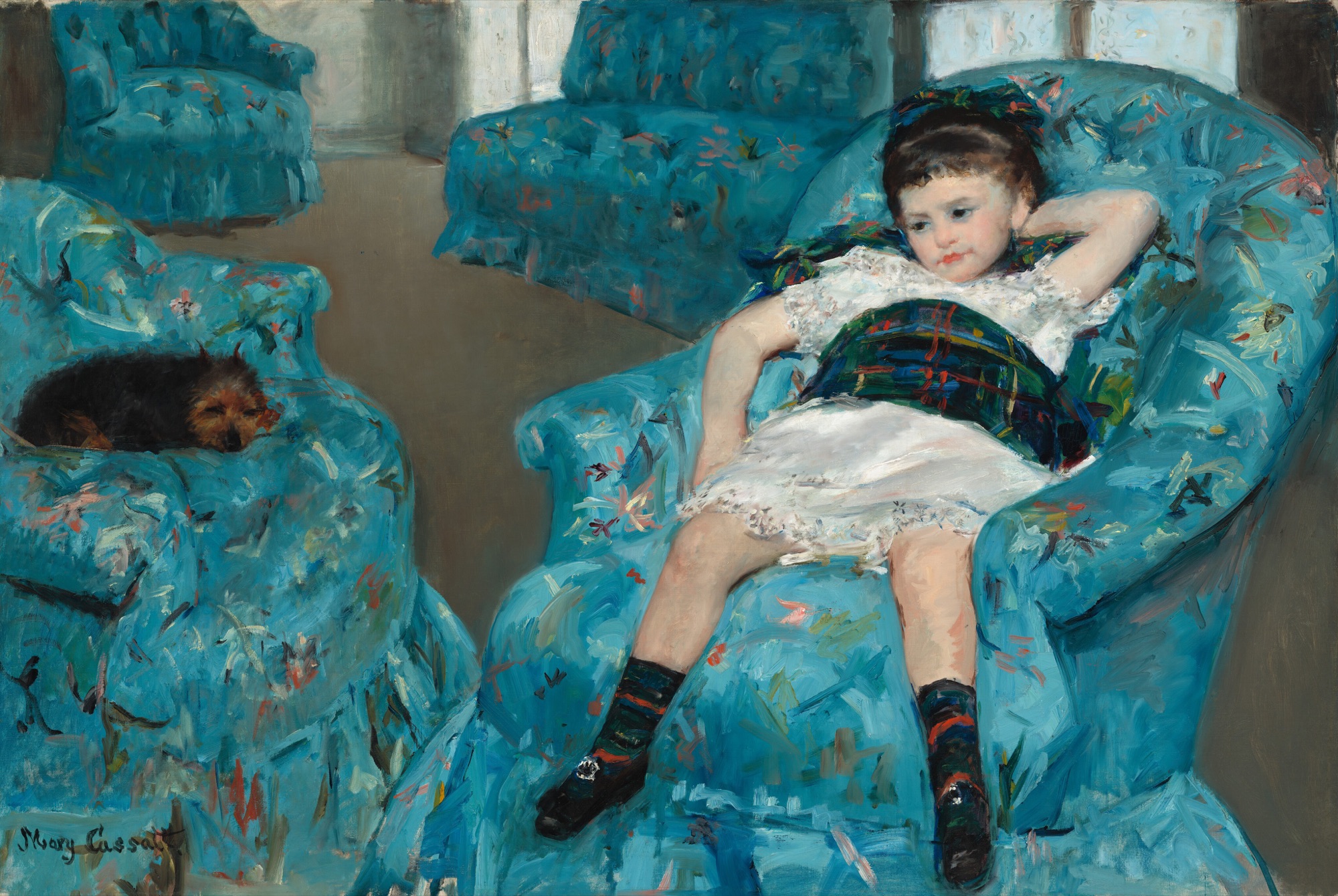
Griselda Pollock, “Modernity and the Spaces of Femininity,” Vision and Difference (1988), printed pp.65–66. In her direct example, the low viewpoint in Little Girl in a Blue Armchair makes the furniture loom and evokes a child’s experience. Her argument connects lived pictorial space with the historically formed positions of making and looking.
Morisot and Monet: the viewer within a social space
Griselda Pollock’s “Modernity and the Spaces of Femininity”, in Vision and Difference (1988), asks how social position shapes both subject matter and pictorial choices. In the full chapter, p.55 connects what artists could paint with how they painted. The distinctions below are a teaching paraphrase of pp.56 and 62–66.
Location concerns represented places and the conditions under which people could enter them. Gender and class shaped those conditions in modern Paris. Pictorial space concerns the organization of depth, scale, overlap and boundaries within the image. Position of looking concerns the relationship the picture offers its viewer: where we seem to stand, whom we can approach and what remains beyond our access. These questions connect but need different evidence.
Morisot: Woman and Child on the Balcony
Berthe Morisot, Woman and Child on the Balcony, 1872, oil on canvas, Artizon Museum, Ishibashi Foundation. The museum record locates the setting at Morisot’s home on Rue Benjamin Franklin. The foreground woman and child look across Paris. Their relatively large bodies, the railing and the planter make the place from which they look part of what we see.
We seem to share the balcony rather than survey the city from a position detached from nearby people. The railing permits a view and marks a boundary. The figures interrupt the panorama and direct attention outward. This can support a reading of socially situated access, company or protection as well as restriction. The image does not establish whether either person wanted to leave. Its formal invention includes the relation between a close foreground and a distant city, rather than simply an inability to paint the street.
Monet: Garden of the Princess, Louvre
Claude Monet, Garden of the Princess, Louvre, 1867, oil on canvas, Allen Memorial Art Museum, Oberlin College, R. T. Miller Jr. Fund, 1948.296. The museum record documents painting from the Louvre’s windows after Monet requested special authorization in April 1867. The viewpoint therefore depended on particular access. Pollock’s p.62 description of an apartment window should be corrected when teaching the setting.
The elevated composition offers a view across garden, street and city. People below become small marks within the larger arrangement. No nearby observer or window frame strongly locates us alongside an identifiable person. The effect can be a sweeping overview in which our own position is less conspicuous. That pictorial effect does not prove unlimited mobility or unrestricted access for Monet. Both paintings can be read as privileged views, while offering different relationships between the viewer, nearby people and the city.
What Pollock changes in the argument
On p.63 Pollock reconsiders her earlier connection between compressed pictorial space and women’s restricted social lives. A simple correspondence risks treating the painting as a passive reflection of conditions. Her discussion moves toward lived space and the socially positioned act of looking. A feminist interpretation therefore asks what an image does with a position, as well as what opportunities were limited.
Return to Cassatt with this distinction. The large service may obstruct our approach and lead our eye inward. The cup conceals part of a face while depicting an ordinary action. Red surfaces can press forward across a room that still has depth. These choices support an argument about our relationship to the women; their feelings and freedom require further evidence. This is our application of Pollock’s framework to The Tea, which she reproduces as fig.3.6, rather than a claim that she gives this exact analysis of it. Her later discussion, especially pp.81–87, also cautions against defining women’s practice only through lack or a natural feminine style.
A feminist reading of The Tea
A feminist reading examines how gender shapes power, opportunity, representation and the position of the viewer. Here it connects the social expectations placed on bourgeois women with Cassatt’s arrangement of the room. Pictorial space means the depth and spatial relationships constructed within an image. Compression makes that space appear shallow or crowded. These are relationships to explain through composition and visual evidence.
The table and silver service occupy much of the foreground. Furniture and repeated pattern fill the space around the figures, while the guest’s cup hides part of her face. A reading of restriction and isolation can connect those choices to the limited opportunities associated with respectable femininity. This does not establish that these two women were literally forced to remain in this room, that they feel isolated, or that Cassatt painted shallow space for one provable reason. Social restriction and the specific women’s inner lives are different claims.
The museum: figures, objects and modernity
Despite these conservative and tasteful surroundings, Cassatt’s painting is a declaration of modernity that demonstrates her rejection of several traditional artistic conventions. First, Cassatt denies the human form its usual compositional primacy: the tea service seems larger in scale than the women themselves. This pictorial conceit of giving inanimate objects equal priority with figures was sometimes employed by Cassatt’s friend Degas. Cassatt further defies custom by obscuring the face of her subject, rendering the guest in the transitory act of drinking… Cassatt reiterates her modernist creed that her painting is not only about representing likeness, but also about design and color…
Museum of Fine Arts, Boston, The Tea, collection interpretation, excerpt supplied in class materials. The museum’s account of modernist design can work alongside a feminist interpretation. It does not itself prove that the women experience their surroundings as oppressive.
Pollock: space and the position of looking
Proximity and compression are also characteristic of the works of Cassatt.
Griselda Pollock, “Modernity and the Spaces of Femininity”, author-abridged reprint in The Expanding Discourse, p.251; original essay in Vision and Difference (1988).
Pollock distinguishes the places represented, the construction of pictorial space and the social position from which an image is made. Gender and class shaped access to modern Paris, though women were not all confined to the home. Her spatial analysis also asks how close, shallow arrangements and absorbed figures affect the viewer’s access. Apply this to The Tea: a covered face can frustrate our desire to read the woman, rather than simply demonstrate her lack of agency.
Broude: constraint and agency
a challenging resistance to any singular or conventional interpretation
Norma Broude, “Mary Cassatt: Modern Woman or the Cult of True Womanhood?”, Woman’s Art Journal 21.2 (2000–2001), p.40, short phrase from her account of Cassatt’s work.
Broude questions readings that reduce Cassatt’s domestic subjects to a single story of imprisonment or conventional femininity. Social restrictions matter, but company, activity and the artist’s control of representation also deserve attention. Use this as a challenge within the feminist discussion: identify what the isolation reading explains and what it leaves out.
Stemp: the table and the paused gesture
The table gets in our way, and distances us from the women, although, in an apparently contradictory way, it also bridges the gap between us and them, leading our eye into the painting.
This isn’t ‘fly on the wall’ observation, it is careful calculation.
Richard Stemp, “Day 15 – The Tea” (2020), supplied article. His close reading relates the foreground and the raised cup to our position as viewers. It helps distinguish a constructed impression of a moment from evidence of what either woman thought. Treat his imagined dialogue as an interpretation to test, not an explanation the women have given us.
Pollock and Veblen: difference and social performance
Difference, however, does not of necessity involve restriction or lack. That would be to reinscribe the patriarchal construction of woman.
Griselda Pollock, “Modernity and the Spaces of Femininity,” author-abridged reprint in The Expanding Discourse, p.261. Pollock has been challenging explanations that reduce women’s art to their gender. Reinscribe means repeat or reinforce; patriarchal describes a social order organized around men’s authority. She does not deny unequal access. Her point is that difference need not be explained as a lack. Formal choices and the position of the viewer require analysis in their own right. Ask how Cassatt organizes red surfaces and our approach to the women before judging the image as a record of deprivation. Her pictorial invention does not prove that restriction produced greater skill.
But the middle-class wife still carries on the business of vicarious leisure, for the good name of the household and its master.
Thorstein Veblen, The Theory of the Leisure Class (1899), chapter 4, “Conspicuous Consumption”. Veblen argues that visible leisure and consumption can demonstrate a household’s standing. In this part of the chapter, a husband may work while a wife’s apparent leisure serves its reputation. Vicarious means on behalf of another. Maintaining the appearance of leisure may involve demanding domestic or social duties. His historical model invites a question about respectable visiting; it does not identify the two women’s marital status, intentions or obligations.
Veblen’s account also allows an object to be useful and to display status: near the chapter’s end he uses a silver table service as an example. The service in The Tea therefore need not be declared useless for a status reading to be plausible. Its foreground scale, shine and relation to the figures make a better argument than silver alone. His broad, dated account is a critical model to test, not a universal history of every household.
Together the passages complicate a simple opposition between freedom and confinement. An apparently comfortable visit can involve social expectations, while the picture’s formal differences need not be treated as deficiencies. Neither passage supplies testimony about these women. This is an application to Cassatt, not either writer’s direct reading of The Tea.
Semiotics of the Kitchen: domestic space and labor
A domestic image can make ordinary life seem familiar while leaving much of its work outside the frame. Domestic labor is work that maintains a home and cares for the people in it. It can be paid or unpaid. Making a drink, preparing a room, cleaning, and caring for another person all take time, but a painting may show only the moment when someone receives or enjoys that work.
Mary Cassatt’s The Tea presents two women in a furnished interior, with the tea service prominent in front of them. Sociability is the activity of spending time and interacting with other people. The picture allows us to consider the value of this company and the expectations attached to it. Clothing, posture, objects, and the organization of the room are evidence to examine. They do not tell us everything about what the women think or who prepared the tea.
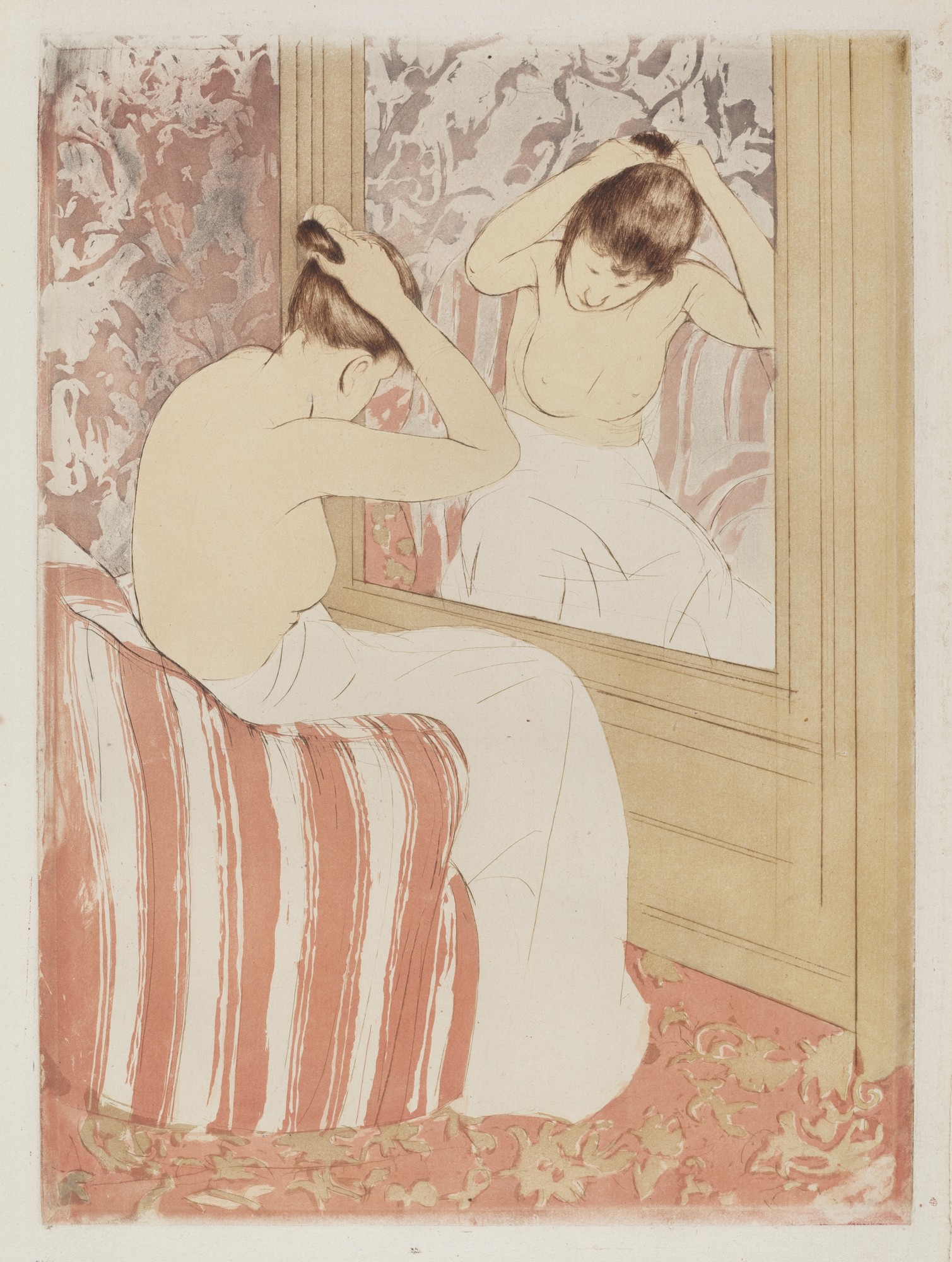
Cassatt’s The Coiffure brings us closer to a private action: a woman arranging her hair. Her arms, the mirror, and the view from behind shape our access to the scene. The supplied image reproduces a color print, not an oil painting. Comparing the two works helps us consider privacy, self-presentation, and the range of activity within domestic space. It does not establish that every woman in a domestic picture is performing the same role. National Gallery of Art, The Coiffure.
A gender role is a social expectation about how a person should behave because of their gender. It is a useful idea for these works, but the interpretation must come from the image and relevant context. A domestic setting can provide company and opportunity while also carrying expectations. One detail may support more than one reading.
Berger: the work beyond the dining room
In “The Eaters and the Eaten,” Berger describes the separation between the bourgeois dining room and the work supporting it. This passage extends the unit’s earlier comparison between food as work and food as social display.
Source quotation: John Berger, “The Eaters and the Eaten,” Selected Essays, p. 372
One door connects with his own daily life; through it he has entered in order to be served with food. The second door connects with the kitchen; through it the food is brought out and the waste is taken away. Thus, in the dining-room, food is abstracted from its own production and from the ‘real’ world of his daily activities. Behind the two doors lie secrets: secrets of recipes behind the kitchen door; professional or personal secrets, not to be discussed at table, behind the other.
Here abstracted means separated from production in the diner’s experience. The two doors offer a way to think about what a scene makes visible and what remains elsewhere. Berger is describing a social arrangement and making an argument about class. His model is not a universal description of every household or meal. Use it to look again: the image may support the model, complicate it, or leave the question unresolved.
Supplemental analysis: flattened space and possible isolation
The useful connection is between the room’s arrangement and the kind of access it gives us to the women. It takes an argument to connect that experience to gendered expectations. Flattening does not by itself prove that the women feel isolated, that they were forced into this room, or that Cassatt made a single deliberate statement about confinement. A feminist interpretation becomes stronger when it explains those steps rather than treating them as equivalent.
The social ritual occupies the foreground
The museum commentary supplied for class observes:
the tea service seems larger in scale than the women themselves.
Museum of Fine Arts, Boston, The Tea, extract from the supplied collection interpretation.
The bright silver, broad oval tray and overlapping vessels compete with the faces. Their position matters as much as scale. They occupy the route by which we approach the people. We first encounter an elaborately equipped social visit, then try to read the women within it. A feminist interpretation can argue that the objects and rules of respectable visiting have been given unusual visual weight.
The museum reaches this observation through an argument about artistic convention. It contrasts the tasteful setting with Cassatt’s modernity, then discusses competition between figures and objects, the obscured face, and design. Its claim about compositional priority does not establish that the women have been reduced to possessions in their actual lives. The room also displays class privilege. Privilege in one relationship can coexist with restrictions in another.
The room has depth, but its surfaces also compete with it
The supplied museum excerpt continues:
Cassatt reiterates her modernist creed that her painting is not only about representing likeness, but also about design and color…
Museum of Fine Arts, Boston, supplied excerpt. Its closing ellipsis is retained.
Flatness means an emphasis on the painted surface rather than an illusion of deep space. The tray’s ellipse, overlapping vessels and modeling still suggest three-dimensional objects. The room is not depthless. At the same time, the tablecloth’s reds connect with the sofa’s floral pinks and the wall’s vertical red stripes. Broad areas of color and repeated marks encourage us to look across the surface. Foreground and background become visually related even where objects overlap.
The close framing leaves little open space around the bodies. A large part of the lower image belongs to the table and service, while patterned upholstery and wall fill much of what remains. This can make the setting feel pressing or constrained. Connecting that pressure with a restricted social role is a plausible feminist reading. It remains different from a claim that oppression caused Cassatt’s formal choices. Her modernist organization of color and surface is a substantial explanation of the same arrangement. Design and social meaning can work together.
Pollock’s argument concerns looking as well as location
Proximity and compression are also characteristic of the works of Cassatt.
Griselda Pollock, “Modernity and the Spaces of Femininity” (1988), author-abridged reprint in The Expanding Discourse, p.251.
Before this sentence, Pollock discusses boundaries in Morisot. After it, she examines other Cassatt works, including Portrait of Mrs. Gardner Cassatt, and the relation between shallow space, averted heads and the viewer’s position. This passage is not a direct account of The Tea. We are applying its distinction between a represented location, constructed pictorial space and the social position of looking. Her account includes bourgeois women’s public activities; it does not confine every woman to the home or claim a naturally feminine way of painting.
In The Tea, we seem close to the objects but cannot simply enter or possess the social exchange. The service occupies our approach, one face is partly hidden and neither woman looks straightforwardly out to greet us. The question is therefore larger than whether the room looks small. It concerns what kind of spectator the picture makes us: near enough to inspect the setting, with incomplete access to its people.
Four meanings of isolation need different evidence
Stemp writes:
The table gets in our way, and distances us from the women, although, in an apparently contradictory way, it also bridges the gap between us and them, leading our eye into the painting.
Richard Stemp, “Day 15 – The Tea” (2020), supplied article.
His sentence explains both obstruction and connection. It complicates an account in which the table works only as a barrier. Its diagonal and the arrangement of objects can lead the eye inward even while its foreground mass stands between us and the women.
| Claim | Evidence and limit |
|---|---|
| Physical separation between the women | They sit close together on the same sofa. The image offers little support for a large physical distance between them. |
| Psychological separation | Their lack of mutual gaze and the held pause can suggest strained company. They can also belong to an ordinary moment of drinking. The women do not tell us how they feel. |
| Distance between the viewer and the women | The foreground objects, obscured face and close framing directly organize our partial access. This is the clearest visible relation to explain. |
| Social restriction | A feminist account connects the respectable domestic ritual to opportunities shaped by gender and class. Historical context supports the argument; the room alone cannot establish the women’s complete lives. |
These meanings can interact, but one does not prove the others. The strongest immediate visual claim concerns our access. Emotional isolation remains a defensible, less certain reading if the pause and gestures make the visit feel strained. A reading of comfortable company must account for the same interrupted access and lack of mutual gaze.
Stemp develops his spatial observation through comparison with Degas and the apparently passing instant. Later he imagines thoughts and an awkward visit. Those are his interpretations. They supply no testimony from the women.
The cup can interrupt our reading of a person
Cassatt further defies custom by obscuring the face of her subject, rendering the guest in the transitory act of drinking…
Museum of Fine Arts, Boston, supplied excerpt. Ellipsis retained.
Stemp adds:
This isn’t ‘fly on the wall’ observation, it is careful calculation.
Richard Stemp, supplied article.
The cup covers part of the face while the eyes remain visible. It may suggest a pause in conversation, but the ordinary activity of drinking also explains the gesture. Calling the hidden mouth a sign that the woman has been silenced adds a claim that the picture alone cannot settle. A competing feminist reading is that the gesture frustrates the spectator’s wish for complete access. Privacy and constraint can produce related visual effects.
The represented instant also differs from the time required to make the image. Cassatt can select a passing gesture and sustain it through a composed arrangement. That does not prove an exact studio procedure or establish that she never observed the action. The painting asks us to attend to a constructed pause, whose meaning remains arguable.
Pollock’s qualification belongs inside the feminist reading
Difference, however, does not of necessity involve restriction or lack.
Pollock, author-abridged reprint, p.261.
This follows her discussion of historical producers and readings that reduce women’s work to the maker’s gender. She then returns to the different viewing relations created by proximity and intimacy. The qualification preserves the analysis of inequality while resisting an account of difference as nothing more than a deficit. The existing Broude reading likewise challenges a single interpretation of domestic subjects.
In The Tea, the social visit can carry expectations and provide company. The composition can register limits while keeping the people partly private. Cassatt’s formal control also matters, but it is the artist’s agency. It does not prove that the two women have the same freedom in their lives.
A qualified reading: The foreground service and compressed room can make this visit feel constrained. The partly covered face also limits our access as viewers. These choices support a reading of possible isolation, while leaving the women’s feelings and choices open. Explain which kind of isolation is meant, then test it against a detail that complicates the claim.
This application develops Composition and Visual Evidence. The original Coiffure comparison and Berger passage remain part of the study.
Feminism, looking and recognition
The numbered source sheet extends the existing feminist reading. hooks supplies a working account of the inequality feminism addresses. Nochlin shifts the explanation toward education and institutional opportunity. Berger’s chapter 3 examines learned self-surveillance and the mirror convention. Shields provides a concrete challenge through Reading Le Figaro, a different Cassatt painting shown in the deck. Butterfield-Rosen extends the discussion from visibility within an image to recognition in art history and museums. These are related questions, not interchangeable theories.
Keep three kinds of agency separate: an artist’s control of representation, a depicted person’s possible actions, and a model’s contribution to making an image. The Tea may support an account of its viewer’s limited access without establishing the women’s actual feelings. Likewise, identifying Laure in Olympia changes our account of the painting without recovering every condition of her work. A source can help frame a question while leaving its answer unresolved. This develops Representation and hooks’s account of feminism, with no Cambridge theory requirement transferred into Art Appreciation.