Martha Rosler: Semiotics of the Kitchen
Class materials: Gender Space and Looking: questions and readings (PDF)
Lesson slides: Download the deck (PowerPoint, 29.7 MB) · image credits
At a glance
| Field | Details |
|---|---|
| Dates | Tue 17 Nov P7 · 13:30–14:15; completed November 17 |
| Focus | Martha Rosler: Semiotics of the Kitchen |
| Unit | The Table As Ethical Space |
Objectives
- Explain how Rosler changes the meaning of a familiar tool gesture.
- Use the order of the alphabet and the model of a cooking demonstration as evidence.
Materials and resources
Gender Space and Looking: questions and readings (PDF). Page 4 follows the Child/Rosler viewing and discussion.
Julia Child’s French Omelette from The French Chef supplies one cooking demonstration. Rosler’s museum record identifies the video.
Tasks
Tuesday, November 17 P7. Bring one question about a domestic object and the behavior expected around it from Cassatt. Watch an excerpt from Julia Child’s omelette demonstration. Look closely at her voice, hands and address to the camera. Watch Rosler’s complete video, then discuss one moment when the gesture changes the meaning of a familiar utensil. Ask a partner how the action produces that reading and follow up on the answer. Return to your initial expectation to revise or defend it with evidence.
Further viewing reference. Watch the full video again. Compare two letters or tools. What does the spoken word lead you to expect? What do Rosler’s hands, pacing and tone do to that expectation?
Assessment and homework
Ungraded viewing and discussion in class.
Description
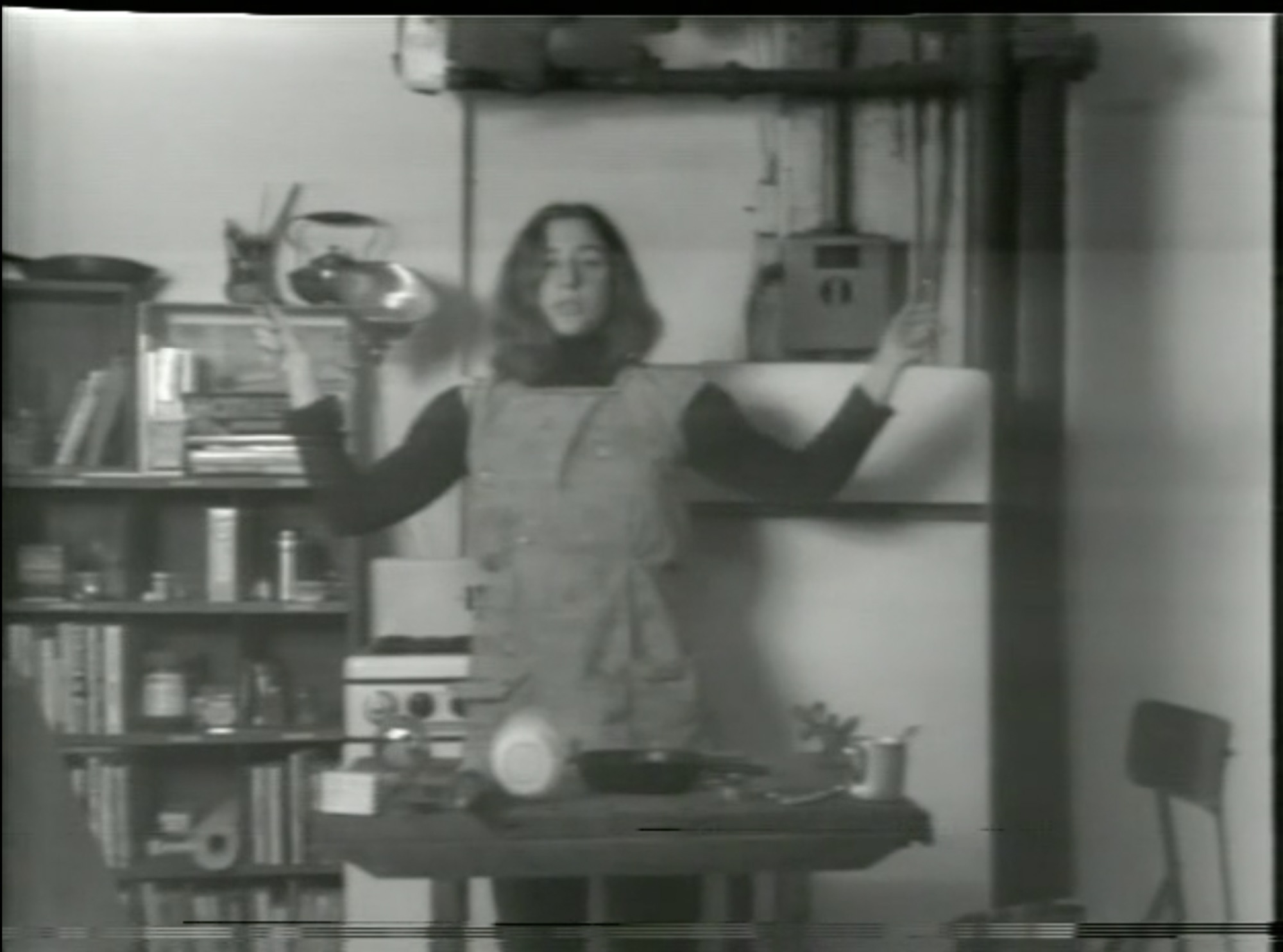
Compare Julia Child’s television demonstration with Martha Rosler’s alphabet of kitchen tools. Follow the movement of a hand, the sound of a voice and the ordering of gestures across two full viewings.
Teaching reference
Rosler: tools as signs
Semiotics is the study of how signs produce meaning. A sign is something, such as a word, object, image, or gesture, that carries meaning through its use and context. A spoon is useful for eating or stirring, but the way someone presents or moves it can also communicate an attitude or expectation.
In Semiotics of the Kitchen (1975), Martha Rosler adopts the recognizable form of a kitchen demonstration. Tools appear in an alphabetic sequence. The names may remain familiar while her handling of the objects disrupts the expected helpful demonstration. Gesture is a movement or position of the body that can communicate meaning. Watch how gesture, spoken word, voice, and sequence work together. Museum of Modern Art, Semiotics of the Kitchen.
The first viewing gives us an encounter with the whole performance. The second allows us to locate evidence for an interpretation. Humor, tension, refusal, and frustration are possible readings to test. Naming an emotion is only a beginning. Explain what a particular action does to the familiar role of the person demonstrating a kitchen tool.
From Cassatt’s room to Rosler’s demonstration
The Morisot–Monet comparison and return to The Tea ask where a picture places its viewer and how it gives access to people and a scene. Pollock connects social conditions with these pictorial choices. Cassatt’s cup has a practical use while its handling can participate in a social ritual. Carry those questions into the performer’s address to the camera. Veblen’s account of household reputation remains an optional extension; it is not presumed covered in P6. None of these models establishes Cassatt’s sitters’ intentions.
Rosler’s video makes the relation between an object, a word and an action unfold over time. A familiar tool can retain its ordinary name while a gesture unsettles the expected demonstration. The bridge is an inquiry into learned roles and the artist’s formal choices, not an account of progress from passive nineteenth-century women to a liberated twentieth-century performer. Cassatt’s pictorial agency and Rosler’s performance are different means of representation. Explain a specific arrangement in one and a specific action/voice in the other before comparing their implications. This develops Semiotics.
Berger: the work beyond the dining room
In “The Eaters and the Eaten,” Berger describes the separation between the bourgeois dining room and the work supporting it. This passage extends the unit’s earlier comparison between food as work and food as social display.
Source quotation: John Berger, “The Eaters and the Eaten,” Selected Essays, p. 372
One door connects with his own daily life; through it he has entered in order to be served with food. The second door connects with the kitchen; through it the food is brought out and the waste is taken away. Thus, in the dining-room, food is abstracted from its own production and from the ‘real’ world of his daily activities. Behind the two doors lie secrets: secrets of recipes behind the kitchen door; professional or personal secrets, not to be discussed at table, behind the other.
Here abstracted means separated from production in the diner’s experience. The two doors offer a way to think about what a scene makes visible and what remains elsewhere. Berger is describing a social arrangement and making an argument about class. His model is not a universal description of every household or meal. Use it to look again: the image may support the model, complicate it, or leave the question unresolved.