Two Judiths: Violence and Female Agency
At a glance
| The works | Caravaggio, Judith Beheading Holofernes, about 1599 to 1602, Palazzo Barberini, Rome, 145 by 195 cm. Artemisia Gentileschi, Judith Slaying Holofernes, about 1620, Uffizi, Florence, about 199 by 163 cm |
| Days | A double period. Doğan teaches the first; a cover teacher runs the second, which is a guided piece of writing on a worksheet. A one-period version is given at the end of How it runs |
| Dates | Tue 29 Sep P6/P7 |
| Deliverable | One paragraph that makes one claim about the two paintings, written closed in 25 minutes. Complete or incomplete |
| Feeds | A2, the essay on Wednesday 14 October, and Two Later Judiths on Wednesday, the same move done alone |
| Homework | None |
Objectives
By the end of this session you can:
- Turn a difference between two paintings into a claim about what the difference does.
- Find the places where a later painter refused what an earlier painter did, and name them one at a time.
- Write one paragraph that holds one claim and points at both pictures for every step.
Goal
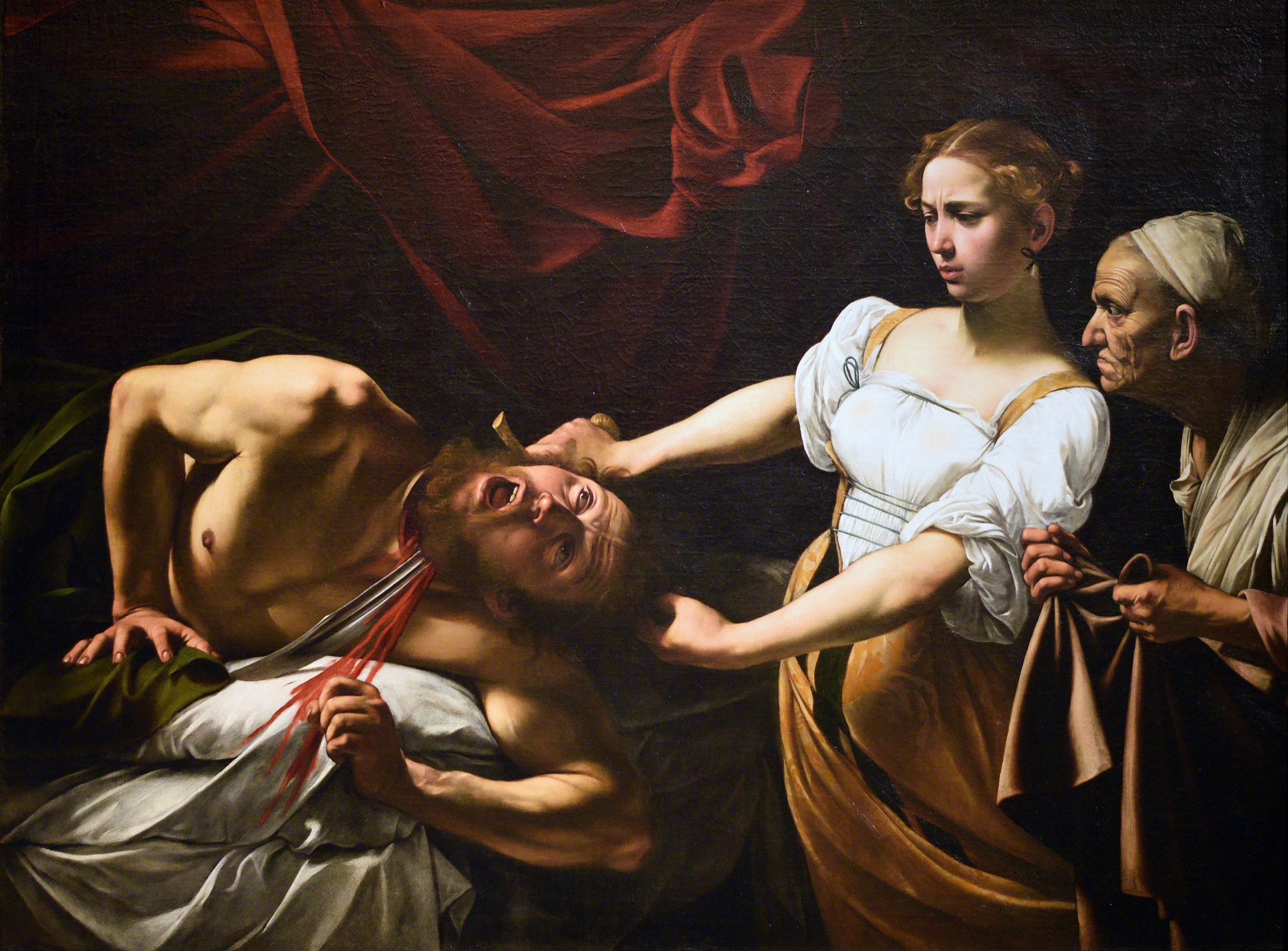
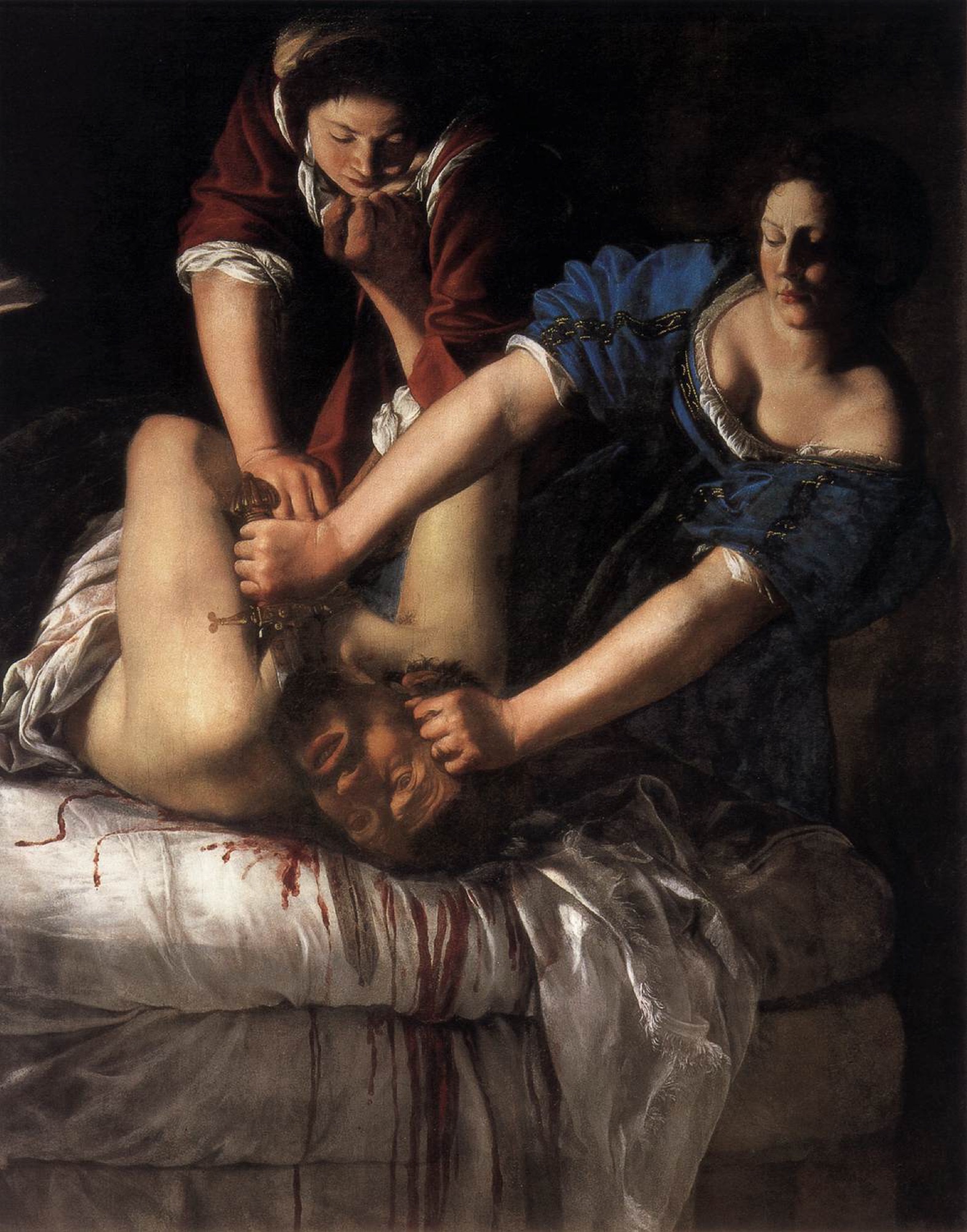
After three weeks of looking at single paintings, practice making one claim about two works before the essay on Wednesday 14 October. The Judith comparison rehearses that task.
The paintings tell the same story about twenty years apart. Gentileschi knew Caravaggio’s painting; compare what she kept and refused.
Both paintings are violent. We describe the violence in the painting before we talk about the painter.
How it runs
First period, 45 minutes: from the details to a conclusion, and the conclusion to a claim.
The whole paintings are held back until the class has looked at parts, and the painters until the class has looked at the whole. Expanded on Mon 28 Sep; the one-page teacher’s guide carries the same plan minute by minute.
A2 (5 min)
Announce A2, an unseen comparison, for Tuesday 13 October (the date originally announced; moved to Wednesday October 14 on October 12, then Friday October 16 on October 13), and say that tomorrow they do the comparison alone on two more Judiths, for a mark. It comes first because the second period is covered and an announcement must not be squeezed out.
Land and the story (2 min)
Slides 1 and 2. One sentence: you are about to see two violent pictures of the same story, in pieces first. Then the story in three sentences. An army has come to destroy Judith’s city. She goes to the tent of its general, Holofernes, and after a banquet he drinks until he passes out. She cuts off his head with a sword, and her maid is with her.
Six crops (10 min)
Slides 3 to 8, matched details, one pair at a time.
The first three are written, one sentence each, in silence: the maids; the hands on the sword; the blood.
The next three are spoken, think and then talk: the faces; the arms; what she wears (his Judith’s earring, her Judith’s bracelet). Describe only.
The whole (5 min)
Slides 9 and 10. Both paintings, side by side, no names. Pairs fill the rows they can on the six-row checklist. Push on which way each picture runs, across or up.
The names and the two painters (7 min)
Slides 11 to 15, about a minute each. The names.
Caravaggio: born in Milan on 29 September 1571, the day of this lesson; in Rome from 1592; painted real people straight onto the canvas; killed a man in 1606, fled Rome and died in 1610.
Artemisia: born in Rome in 1593; trained in her father’s workshop because women were rarely taken as apprentices; the first woman member of the Academy of Drawing in Florence, in 1616.
How they are connected: her father, Orazio, knew Caravaggio in Rome and painted in his way from about 1600, and in 1603 the painter Giovanni Baglione sued them both, with others, over insulting poems; Orazio told the court he had lent Caravaggio a friar’s robe and a pair of wings.
Her life in 1611 and 1612: the rape by Agostino Tassi, the seven-month trial, the torture of her fingers, and a sentence that was never carried out. Said once, plainly.
Side by side, and the conclusion (8 min)
Slides 16 to 19. Four details of each Judith in one grid (her face, her arms, what she wears, her maid), then him (his face, the blood). Which Judith is there to be looked at, and which is there to do the work? Pairs say the conclusion in one sentence with a “so” in it before the teacher does.
Then John Berger’s line from Ways of Seeing: “Men act and women appear.” Does his Judith act, or appear? Does hers?
Test the conclusion (3 min)
Slide 20. Is it only because she is a woman? Griselda Pollock’s objection to reading the painting as revenge; the twenty years and the Grand Duke who paid for it as other reasons; and the rule that the evidence comes from the painting.
Into the claim (4 min)
Slides 21 and 22. The conclusion becomes the claim: one refusal with a “so”. The weak and the strong model claim, on Bosch and the Johns, read aloud. The two tests and the four criteria (slides 23 and 24) only if there is time, since the worksheet carries both.
Before you go (1 min)
The paragraph is next period, Two Later Judiths is tomorrow, and there is no holiday homework. Leave slide 26 or slide 11 on the screen for the cover teacher; both show the two paintings with their names.
Second period, 45 minutes, with a cover teacher: write it, guided.
The worksheet carries the steps; the cover note says what to do. Doğan is not in the room.
Set up (5 min)
The cover teacher hands out the worksheet. Checklists and notes go away; the sheet and a pen stay. Both paintings stay on the screen, slide 11 of the deck (slide 26 is the same slide).
Steps 1 to 4 (10 min)
On side one: the difference, written as one sentence; the claim, with its “so”; the two tests, ticked; the plan of the paragraph in six sentences.
Write (20 min)
The paragraph on side two, by hand, in silence.
Read your own (5 min)
Step 6: the four criteria on the sheet, the weakest ticked, one line on why.
Close (5 min)
The cover teacher collects every sheet and leaves them on Doğan’s desk.
If there is only one period, run the first period as written and let the claim be spoken, not written. The paragraph can then be the next session’s first twenty-five minutes.
The checklist
Six things to compare, the same six for any two paintings of one subject. Fill each cell in six to ten words. The rows come from the Judith checklist in Representation and Comparative Writing, which was recovered from the earlier course.
| What to notice | |
|---|---|
| 1 · Moment | before, during or after |
| 2 · Distance and crop | close, middle or far; what is cut off |
| 3 · Light | where it comes from and what it leaves dark |
| 4 · Color | few colors or many, and which ones |
| 5 · Gesture and force | hands, grip, how the bodies lean |
| 6 · Moral frame | what the picture seems to think of what is happening |
Assessment
Complete or incomplete: Course Skills for the A-Level class, a Minor for the AP class, no number. Complete means one paragraph that makes one claim and points at both paintings, handed in with the line at the bottom naming the writer’s weakest criterion. The four A2 criteria, the claim, evidence from the pictures, comparison as argument, precision of language, are read against every paragraph in the feedback, not in the mark. The full rubric is on the A2 brief. The students’ brief is Two Paintings, One Claim. The marked version of the same move is the next morning: Two Later Judiths, out of 100.
A quotation
“And Judith was left alone in the tent, and Holofernes lying along upon his bed: for he was filled with wine. Now Judith had commanded her maid to stand without her bedchamber, and to wait for her coming forth, as she did daily: for she said she would go forth to her prayers, and she spake to Bagoas according to the same purpose. So all went forth, and none was left in the bedchamber, neither little nor great. Then Judith, standing by his bed, said in her heart, O Lord God of all power, look at this present upon the works of mine hands for the exaltation of Jerusalem. For now is the time to help thine inheritance, and to execute mine enterprizes to the destruction of the enemies which are risen against us. Then she came to the pillar of the bed, which was at Holofernes’ head, and took down his fauchion from thence, And approached to his bed, and took hold of the hair of his head, and said, Strengthen me, O Lord God of Israel, this day. And she smote twice upon his neck with all her might, and she took away his head from him, And tumbled his body down from the bed, and pulled down the canopy from the pillars; and anon after she went forth, and gave Holofernes his head to her maid; And she put it in her bag of meat: so they twain went together according to their custom unto prayer.”
The Book of Judith, chapter 13, verses 2 to 10, in the King James Version of 1611; read on Wikisource, Sun 27 Sep (a fauchion is a short curved sword). Both painters had this text. The maid is outside the room in it; “she smote twice”; the head goes into a bag of meat. Which painter kept which of these, and which refused them?
Suggested reading
- Mary D. Garrard, Artemisia Gentileschi: The Image of the Female Hero in Italian Baroque Art (Princeton University Press, 1989). The book that made Gentileschi’s Judith the picture it is now read as, and the source of the biographical reading the lesson keeps for last. Not in the vault.
Practice
Try each question before you open its answer.
1. What is the difference between a difference and a claim?
Answer: A difference is something you can see in both pictures, such as “one is dark and one is bright”. A claim says what that difference does. It has a “so” in it. If you cannot finish the sentence “and so this picture is about”, you still have a difference.
2. How do you test a comparison claim?
Answer: Two ways. Swap the two paintings in your sentence. If the sentence is still true, it says nothing about either one. Then ask whether a careful person could disagree with you. If nobody could, you have described the pictures and not yet argued anything.
3. You have six differences and twenty-five minutes. What do you do?
Answer: Pick one and follow it all the way. A paragraph that lists six differences is an inventory. A paragraph that takes one difference, shows it in both pictures and says what it changes is an argument, and an argument is what is being marked.