Sound, Voice, and Meaning
Current task guidance, October 17: the Film Letter is now A1. Its original October 8 at 08:00 deadline remains unchanged; outstanding work is late. Earlier dates in the September teaching record are historical. Direction/design now develops through the October workshops and November 2 review, with the research-checkpoint arrangements governed by the current register and November 13 lesson. The assessment register and current task brief govern submission.
Media Studies · Film Form and Production · Project guide · Video Letter overview · ← Intention and Shot Design | Sequence and Meaning →
How does sound add meaning that the pictures cannot provide alone?
Lesson slides: Download the deck (PowerPoint, 2.8 MB) · image credits
At a glance
| Teaching sessions | Wed 23 Sep P7, second period of the double. |
| Unit | Film Form and Production |
| Work | One stage of A1. The A1 brief holds the complete requirements and rubric. |
Objectives
- Identify diegetic and non-diegetic sound, voiceover, sound perspective and sound bridges.
- Monitor and record location sound, near and far versions of a sound, and your voiceover.
- Choose which sound will connect two shots in your film.
Learn
Diegetic sound belongs to the story world. Non-diegetic sound comes from outside it. In Parasite (Bong Joon-ho, 2019), compare rain at the windows with the score over the plan. A sound bridge begins before or continues after a picture cut: the music joins the semi-basement to the walk up the hill. Sound perspective makes the party seem distant when heard from the bunker.
Your voiceover reads the letter over the pictures. If you present it as narration outside the depicted action, explain that relationship; an unseen speaker is not automatically outside the story world. Record the ambient sound of your filming location as well. Monitoring means listening through headphones and watching levels while recording. Playback tells you whether a take is usable.
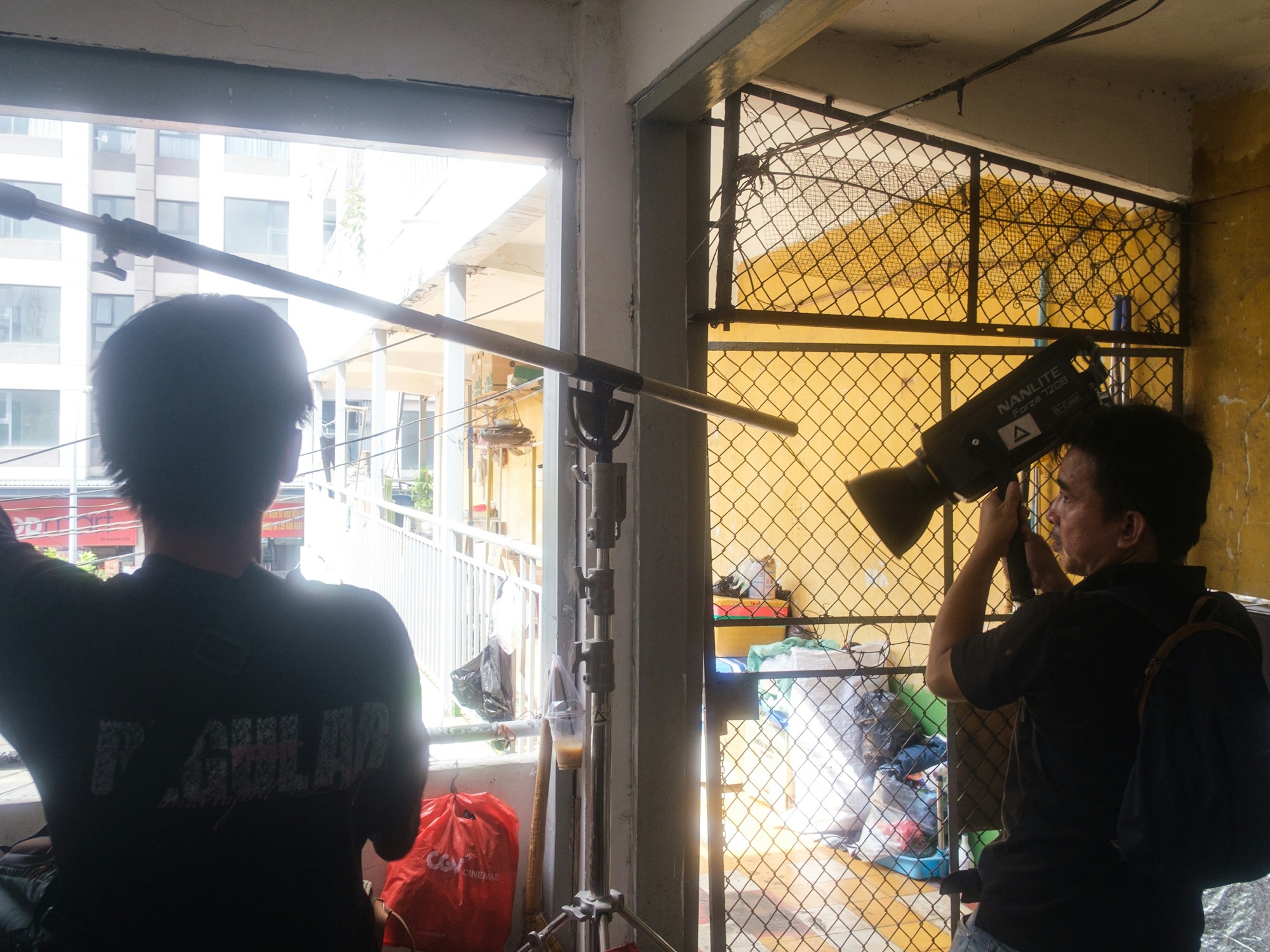
The recording photograph shows a crew capturing sound deliberately. Your phone and headphones are sufficient for this exercise.
How it runs
Wed 23 Sep, second period: sound and voice
The terms, on the film (10 min)
The syllabus’s sound list, each term landed on a Parasite moment the room can remember, said by the room before the term is given.
Start from what they already heard on Thu 17 Sep, when the audio-only exercise ran in L03: the birds and the detuned piano on the approach to the Parks’ house, the rain recognized as the flood before its pictures were shown, the theremin-like line the class named.
Diegetic and non-diegetic: the rain on the windows against the baroque score over the plan.
Sound bridge: the music that starts in the semi-basement and carries the family up the hill.
Sound perspective: the party heard from the bunker.
Voiceover is a voice heard over the pictures. Parasite uses the final letters in voiceover, as the published screenplay shows on pp. 138–140. Establish who speaks and the voice’s relation to the story; do not classify it only because the speaker is outside the current frame.
The four the film letter needs are the four on the board. Capture sheet: WS 2.2.
One thing shown (5 min)
Record ten seconds of the room while monitoring through headphones and watching the level. Then record ten seconds with the phone on the desk and the door open. Play both back to judge whether each take is usable.
Demonstrate sound perspective by recording the same sound from one meter and five meters.
The recordings (25 min)
Three things, each student on their own, headphones on.
One diegetic sound recorded in a place where they filmed.
One sound recorded near and then far.
The voiceover: the letter read once in the quietest corner available, each take played back before the next.
A letter that is not written yet is written now, in ten minutes, and the voiceover follows.
Close (5 min)
Every student says which sound they will carry across a cut, and between which two shots. That is the sound bridge, planned before the edit. Nothing new for homework. Everything is on the phone.
Practice
Sound terms are defined in the media vocabulary glossary and listed in full on the technical elements page.
1. A character switches on a car radio and a song plays. Diegetic or non-diegetic? Now the song continues over the next scene, in a kitchen, with no radio. What has happened?
Answer: In the car it is diegetic: the song exists in the world and the character can hear it. The continuation is a sound bridge. Its status in the kitchen depends on how the sequence establishes the source. It may remain sound from the earlier story-world event, or be used as music outside the new scene. A cut alone does not decide diegesis. Explain the source and the connection across the edit separately.
2. Define a sound bridge in one sentence.
Answer: Audio from one scene begins before, or continues after, the cut that changes the picture. It ties two spaces or times together through the ear rather than the eye.
3. Which of these is not in the syllabus’s sound list?
- a) Sound perspective
- b) Sound motif
- c) Match on action
Answer: c) Match on action is editing, not sound. Misfiling it is a common and costly error; the mark scheme reads the category you put it in.
4. Your voiceover reads your letter over a shot of an empty corridor. Is the voice diegetic or non-diegetic, and what is the corridor’s own sound called?
Answer: An empty corridor does not establish who can hear the voice or where it belongs. Identify whether it is narration, remembered/internal speech or a voice from the depicted action. Explain its story-world status from that context. The corridor’s background hum is ambient sound; a footstep can be a distinct sound effect. State what the soundtrack actually presents.
5. In Parasite, string music starts while the family is still in the semi-basement and is still playing when they are walking up the hill to the house. Name what has happened, and say what it does.
Answer: A sound bridge, and the music is non-diegetic. It joins two places and two moments through the ear, so the plan and its execution feel like one movement. Your own film needs one of these, and Wednesday’s close asks you which sound it will be.
Check your progress
Play back each recording. Name the sound you will carry across a cut and the two shots it will connect. There is no new homework after this session.
Source quotation
Sounds can be classified as diegetic/non-diegetic, and synchronous/non-synchronous.
Cambridge International AS & A Level Media Studies coursebook, §2.3, Sound, p. 36.
Suggested reading
Coursebook §2.3, pp. 35–40, and WS 2.2 for the sound terms.