Ownership and Media Institutions
Section B case-study pack: Barbie and La Chimera: complete printable pack · Editing comparison and technical retest (PDF)
Lesson slides: Download the deck (PowerPoint, 2.6 MB) · image credits
At a glance
| Days | 4: Monday reception and ownership; Wednesday supported Section A double; Thursday Section B writing; Friday production clinic |
| Dates | Mon 7 Dec · Wed 9 Dec · Thu 10 Dec · Fri 11 Dec |
| Band/Unit | U5 Media Contexts (Industries and Audiences) |
| AO focus | AO1 + AO2 |
| Deliverable | the guided Section A script (Wed); a formative Section B paragraph written and revised in class (Thu); the animatic and the call sheet at Friday’s production clinic, and each student’s shoot window declared (A, B or C) |
| Feeds | A4 |
| Homework | Follow the current single weekly assignment route. Use existing classwork and production revisions for the named task; Section B case work and the ungraded media diary add no separate upload. |
Objectives
By the end of this lesson, students should be able to:
- Explain differential readings using Morley and one example from the room
- Trace one editorial or content decision back to an ownership structure
- Write a Section A response while consulting the mark scheme and say which band each paragraph targets
- Audit their own case-study document against the template’s rows and the five-year rule, score its industry and audience coverage honestly, and name its gaps in writing
Goal
Students use audience readings and ownership evidence to explain media choices. Supported Section A writing makes the criteria usable before A4. Animatics and call sheets test the readiness of their own production plans.
How it runs
D1 · Mon 7 Dec: Morley and ownership
Reception (7 min)
Explain Morley’s usable claim: groups can produce systematically different readings of the same broadcast in relation to their social situations. Compare two possible readings of the existing case source and ask what evidence would establish a pattern beyond this room. Keep the difference between an illustration and research. The earlier twelve-minute classroom replication is replaced by the editing repair below.
Input (15 min):
PSB vs commercial: who pays (license, advertisers, subscribers, the state), and what each payer buys.
Curran & Seaton’s claim attached: ownership concentration narrows the stories that get told.
Use Le Gray’s commissioned photograph of the Emperor’s camp in 1857 as a historical example.
Ask how the commission may have shaped the photograph, then compare B1/B7 with L1/L2. Distinguish ownership, co-production, support, sales and distribution. Students propose a pressure and identify what the credits cannot prove about editorial control.
Editing repair (20 min)
Use five minutes to compare a teacher-made action match with a graphic match. Carry one hand movement across a cut; then match the circular shape of a cup with a clock. The first preserves action, while the second links shape/composition and may suggest a relationship between different spaces or times. Contrast with a jump cut and with the shot/reverse/eyeline relationships practiced November 23.
Use five minutes of the same original demonstration material for time and transitions: remove an interval for ellipsis, repeat/overlap an action to expand time, compare a dissolve/fade/wipe and a superimposition, then show one deliberately identified post-production visual effect. A long or short take concerns shot duration; slow motion changes displayed movement/time. Post-production is the wider process, not one particular transition. Crosscutting can connect concurrent actions; parallel editing can invite a comparison between strands without establishing simultaneity. Explain the actual relation shown rather than assuming every alternating sequence is simultaneous.
For seven minutes, each student compares two versions of one example, identifies the changed technique and writes how it changes time, connection or representation. Choose the weak items from the coverage matrix; do not require a new demonstration of every familiar term. In three minutes, check the term, precise evidence and effect. Carry an unresolved weakness into December 9’s whole answer.
Close (3 min):
Record one limitation of the reception illustration and one editing choice whose effect you can explain. Keep the ownership chain for Thursday’s Section B paragraph; Wednesday remains the supported Section A double.
Case-file reference for Thursday and December 18.
The trace (preparation): follow the money, against the clock
(per the activity layer): pairs take one text and trace one visible decision back to who pays for it: the ad break’s placement, the family-friendly cut, the product in shot, the story not covered.
Use decision ← incentive ← payer as a reference within Monday’s existing ownership input. Each link needs evidence. This is not an additional race or a presentation in Friday’s production clinic.
Keep the reception comparison, editing explanation and funding chain in existing class notes. Use a relevant part on Thursday. Use the pack media-use record for the existing ungraded diary due for discussion December 14; there is no additional upload. Follow the single weekly assignment route.
D2 · Wed 9 Dec (double): guided Section A
Extract (5 min):
View the prepared extract once. This is a supported exercise, not the authentic 30-minute viewing protocol.
The demystification (15 min):
The official five-criteria rubric on every desk (concepts / contexts / terminology / analysis / examples, 0–5 each) and read aloud so students can use each criterion. Deck U5.2’s context-terms quiz as the warm-up.
the guided Section A (50 min):
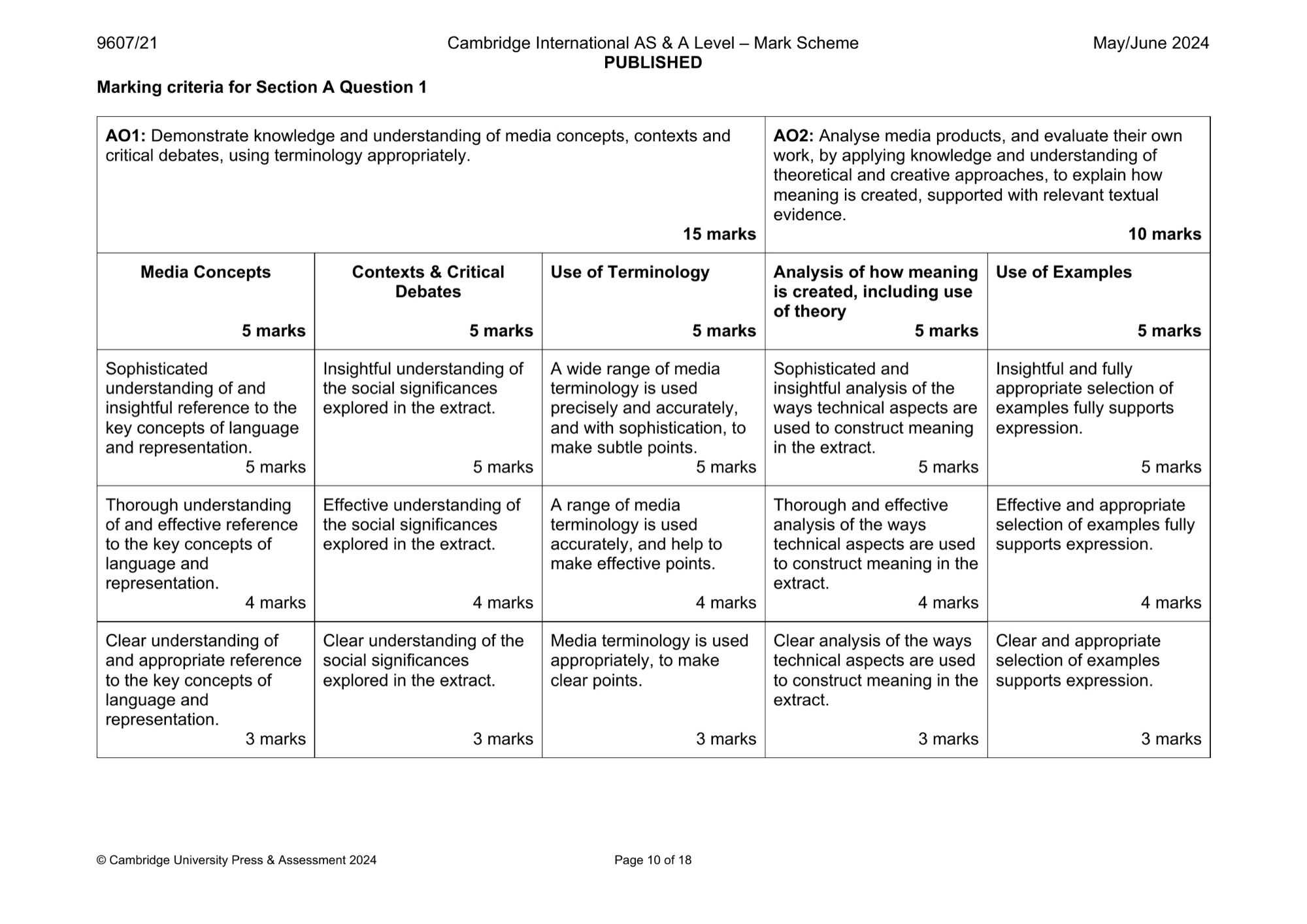
A Section A response written with the mark scheme visible and consultable, part collaborative by design: paragraphs drafted solo, but any student may stop, check the band language, and annotate their own margin (“this sentence is my terminology evidence”). Students practice consulting the criteria as they write.
The mapping (20 min):
Review maps paragraphs to bands: each student labels which criterion each of their paragraphs was earning, and identifies any criterion their response did not address. That gap is next week’s target: scaffold removed at A4.
This exam double replaces the regular practical workshop. The actual animatic and call sheet are reviewed in Friday’s preserved clinic.
D3 · Thu 10 Dec: second Section B paragraph
Focus (5 min):
Read the prompt and the previous feedback. Name the connection the answer must explain.
Independent writing (25 min):
Write the paragraph set Nov30 on the gratification served by a product from the case-study institution. Use the named product and dated evidence, explain the gratification and return to the question. Use your ownership chain if relevant. Write without a partner or a model answer. Use the question and your permitted notes.
Feedback (8 min):
Exchange the paragraph and use the official five criteria. Identify one inaccurate term, unsupported claim or missing link from evidence to meaning. The teacher checks the correction.
Rewrite (7 min):
Revise the weak connection independently. Keep the original and the revision together, underline the changed passage and hand in the document.
Use the November 30 application with B3/B6 or L4/L5. Separate a proposed gratification from a measured audience response. Explain how access or the institutional offer enables that use, rather than listing theory.
D4 · Fri 11 Dec: the production clinic, the animatic, the call sheet and the window (Foreign Culture Day: lessons run)
The animatic screened (15 min)
Every animatic (the storyboard frames cut to their running times with a temp track, started Fri 27 Nov) screened to the room, one after another, no introductions. One line per animatic from the room on a card: the second where I lost the thread. Makers write the second down; that frame is the first fix.
The call sheet (15 min)
One call sheet per shoot day from the shot list, on the sheet in the shoot guide: date and window, call time, location and how to get there, the shots in shooting order with their frames, who is needed for each, the equipment list, the light and the sound problem for each location from the recce, a contact for each person, the shot to cut if an hour is lost.
Cambridge’s moderator asked for “a call sheet completed for each day of filming”; this is where ours are made.
The window declared (10 min)
Each student names their shoot window on the sheet: A, the late-December weekends; B, January 24–February 21, the principal filming window; C, the first two spring weekends for limited pickups or failed shots.
The teacher checks the planned dates against cast availability, location access and daylight.
Check school friends and school locations explicitly before approving holiday filming.
The declaration goes on the blog as a planning post with the call sheet.
Close (5 min)
The pre-production gate on Wed 23 Dec: animatic, a call sheet per shoot day, cast and locations confirmed, equipment booked, window confirmed. Use the school equipment sign-out and access arrangements; the gate checks readiness for principal photography, while approved classroom tests continue.
Assessment
| Item | Date | What | AO |
|---|---|---|---|
| Guided Section A | Wed 9 Dec | Guided Section A script, mark scheme open; register-named direct practice for A4, same format family, scaffold removed next week | AO1+AO2 |
See the full register.
Practice
Editing comparison and technical retest
On December 7 use page 1 to identify the changed technique in the two demonstrated versions and analyse its effect. Keep the existing 5/5/7/3-minute sequence.
Use Barbie and La Chimera pack for the film-industry work in this lesson. Select source cards that answer the question, explain the institutional or audience consequence, and state the limit of the evidence. Keep the work in the existing case file.
Try each question before you open its answer. Keep your case-study document open; several answers belong in it. Use Technical Elements to check the sound/editing distinctions before the guided answer.
1. State Morley’s usable claim in one sentence. What do the different readings track?
Answer: Real audiences, in groups, produce systematically different readings of the same broadcast. The differences track their situations, not their intelligence. A comparison can illustrate different readings; it cannot establish Morley’s wider findings.
2. Explain the possible relationship between ownership or funding and a production choice. Use the Le Gray commission as an example and state what remains uncertain.
Answer: Concentrated ownership may constrain the range of work an institution supports. Le Gray’s commission identifies a funding relationship and a possible incentive. It does not by itself prove exactly which instructions shaped every choice. Apply that distinction to the named companies in the film source cards.
3. Who pays for public service broadcasting, for commercial TV, and for a streamer, and what does each payer buy?
Answer: A license fee, advertisers, subscribers. The license buys a public remit. Advertisers buy audiences delivered at scheduled times. Subscribers buy retention, which buys autoplay and the season drop. Name the payer and you can predict the schedule.
4. Trace one visible decision back down the chain: decision, incentive, payer. Use a text you watched this week.
Answer: Any complete chain works. Example shape: the ad break lands on a cliffhanger (decision), because the broadcaster must hold you through the break (incentive), because advertisers pay for delivered audiences (payer). A chain that survives a challenge is exam material.
5. Name the five criteria a Section A script is marked on, and the marks each carries.
Answer: Concepts, contexts, terminology, analysis, examples. Five marks each. This is the whole secret. Label your own paragraphs with the criterion each one feeds, and find the criterion you never feed. That gap is your A4 target.
Editing check. Compare two versions of the same short sequence. Name the actual change, locate it and explain how it changes time, spatial relationships or meaning. Distinguish an action match from a graphic match and a shot’s duration from slow motion. Keep the explanation for the guided Section A answer.
6. Update the existing case file during the scheduled source activities and revision. Record event dates, publication dates and access dates distinctly. Use the coverage audit to choose a weak explanation to repair; no additional weekly submission is created.
Weekly work
Use the weekly assignment route. Each normal teaching week has one Course Skills assignment or an attainment. Use existing classwork where the brief allows it. Every task produces material for the student’s own C1 portfolio or practices a C2 response. Other class exercises receive feedback without another submission.
Source quotation
How does digital distribution affect consumption of media texts?
Cambridge International AS & A Level Media Studies coursebook, §5.4, “Why develop case studies?”.
Suggested reading
Use the coursebook section cited above and the linked current task brief. For timed writing, consult the Exam Answer Guide; for production, use the Shoot Guide.