A4: Section A Assessment
Section B case-study pack: Barbie and La Chimera: complete printable pack · Editing comparison and technical retest (PDF)
Lesson slides: Download the deck (PowerPoint, 3.8 MB) · image credits
At a glance
| Days | 4, Mon, Wed double (A4 sits), Thu, Fri (Thursday banks the self-band while the sit is fresh and runs the end-to-end trace) |
| Dates | Mon 14 Dec · Wed 16 Dec · Thu 17 Dec · Fri 18 Dec |
| Band/Unit | U5 Media Contexts (Industries and Audiences) |
| AO focus | AO1 + AO2 |
| Deliverable | A4 remains Wed 16 Dec:30min viewing/notes+45min writing. Thu: self-band and protected institutions paragraph. Fri: full45-minute formative Section B answer, using the prepared case-study file. |
| Feeds | End of Term Exam; Forecast Grade anchor |
| Homework | Existing case-file preparation carries the rows/facts/figures, synergy/convergence, regulation and end-to-end chain displaced from Friday. The full B rehearsal is announced Mon 14 Dec. No additional graded homework task is created. |
Objectives
By the end of this lesson, students should be able to:
- Define integration, synergy and convergence and evidence each from one institution
- Use the 30-minute viewing window to produce structured notes, not a transcript
- Sustain the 45-minute write from notes rather than memory
- Explain who regulates their case study institution and one concrete consequence
Goal
A4 provides Forecast Grade evidence through authentic Section A conditions: thirty minutes of viewing and note-making before forty-five of writing. Explain how this differs from A2’s supported 60-minute answer. Institution concepts, case-file preparation and paragraph revision support the full formative Section B rehearsal.
How it runs
D1 · Mon 14 Dec: institutions 2, production, distribution and marketing, then the three words
Input (15 min):
How a product reaches its audience, on the case-study institution: who greenlights, who produces, who distributes, how it is marketed, where audiences meet it, who takes the revenue.
Then the exam’s three institution words, defined and separated: integration (owning the stages: vertical; owning the neighbors: horizontal), synergy (parts selling each other), convergence (media and platforms flowing together).
One historical anchor: Lindbergh, 1927: one man, and every channel of the era selling the same story to itself: newsreels, press syndicates, radio, records. The media event predates the internet by seventy years.
The hunt (18 min):
Use eight minutes to classify B3/B7 and L3/L5: partnership, ownership across stages, or platform access. Then use ten minutes for the existing ungraded diary discussion. Each student explains one actual encounter and its limits as population evidence. Compare B5 with L6 to separate capture technology from later digital circulation; retain this distinction in the case file.
The gap check (7 min): technical retest and repair
Use the weakness identified in December 9’s guided answer. Show a short unfamiliar teacher demonstration, allow each student to identify the technique and explain its effect, then correct and rewrite the inaccurate term or weak reasoning. Check the example against the official criteria already practiced on December 9. Preserve the seven-minute limit; this replaces the specimen-paragraph calibration, not the industry hunt. Any substantial remaining gap must be recorded for a specific further teaching decision rather than declared solved. Do not use A4’s sealed extract in the repair.
Close (5 min):
Announce original pack question 8 for the ungraded full Section B rehearsal on Fri 18 Dec, its 45-minute conditions and preparation from both cases (3 min). The dossier is closed for that full answer.
Then the two-minute structured-notes drill: 90 seconds of a trailer, notes in the four-family grid, pens down.
D2 · Wed 16 Dec (double): A4, the authentic sit
Set-up (5 min):
Explain the conditions and emphasize that the viewing window is for structured notes, not a transcript: the grid, not sentences.
Use blank paper for notes and the conditions in the current A4 brief; do not supply the earlier A2 technical checklist.
Viewing and notes (30 min):
The selected sealed Section A paper, a real past paper: its extract, screened to the paper’s own protocol; notes only.
Writing (45 min):
The Section A response, run exactly to the paper’s clock.
Collect (10 min):
Scripts in; Do not debrief today. Students use this session to experience the full exam format.
D3 · Thu 17 Dec: A4 self-band and an institutions paragraph
Self-band and focus (5 min):
Record five criterion scores from memory of yesterday’s A4 response and seal them for Monday’s return. Set the institutions paragraph prompt.
Independent writing (25 min):
Write one Section B paragraph linking an institution’s ownership or funding to a production/distribution decision. Include named contemporary evidence, its consequence and the link back to the question. Write without a partner or a model answer. Use the question and your permitted notes.
Feedback (8 min):
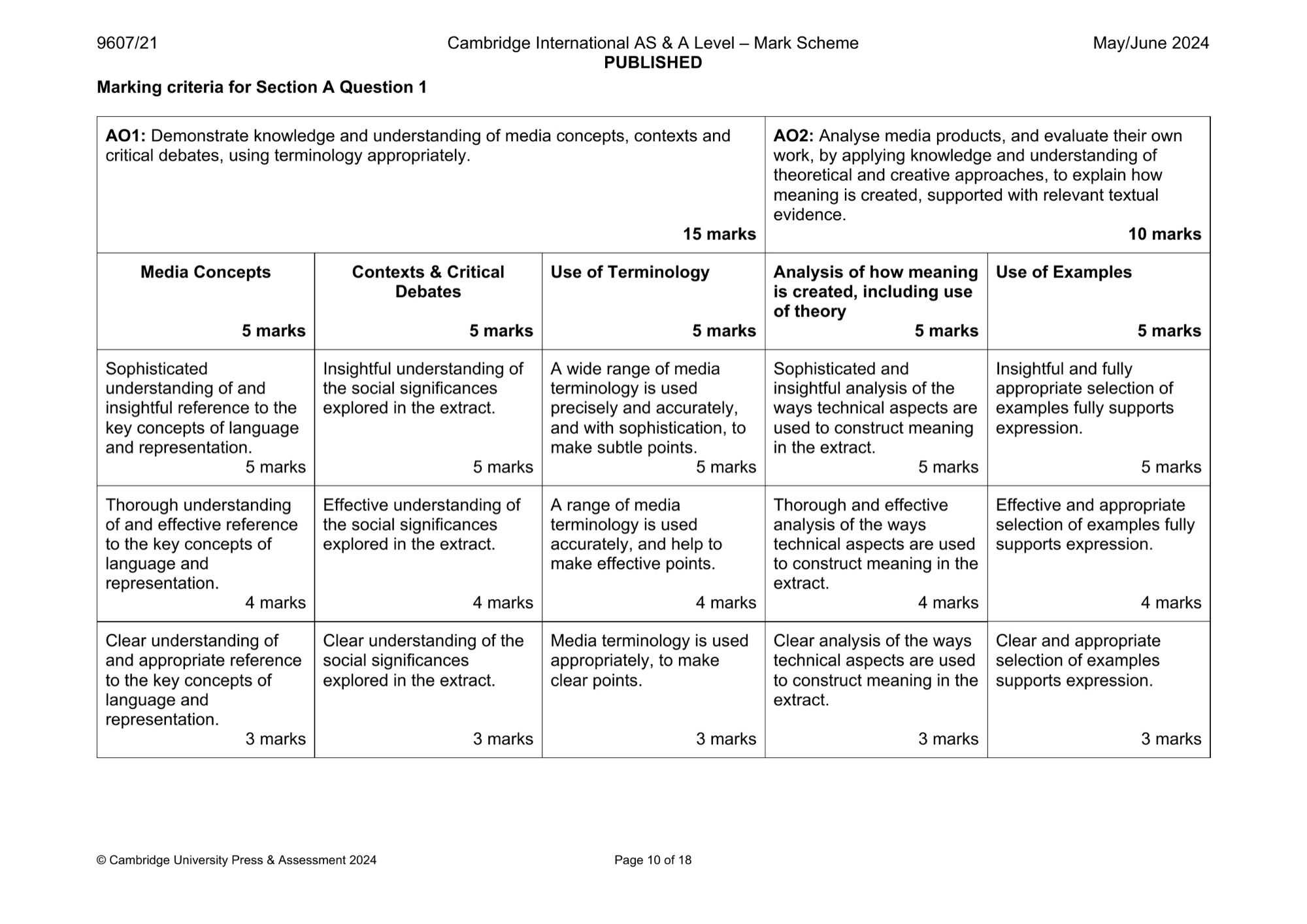
Exchange the paragraph and use the official five criteria. Identify one inaccurate term, unsupported claim or missing link from evidence to meaning. The teacher checks the correction.
Rewrite (7 min):
Revise the weak connection independently. Keep the original and the revision together, underline the changed passage and hand in the document.
For the institutions paragraph, use the pack’s source-role chain and one relevant comparison. Check names and dates against the dossier during permitted preparation, then write independently. Preserve the existing five-criteria feedback and rewrite timing.
D4 · Fri 18 Dec: full formative Section B rehearsal
Full answer (45 min):
Write the announced original pack question 8, using case-study knowledge from memory.
The prompt and permitted conditions are prepared before P6 so the full period is writing.
This is formative practice, not a new graded Course Skills task or attainment.
The teacher returns one specific correction for the December 21 discussion and January rewrite.
Case-file preparation before Fri 18 Dec, replacing the Friday consolidation.
The trace (preparation):
The same institution followed from decision to screen: who greenlights, who produces, who distributes, how it is marketed, where audiences meet it, who takes the revenue. Draw the chain in your case-study document and annotate each link with evidence from the document. The teacher checks the prepared chain before Friday.
The structure pass checked (preparation):
The document’s rows (identity and ownership; production patterns; distribution and marketing; audience and consumption; regulation; technology; dated key facts) developed through scheduled case work; unsupported entries flagged and contemporary dates checked.
Synergy and convergence, on paper (preparation):
The two words from Monday written into the document as entries on the case-study institution itself: one product that sells another, one platform the institution moved onto, each with a date and appropriate evidence. A figure is useful only where the source provides one.
Then the facts and figures page: a few accurate figures relevant to the argument, such as a budget, box-office figure, release date or documented audience measure, learned by heart, rehearsed from memory and checked against the document.
Regulation, briefly (preparation):
Regulation as the fourth context: who regulates the case-study institution (the relevant film-classification body, market rules or platform policy, as supported by the case source), with what powers, and what that visibly changes about its output: scheduling, cuts, ratings, what never gets made.
Use the regulator for the exam-eligible institution. NRTA remains a spoken classroom comparison if discussed.
The entry (preparation):
The regulation row of the case-study document dated with one entry; the chain from L15 extended one link: decision ← incentive ← payer ← regulator.
Use the existing case-file work across the weeks of December 7 and14. Check rows/dates, rehearse selected accurate evidence and update the end-to-end/regulation chains before Friday. These updates support the rehearsal and remain ungraded.
Assessment
Full brief (objectives, task, instructions, rubric): A4 Section A.
| Item | Date | What | AO |
|---|---|---|---|
| A4 | Wed 16 Dec | Component 2 Section A in authentic format on a sealed past paper: 30 min viewing/notes + 45 min writing; Forecast Grade anchor, marked on Cambridge’s five criteria against the paper’s official mark scheme | AO1+AO2 |
| Formative full Section B | Fri 18 Dec | 45-minute answer from memory; feedback, not an additional graded task | AO1+AO2 |
See the full register.
Practice
Editing comparison and technical retest
On December 14 use page 2 for the seven-minute repair chosen from December 9 feedback. Identify the demonstrated technique, explain its effect and revise the weak reasoning. The A4 extract is not used.
Use Barbie and La Chimera pack for the film-industry work in this lesson. Select source cards that answer the question, explain the institutional or audience consequence, and state the limit of the evidence. Keep the work in the existing case file.
Try each question before you open its answer. Synergy and convergence are defined in the media vocabulary glossary.
1. Define the exam’s three institution words so they cannot be confused with each other.
Answer: Integration is ownership: vertical when a company owns the stages of production, horizontal when it owns its neighbors. Synergy is parts selling each other: the film, the soundtrack, the game, the ride. Convergence is media and platforms flowing together, so one device or service carries what used to be many.
2. What does Lindbergh in 1927 prove about media events?
Answer: One man, and every channel of the era selling the same story to itself: newsreels, press syndicates, radio, records. The media event, and synergy with it, predates the internet by seventy years. New platforms change the plumbing, not the pattern.
3. The thirty-minute viewing window: what is it for, and what is the classic mistake?
Answer: Structured notes in the four-family grid, so the forty-five minute write runs from notes rather than memory. The classic mistake is a transcript: sentences describing the extract in order, which cost the window and feed nothing. The grid, not prose.
4. Who regulates your case-study institution, and what is one concrete thing regulation visibly changes in its output?
Answer: Name the regulator for its home market, such as the relevant film-classification body or evidenced platform policy for the chosen case. Then the visible consequence: scheduling and the watershed, cuts and ratings, what never gets made. Regulation is the fourth context, and it earns marks only when tied to visible output.
5. Extend the funding chain by one link and read it back.
Answer: Decision, incentive, payer, regulator. The cut that keeps a rating (decision) protects the slot (incentive) that the advertiser pays for (payer) inside rules the regulator sets and enforces (regulator). Four links, one sentence each, and Section B of the real paper is already half-planned.
6. Run the structured-notes drill: ninety seconds of any trailer, notes straight into the four-family grid, pens down at two minutes. Repeat on a second trailer, grid tighter. This is the exact discipline the sit’s viewing window rewards.
Workload and feedback
A4 is this week’s attainment. Use class time to address a specific weakness in the existing case file, including the end-to-end chain, synergy/convergence or regulation where needed. No additional weekly submission is set. The December 18 45-minute Section B answer is formative and receives a specific correction for December 21. A4 is returned in the December 21–23 block. Current syllabus timing and permitted aids govern the authentic sitting.
Source quotation
How important is cross-media convergence in your chosen media form?
Cambridge International AS & A Level Media Studies coursebook, §5.4, “Why develop case studies?”.
Suggested reading
Use the coursebook section cited above and the linked current task brief. For timed writing, consult the Exam Answer Guide; for production, use the Shoot Guide.