Images, Signs and Reality
Lesson slides: Download the deck (PowerPoint, 1.7 MB) · image credits
At a glance
| Field | Details |
|---|---|
| Dates | Wed 18 Nov P1 · 08:00–08:45; Tue 24 Nov P6+P7 · 12:35–14:15 |
| Focus | How an image can reflect a subject, distort it, imply a missing source or become a model for experience. On November 24, students defend a reading of an artwork or media example. |
| Unit | Images, Mediation and Modernity |
| Preparation | No prior Berger or Baudrillard reading is assumed. |
Objectives
- Use Baudrillard’s four phases to explain what an image does in relation to its referent, using evidence from an artwork or media example.
- Explain how learned conventions shape the interpretation of a sign, image or performed role.
- Support a reading of Sherman’s performed film character with visible evidence and consider another reading.
- Use the Disneyland passage to explain what declaring one place fantasy can make us assume about everyday life. Apply the four phases to a different image and defend the choice.
- Explain how an actual action can also become a constructed image, then qualify one claim about representation.
Materials and resources
Unit introduction resources: Classroom slides (PDF) · Artwork images, credits and sources (ZIP)
- Library of Congress, Muybridge’s The Horse in Motion and the original and retouched photographs of Lenin’s speech.
- Puschak’s Will AI Images Change Our Memories? and National Geographic’s February 1982 cover beside Gordon Gahan’s source photograph.
- Classroom PowerPoint; Classroom PDF.
- Van Gogh, Wheatfield with Crows for the Berger caption comparison.
- Artwork files, credits and screening sources. Whole views and video previews are distinguished there. Recurring works connect through the Image Slide Library.
- Baudrillard: the two supplied subsections in the Poster edition; Media Studies teaching article; linked video, 06:13–07:05.
- Alternate Glaser translation, corresponding Disneyland subsection.
- Complete Warhol screening copy linked by Kunsten, 4:27; separate Louisiana filmmaker interview.
Artwork download: Seven image files with credits and provenance (ZIP).
Tasks
November 24 · The four phases of the image
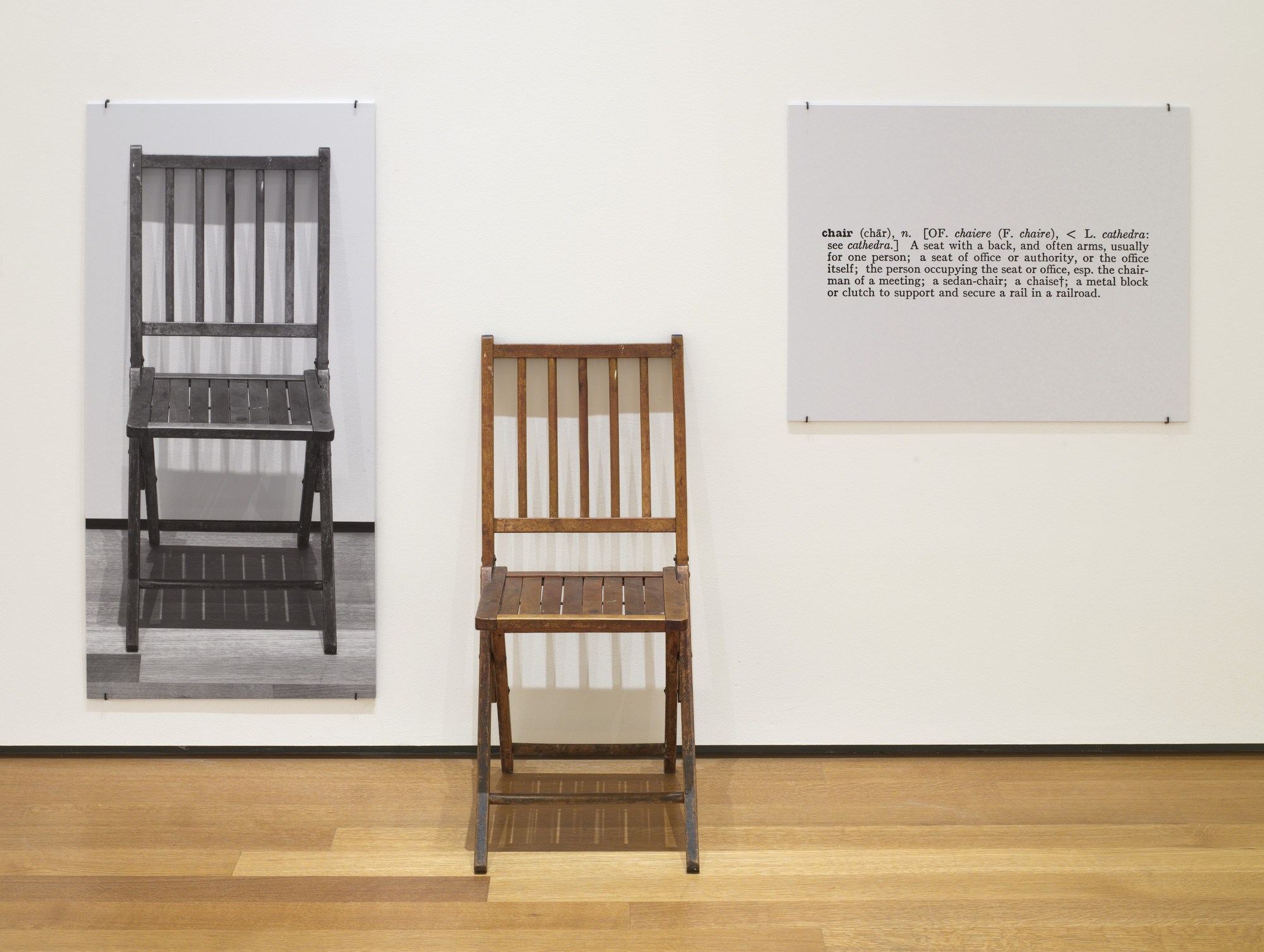
- Look at Sugimoto’s cinema photograph and name something you can see. In Kosuth’s work, identify a feature you can check against the chair. In Muybridge’s sequence, find a frame where all four hooves are off the ground.
- Look at Van Gogh’s painting before reading Berger’s caption. Which detail changes meaning? Compare the original and retouched photographs of Lenin’s speech. What changed on the steps, and what would a viewer infer from seeing the edited version alone?
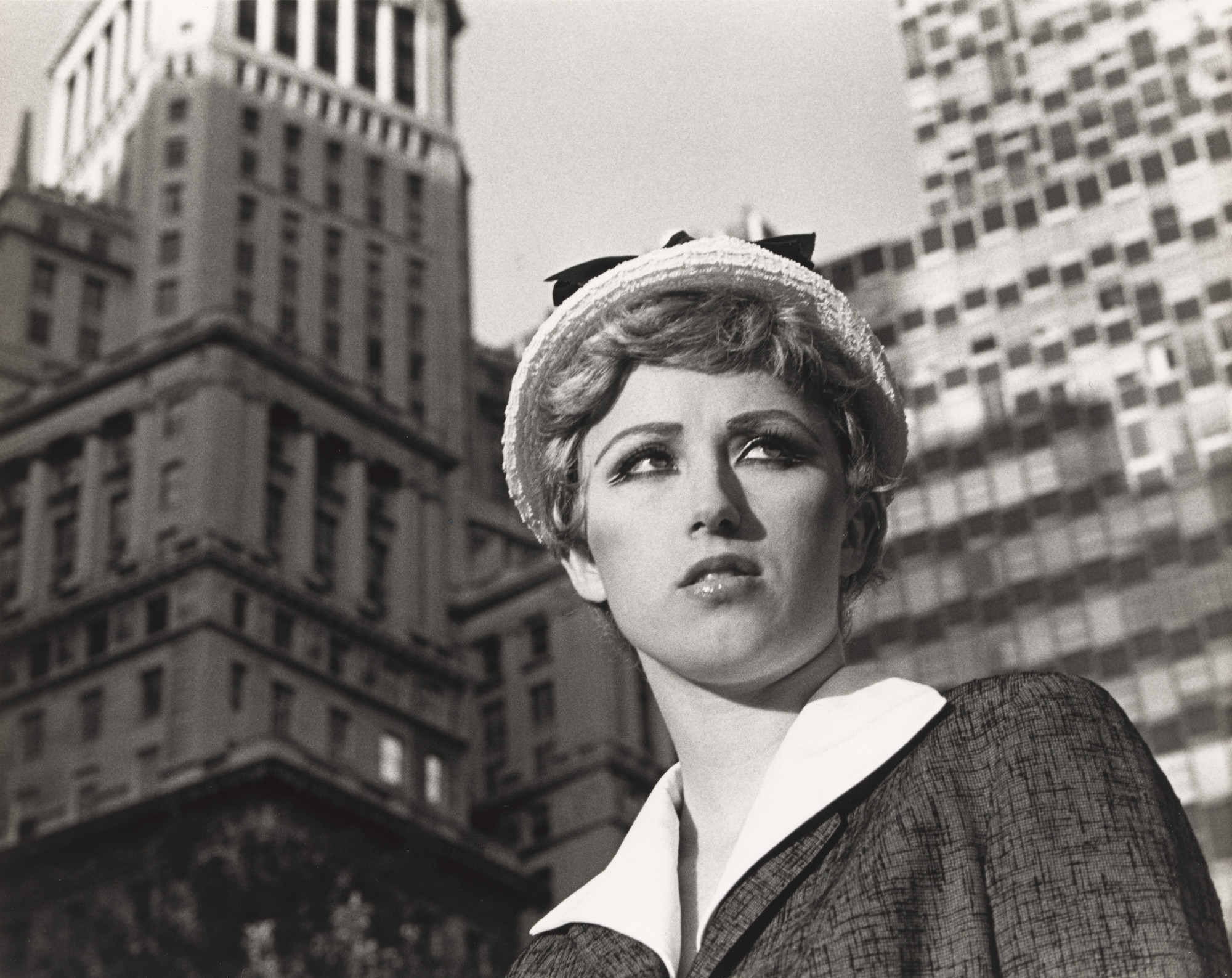
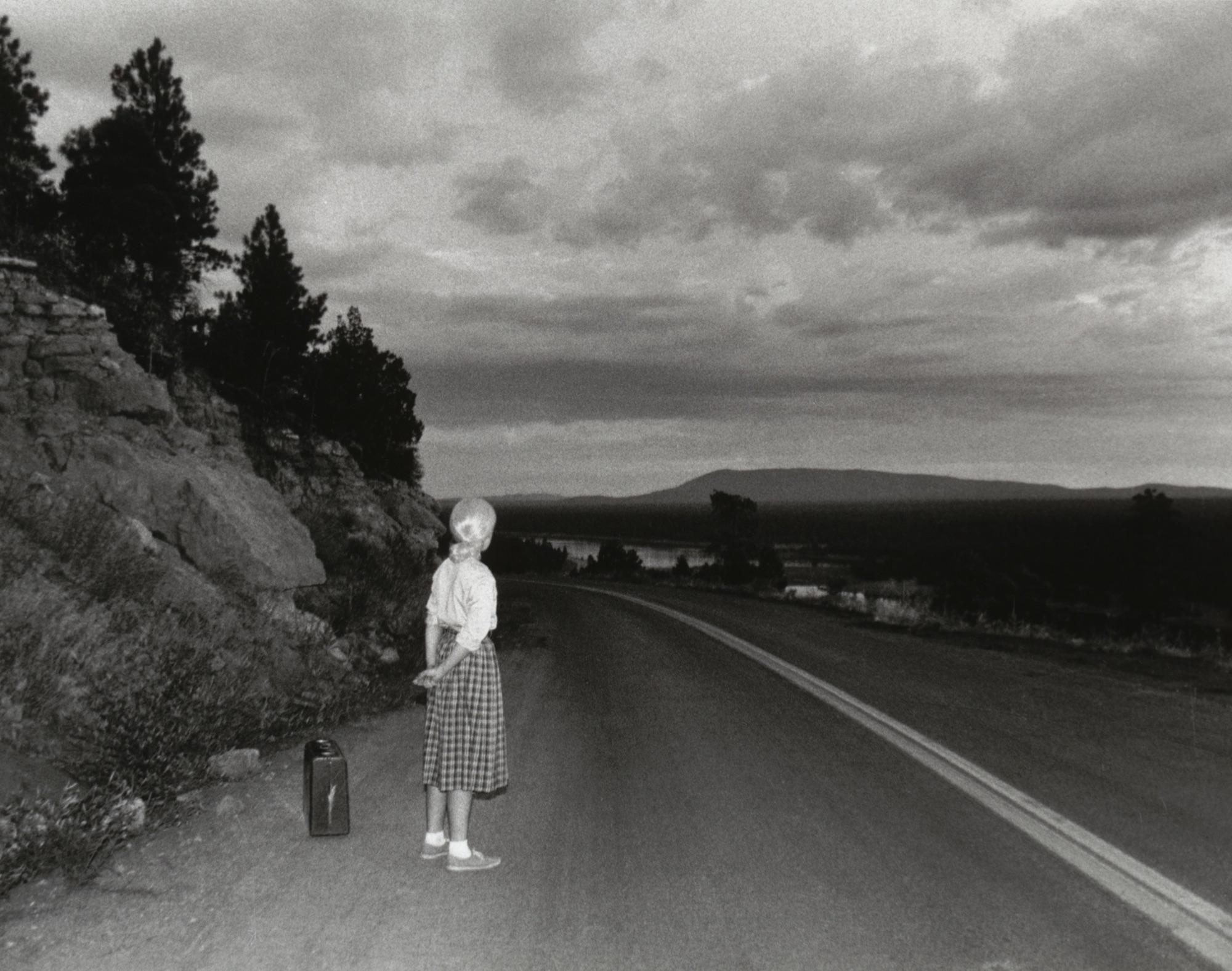
- Look at Sherman’s film still. Name one detail that made you imagine a larger story. What original source would someone expect to find?
- Compare the toy Dreamhouse with the life-size Malibu DreamHouse. Which features make the building recognizable? Read the Disneyland plaque and explain what calling the park fantasy invites you to assume about the outside.
- Use Puschak’s Scotland photograph to distinguish what the camera recorded, one altered detail and an encounter the image implies. Imagine this kind of picture sets the standard for what a Scotland holiday should look like. Name one decision a future traveler might make because of that model.
- Choose a panel of the fish meme, Gursky’s 99 Cent, or an image you know well. Name the phase, identify its subject or model and point to one detail. Explain why a neighboring phase fits less well.
Earlier unit opening
- Explain one association recalled from Rosler, the alphabet, the smiley or the coffee advertisement. What convention or context helps produce it?
- Look at Sherman’s #21. Propose a role or situation and support it with two visible details. Test a partner’s different reading. After learning about the series, revise your explanation of why the scene feels familiar.
- Read the continuous Disneyland paragraph across both slides. Explain why Baudrillard moves from the park as an idealized America to a claim about the world outside. Use the explanation of the reality principle to paraphrase his argument.
- Use Main Street, Prince’s cowboy or Gursky’s store to explain one step in the argument. Point to a visible detail, explain the proposed mechanism, and identify an objection. Distinguish evidence that a place or image is constructed from proof that the boundary between reality and fantasy has failed.
- Watch the hamburger sequence. Explain how one actual action becomes meaningful through its filmed presentation. Finish with a short individual explanation using one case, one detail and one limit. Your reasoning should distinguish an observation, an inference and a claim that would need more evidence.
Assessment and homework
The November 24 reading, comparisons and short individual response are formative class work.
The initial interpretation, paired challenge and final explanation are formative class work. See the November 20 and 23 classwork guide for the board and Berger reading.
Description
Cindy Sherman’s #21 and a sustained Baudrillard reading introduce the unit’s inquiry into images, mediation and modernity. Disneyland tests the theorist’s stronger argument about the boundary between fantasy and the outside world. The Warhol/Leth sequence lets us examine an actual action as filmed performance. These cases prepare Berger’s reproduction/context inquiry and the later study of artistic identification with Danto. On November 24, Sugimoto’s long exposure opens a different question. What relationship does an image claim to have with a subject, and when does an image supply the model for an experience?
Teaching reference
Words, images and things
Optional background, outside the required ten-slide presentation.
A painted bed cannot provide the support needed for sleep. It can communicate a bed’s appearance, associations or imagined use. That functional difference does not mean art contains nothing real. Kosuth’s One and Three Chairs (1965) includes a manufactured wooden chair, a photograph and an enlarged dictionary definition. The installation makes their differences available for thought. Even the photograph projected in class is another reproduction of that installation. MoMA object record.
The word chair is a signifier; the associated concept is the signified; a particular chair can be a referent. Languages can use different signifiers for related concepts. A change in conversational context can change the interpretation of the same emoji. Neither example means an individual can freely dictate every meaning. Semiotics supplies terms for examining these learned relations.
Cindy Sherman: a scene without a source film
Untitled Film Still #21 (1978) places a costumed woman against tall urban buildings. The camera looks upward, while her gaze leaves the frame. Those relationships encourage a viewer to imagine a larger city and action occurring beyond the photograph. Her tailored clothing can support an interpretation of a working or public role; it cannot establish her occupation or whether she feels threatened. Another viewer might read curiosity, watchfulness or self-possession. The inference must return to the image.
Sherman’s series stages generic film-character situations. These are photographs made to resemble promotional stills, rather than frames extracted from existing feature films. The absent source film shifts the question: what conventions allowed us to invent a story so quickly? In the November 24 continuation, #48 (1979) uses a road, luggage and a solitary figure to suggest a different possible story about departure or waiting. The series connects recognizable femininity with learned visual roles while keeping particular narratives unsettled. MoMA #21 and series explanation; #48 record.
This is our link from Rosler: an artist uses a familiar performance code so that its construction becomes visible. Sherman’s work does not demonstrate that every personal identity is fictional. The photograph is also a real object made through actual performance, lighting and a camera. The relation between construction and reality is the problem to examine. See Representation.
Baudrillard: when an image supplies the model
Doğan’s phrase “the signifier becomes the thing it signifies” names a useful problem. Here, make the mechanism precise: an image can become a template for producing an object, or a standard for judging experience. The dinosaur-shaped nugget is a real object manufactured using an already familiar silhouette. It does not become the pictured animal. With an aspirational advertisement, a represented life may supply standards for what a desirable life should look like. These are teaching applications, not automatic demonstrations of Baudrillard’s entire theory.
Baudrillard’s stronger argument concerns a world organized by signs and models, where an independent original no longer guarantees the distinction between reality and representation. The opening source reverses the familiar idea of a map recording a territory. The full optional paragraph is available in the original Glaser translation, printed p. 1. Read the complete paragraph if extending this strand later; it is optional here.
Baudrillard: the complete reading passage
Read the phases and the paragraph that follows together on November 24. Use the supplied wording from “The divine irreference of images”.
These would be the successive phases of the image:
1 It is the reflection of a basic reality. 2 It masks and perverts a basic reality. 3 It masks the absence of a basic reality. 4 It bears no relation to any reality whatever: it is its own pure simulacrum.
In the first case, the image is a good appearance: the representation is of the order of sacrament. In the second, it is an evil appearance: of the order of malefice. In the third, it plays at being an appearance: it is of the order of sorcery. In the fourth, it is no longer in the order of appearance at all, but of simulation.
Jean Baudrillard, “Simulacra and Simulations,” in Selected Writings, edited Mark Poster, 1988, pp. 166–184. The selection is transcribed from the supplied text. The original Notion material uses the alternate Glaser wording.
The opening thought experiment separates acting ill from producing a symptom. A visible sign still needs evidence about its cause. A second example asks whether an icon directs attention to the sacred or becomes what gives that authority its visible form. The Met’s painted Deesis copy provides a different reference relation we can verify between actual works. Met object record.
Four phases of the image · Exemplars
Name the relationship you are trying to explain before choosing a phase. A photograph, a caption and a setting may require different judgments.
| Phase | What the image does | Example to examine |
|---|---|---|
| 1. Reflection | A particular subject exists and a descriptive claim can be checked against it. | In Kosuth’s One and Three Chairs, compare a slat or edge in the photograph with the chair. The definition applies more widely. The entrance photograph and the article’s traveler photograph offer two further checks on this relationship. |
| 2. Distortion | A real subject is presented through a changed or misleading account. | Berger’s caption makes Van Gogh’s Wheatfield with Crows illustrate a claim about his final painting. The museum records works made after it. Observe the painting before deciding what the caption directs you to notice. |
| 3. Disguised absence | The image looks like evidence for an apparent source that is missing. | Sherman’s Untitled Film Still #48 uses a roadside setting and luggage to suggest a scene in a film. Sherman staged the photograph. The scene as a photograph is real, and the apparent film is imagined. |
| 4. Simulacrum | Other signs and models supply the standard for what feels authentic. | The Malibu DreamHouse is a physical building people could visit. Its saturated pink surfaces and oversized details make it recognizable as Barbie’s through the visual language of toys and other versions. No historical home once occupied by Barbie settles whether the design looks right. |
Sugimoto and the cinema · MoMA, Kosuth · Berger, Chapter 1 · Van Gogh Museum · MoMA, Sherman #48 · Mattel’s Dreamhouse · Airbnb’s Malibu photographs.
Applying all four phases to one photograph
Evan Puschak begins with a photograph taken during a real trip to Scotland, then discloses changes made with Adobe’s Generative Fill. Use his account of the original photograph, his green boots and the invented dog in the first ninety-two seconds. Video essay.
| Phase | What this part of the image asks us to believe |
|---|---|
| 1. Reflection | The source photo records Puschak in Scotland. The camera could record the green boots he wore. |
| 2. Distortion | The edited boots give a different color for something he really wore on the trip. |
| 3. Disguised absence | The finished photo seems to record a trip with his dog. Puschak says he does not have a dog, so that shared experience is invented. |
| 4. Pure simulacrum | Imagine the edited look spreads across travel pictures and sets the standard for a Scotland holiday. A traveler books a cottage or plans a photograph to match the circulating image. In this extension the image helps produce the experience. |
Ask what each reading needs as evidence. Phases one through three use Puschak’s own account of the photo. The fourth row imagines a possible effect of repeatedly circulated images. The essay asks how editing might influence memory. It leaves open whether this photograph actually changed anyone’s plans or memories.
Disneyland: fantasy and the world outside
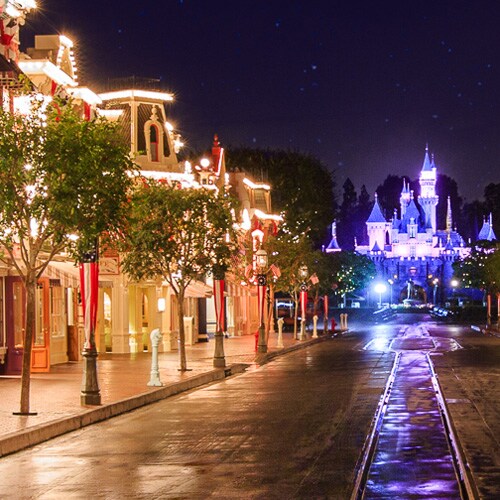
The official Main Street publicity image shows a carefully lit street leading toward Sleeping Beauty Castle. It offers evidence of a designed visual experience and of the park’s own promotional framing. It does not show every visitor’s experience or establish what the surrounding city is like. It is a contemporary illustration of the site Baudrillard discusses, not a photograph from the publication of his text. Disneyland’s Main Street page and source photograph.
Baudrillard first considers the park’s miniature, idealized version of America. He then argues that presenting the park as imaginary helps sustain belief in the world outside as simply real. Calling one place fantasy can protect that outside world’s claim to reality. His target is this relationship, rather than the straightforward observation that a castle is constructed. The November 18 presentation carries the selected continuous passage across two slides. The November 24 deck returns to it after the four phases, using the entrance plaque as a way to follow the argument. It comes from the text Doğan supplied; the wording matches the Poster selection, Hyperreal and imaginary. The corresponding Glaser argument crosses printed pp. 12–13 but uses different wording.
But this conceals something else, and that "ideological" blanket exactly serves to cover over a third-order simulation: Disneyland is there to conceal the fact that it is the "real" country, all of "real" America, which is Disneyland (just as prisons are there to conceal the fact that it is the social in its entirety, in its banal omnipresence, which is carceral). Disneyland is presented as imaginary in order to make us believe that the rest is real, when in fact all of Los Angeles and the America surrounding it are no longer real, but of the order of the hyperreal and of simulation. It is no longer a question of a false representation of reality (ideology), but of concealing the fact that the real is no longer real, and thus of saving the reality principle.
Jean Baudrillard, “Hyperreal and imaginary,” in Selected Writings, edited Mark Poster, 1988. Continuous selection from the supplied passage, without ellipses or omitted words.
The context and difficult terms. Immediately before this selection, Baudrillard describes an idealized America in miniature and considers an ideological reading of it. He then says that reading conceals a deeper operation: labeling the park imaginary helps preserve the belief that the world outside is securely real. Reality principle here refers to that maintained division. Hyperreality names the operation of signs and models in what is accepted as real, rather than merely a vivid fantasy. His claim challenges a reliable independent original against which representations can be judged. Carceral means relating to imprisonment or confinement. The prison analogy claims that a marked exception can conceal a more widespread condition; it needs argument and evidence of its own. Third-order simulation is Baudrillard’s term here for the wider operation of signs. Phase three in the four-phase image list concerns a sign that implies an absent source.
Scaffold 1: Disneyland declares the fantasy. The lit façades, orderly street and distant castle support an interpretation of a selected ideal environment. The official publicity photograph is another mediation of it. The first distinction is easy to identify: we recognize a named imaginary setting. Baudrillard then asks what that designation lets us assume about the outside world. Model this causal step before asking students to paraphrase it. A reasonable paraphrase is that putting fantasy in one marked place can make fantasy’s influence elsewhere less visible. This explains the claim without proving it.
The gate as a caption. The entrance plaque names the world inside as yesterday, tomorrow and fantasy. Berger’s account of surrounding words helps us ask how this label frames what visitors see. Baudrillard’s further claim concerns the world left outside. Calling the park fantasy can make the space outside appear to be ordinary reality by default. Observe the plaque, then identify the step from the words to an inference about belief. Disneyland’s official guide.
Can you leave a simulation? In the supplied video, characters in The Matrix can cross between the computer simulation and a material outside. Baudrillard’s argument asks how shared images and models already shape everyday experience. Switching off a screen does little to change the layout of a shop or the visual standard used to design a house. What part of that distinction could you show in Gursky’s photograph? Video, 06:13–07:05 · Baudrillard interview.
Richard Prince: advertising as a model of identity
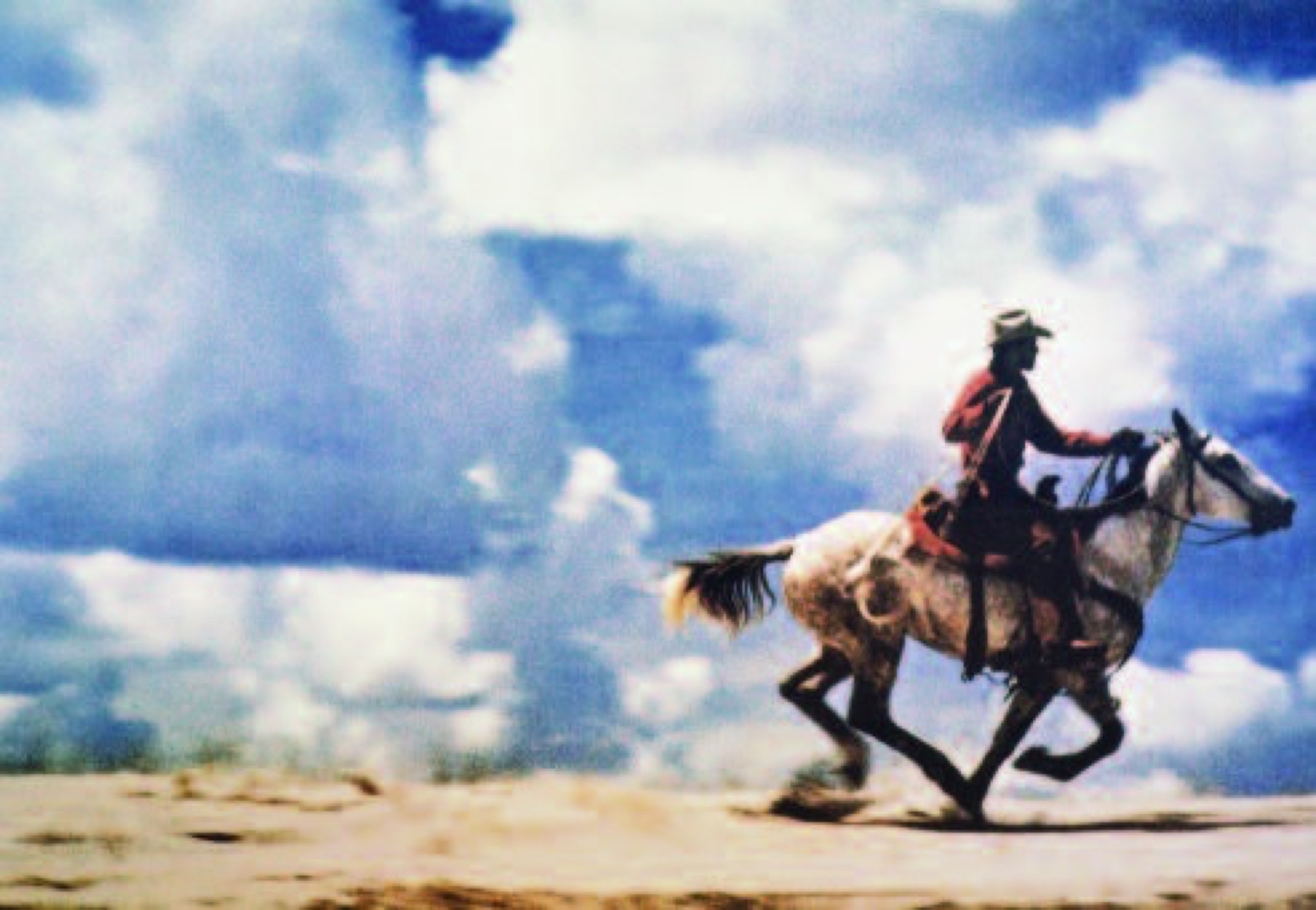
Richard Prince, Untitled (cowboy), 1989, verified museum teaching reproduction. Prince rephotographed a Marlboro cigarette advertisement and excluded the commercial text. The isolated rider, running horse and expansive cloudy sky can suggest independence and adventure. The absence of the pack does not remove the image’s commercial history. Guggenheim, complete Cowboys section and activities, PDF pp. 5–6; Met object 2000.272.
Scaffold 2: an image offers a standard to live by. Connect the visible relationship to an offered identity: a product advertisement can attach independence to buying and using the product. The image may then become a model for how someone wants to appear. This returns to the coffee advertisement’s offered gender role while widening the inquiry beyond domesticity. It gives a precise sense to Doğan’s signifier/thing formulation: the image supplies a standard for real conduct or self-presentation. It does not turn into a cowboy or prove how all smokers behave. Prince’s later work is our teaching comparison, not a case Baudrillard analyzes in this passage.
Andreas Gursky: signs in an ordinary store
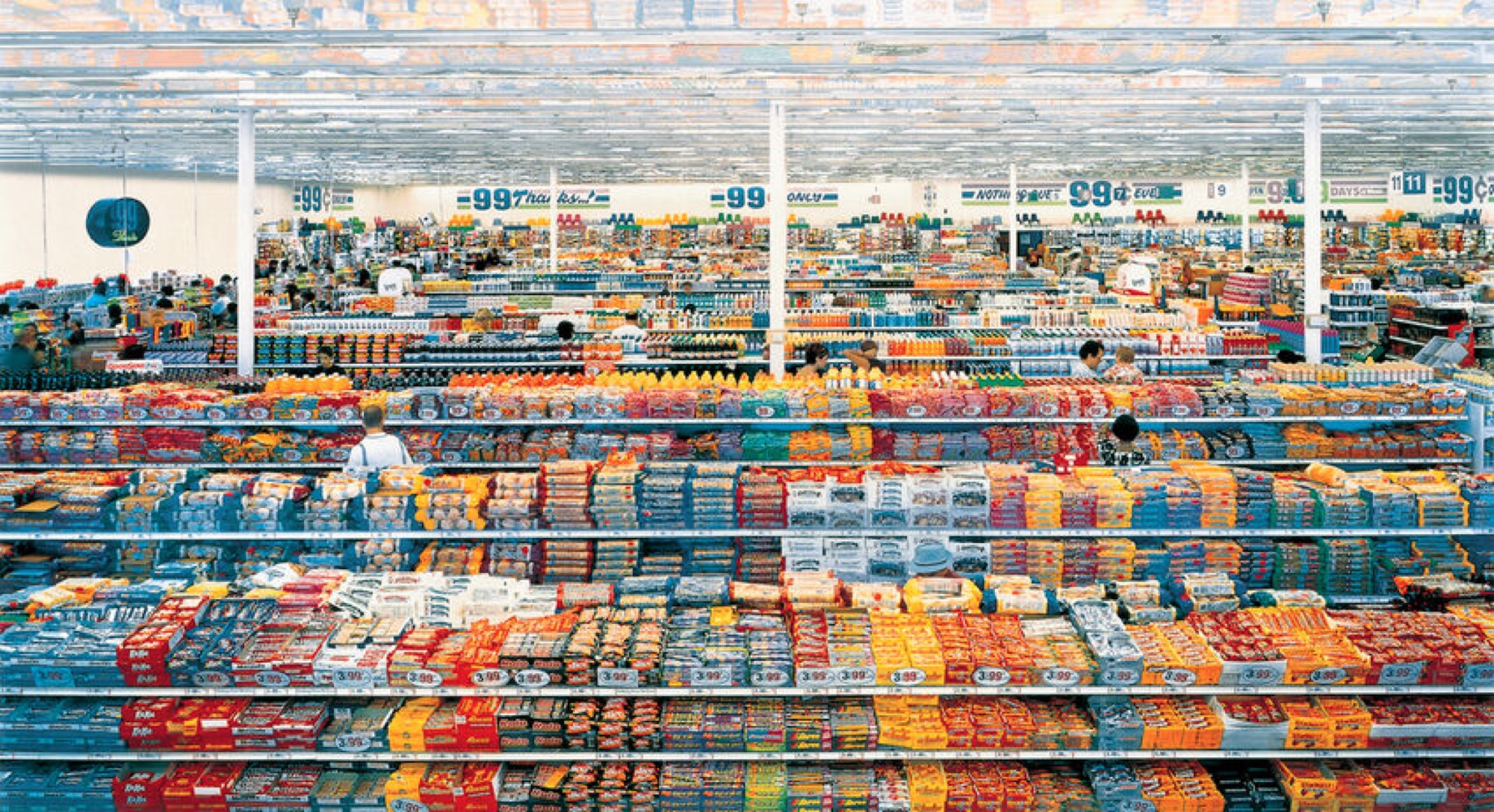
Andreas Gursky, 99 Cent, 1999, SFMOMA reproduction. SFMOMA identifies a Los Angeles store. Repeated shelves, saturated packages and large price signs organize the photographed space. The rows can direct attention toward a display of abundance, while the repeated price offers a standard of value. This is an interpretation of visible relationships; the photograph is also Gursky’s presentation. SFMOMA object record and complete audio transcript.
Scaffold 3: examine the outside world’s claim to reality. Students now test whether the ordinary commercial environment also relies on signs and designed expectations. The distinction becomes more difficult than fantasy inside, reality outside. Ask them to supply the connection with less teacher support, then a limit. The fact that a shop is designed supports a weaker claim than Baudrillard’s thesis. A critic can accept that media shape desires and still maintain a meaningful difference between an ideal image and the goods, money, labor and bodily consequences of shopping. This objection tests the theory rather than dismissing it with a label. Gursky is a teaching comparison, not evidence of his endorsement of Baudrillard.
Model of a qualified response, authored for this lesson: The Main Street photograph supports a claim that Disneyland offers a deliberately arranged image of an ideal street. Its lighting directs attention toward the castle and presents the street as orderly. Baudrillard’s argument asks us to examine the relation between that named fantasy and what visitors accept outside it. The image alone cannot prove the whole outside world operates through simulation. A visitor may recognize that both a theme park and an ordinary city are designed while still distinguishing their purposes and material consequences.
Warhol: actual action and filmed presentation
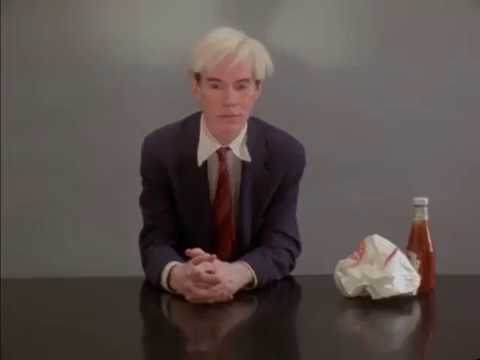
Jørgen Leth’s hamburger sequence was filmed in 1981 for 66 Scenes from America, released in 1982. Warhol eats while the camera records him. The screening version linked by Kunsten lasts 4:27; upload titles and museum catalog runtimes vary. Credit Leth as filmmaker and Warhol as performer. The preview file is a screening thumbnail, not an extracted high-resolution film frame. Kunsten’s teaching material, PDF p. 5; Leth’s account.
The camera, duration, selected setting and Warhol’s public identity give an ordinary action an audience. Test those features against the actual screening rather than assuming a required anti-consumerist message. The action can be materially actual while its presentation is constructed. This answers the painted-bed example from another direction: art and media can include real objects and actions, yet their presentation changes how we encounter them.
From this introduction to Berger and Danto
Berger will help us ask how a reproduction changes through its setting, scale and surrounding words. Later studies extend the inquiry into print commerce, film and perception, image circulation, photography and evidence. Danto adds a different question: how can something resembling an ordinary object be identified as art? His The Artworld (1964) places theory and historical understanding in that identification. His later end-of-art argument concerns the end of one necessary historical narrative and the coexistence of different practices; artmaking continues. These are related questions, not interchangeable theories. The full Danto lesson remains December 22. See Artworld.