John Berger: Reproduction and Context
Selected passages from Ways of Seeing, Chapter 1 (1972). See the November 20 and 23 classwork guide.
Before reading
Berger argues that reproduction changes where and how an image is encountered. The same image can enter different arguments. He also preserves a difference between an original material object and its reproduction. Read his claim as an argument to test, rather than a rule that every copy means anything at all.
Mark one phrase for discussion. No separate reading report is required.
Source quotations
Supplied chapter PDF, actual pages 7–8, 13 and 14–15. Nonconsecutive passages are separated by omission markers.
Source text: 423 words. Introductions, vocabulary and questions are course commentary. Paragraphs below retain the author’s wording; line wrapping is removed.
The uniqueness of every painting was once part of the uniqueness of the place where it resided. Sometimes the painting was transportable. But it could never be seen in two places at the same time. When the camera reproduces a painting, it destroys the uniqueness of its image. As a result its meaning changes. Or, more exactly, its meaning multiplies and fragments into many meanings. This is vividly illustrated by what happens when a painting is shown on a television screen. The painting enters each viewer’s house. There it is surrounded by his wallpaper, his furniture, his mementoes. It enters the atmosphere of his family. It becomes their talking point. It lends its meaning to their meaning. At the same time it enters a million other houses and, in each of them, is seen in a different context. Because of the camera, the painting now travels to the spectator rather than the spectator to the painting. In its travels, its meaning is diversified.
One might argue that all reproductions more or less distort, and that therefore the original painting is still in a sense unique.
[Passage omitted.]
Paintings are often reproduced with words around them. This is a landscape of a cornfield with birds flying out of it. Look at it for a moment. Then turn the page.
[Image/caption comparison reconstructed below.]
It is hard to define exactly how the words have changed the image but undoubtedly they have. The image now illustrates the sentence. In this essay each image reproduced has become part of an argument which has little or nothing to do with the painting’s original independent meaning. The words have quoted the paintings to confirm their own verbal authority. (The essays without words in this book may make that distinction clearer.)
[Passage omitted.]
Consequently a reproduction, as well as making its own references to the image of its original, becomes itself the reference point for other images. The meaning of an image is changed according to what one sees immediately beside it or what comes immediately after it. Such authority as it retains, is distributed over the whole context in which it appears.
[Passage omitted.]
Original paintings are silent and still in a sense that information never is. Even a reproduction hung on a wall is not comparable in this respect for in the original the silence and stillness permeate the actual material, the paint, in which one follows the traces of the painter’s immediate gestures. This has the effect of closing the distance in time between the painting of the picture and one’s own act of looking at it.
Image and caption comparison
Look at the image before reading the caption on the following line. In print, cover the caption at first.
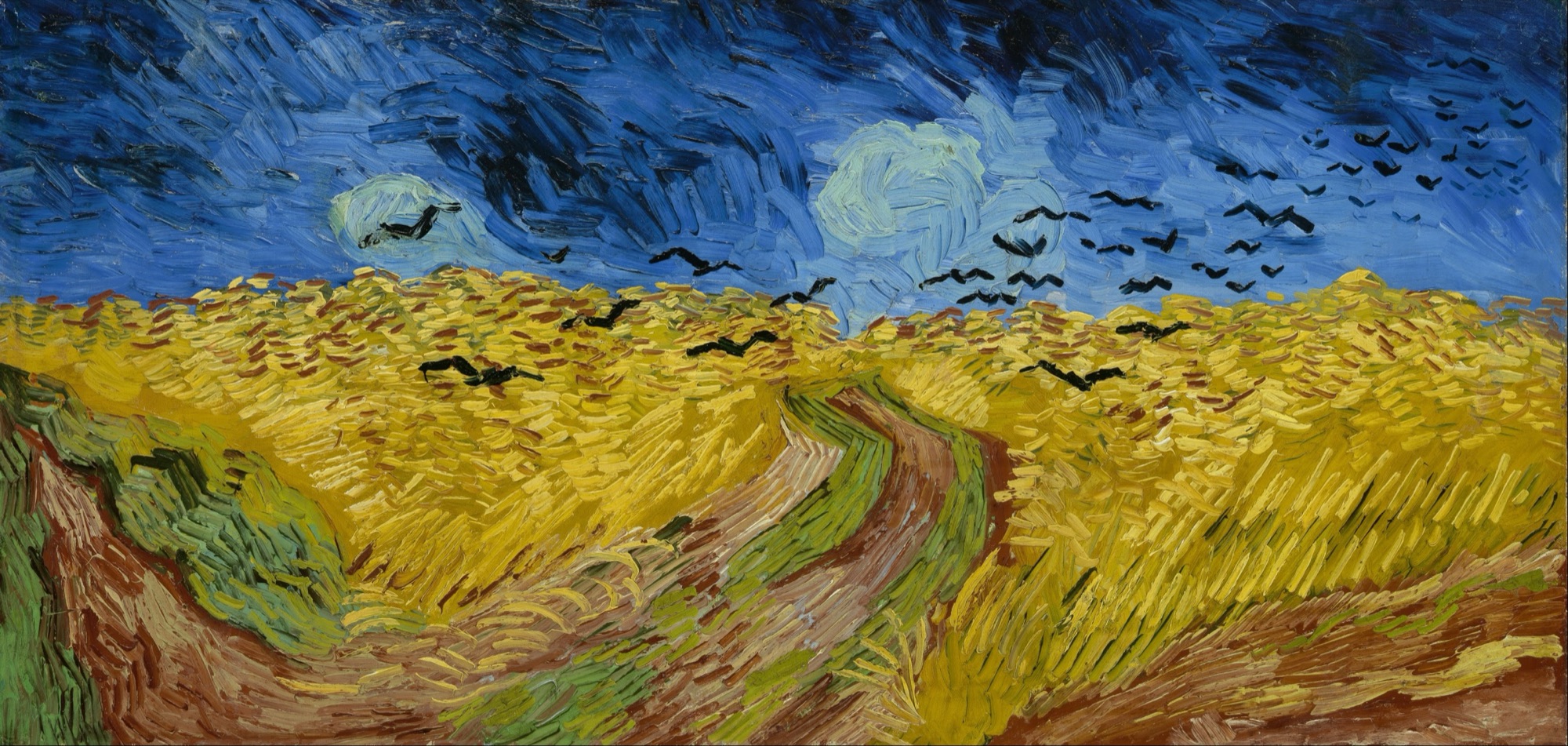
Vincent van Gogh, Wheatfield with Crows, 1890. Van Gogh Museum, Amsterdam. Existing course reproduction, public domain.
Source quotation
Caption used in Berger’s demonstration:
“This is the last picture that Van Gogh painted before he killed himself.”
Compare the framing
This reconstructs the comparison because the supplied webpage PDF has a missing image. The caption is a historical claim to verify, not a fact established by the painting or a reason to assume its mood. Explain how it directs your reading. The painting’s sequence within Van Gogh’s last works should be checked through an artwork record before using that claim as evidence.
Vocabulary
- Reproduction: Another version made through a process such as printing or photography.
- Context: Surrounding words, objects and circumstances that affect interpretation.
- Authority: The power to make a reading seem credible.
- Mystification: An explanation that hides how value or power operates.
Discuss
- Choose one visible relationship in the painting before reading the caption. What changes in your account after the caption?
- Does the caption direct attention to a detail, or supply information that the image cannot establish?
- What could remain important about encountering the original even if the reproduction is useful?
Connection
Steyerl follows the routes by which copies reach these settings. Ask who gains access and who controls the route.
Full source / further reading.