Scriptwriting and Storyboarding
Friday proposal resources: Proposal template (Word) · Proposal template (PDF) · Completed proposal example (Word) · Completed proposal example (PDF) · Later workshop: Scriptwriting and Storyboarding (PDF)
Lesson slides: Download the deck (PowerPoint, 20.2 MB) · image credits
At a glance
| Dates | Fri 20 Nov P6 12:35–13:20 |
| Time | Friday P6 is 45 minutes of independent classwork, 12:35–13:20. |
| Assessment | Film Opening Proposal is graded Course Skills. Submit the post’s direct link by Tuesday, November 24. |
| Work | Use either Friday or Monday to start the proposal or the Section B worksheet. |
Open the November 20 and 23 classwork guide for both tasks.
Objectives
For Friday’s independent work, record and justify the current opening, intended viewer response, representation, feasibility and next research question.
The following objectives guide the subsequent script/storyboard and practical workshops after proposal check and research:
- Write two minutes of screen time in screenplay format, with the title and each credit placed on a line of its own
- Draw a storyboard frame that carries the shot type, the angle, the movement, the sound and the running time, so a stranger could shoot it
- Review a partner’s storyboard against Cambridge’s research and planning criteria and write actions in that language
- Cast the opening from people they can actually get, and say what each choice says
- Check a location for light, sound and risk. Shoot at least one planned frame, compare a viewer’s reading with your prediction and record a revision.
Goal
Students document the opening before filming it. The current semester plan leads to the December 23 pre-production gate, January readiness check and principal filming during January 24–February 21. Students use the intervening weeks to produce planning evidence a moderator can review. Cambridge’s top candidate posted a script, a storyboard, an animatic, casting, a recce and a shot list, and her planning was called sophisticated because every choice on screen could be traced to a page on the blog. Cambridge’s Level 3 candidate posted one planning page and was asked six questions about it.
Friday records the current proposal and reasons before the teacher direction check and focused opening research. The subsequent workshops turn a checked, researched choice into a readable, timed plan and then test its meaning in footage. The proposal, research, plan and justified revisions become evidence for the pitch and later production approval. Scheduled or prepared work is not treated as completed evidence.
How it runs
Script and storyboard workshop reference · after proposal check and research
This prepared workshop is follow-up material after the recorded proposal, teacher direction check and focused opening research. Its allocation will be confirmed separately; it is not the independent task for November 20.
P6, 12:35–13:20. Model and annotated p. 153 frame 8 minutes, check each maker’s confirmed direction, available initial research and next action 10, screen action and credits 15, begin frames 12. Break 13:20–13:30. P7, 13:30–14:15. Finish frames 3 minutes, shot list 10, introduce the peer review 5, review in pairs 25, save/share 2.
Bring the dated working proposal and reasons checked before research, the initial research notes actually available and a provisional annotation, alongside representation/casting notes. Identify the decision carried forward and develop it across the script/storyboard. If a prerequisite is incomplete, identify it from the actual entry and complete it before dependent work. The final posting block saves work in progress; it does not require polished posts or extra preparation prose.
The two pages on screen (8 min)
Show the diner passage from Little Miss Sunshine through its screenplay. Olive is travelling to a child beauty pageant. After Richard comments on ice cream, she offers hers away. The family begins eating and Olive takes a bite. Use one minute to establish the situation, two for the source, two to compare holding on Richard with cutting to Olive, and three to mark the same decision in a p. 153 frame. These two framings are possible student choices. Keep Candidate B’s printed storyboard and script as format references.
Open §6.3, p. 153 beside the annotated frame each student brought. Ask a partner to predict the image and sound without the script. Compare the prediction with the labels.
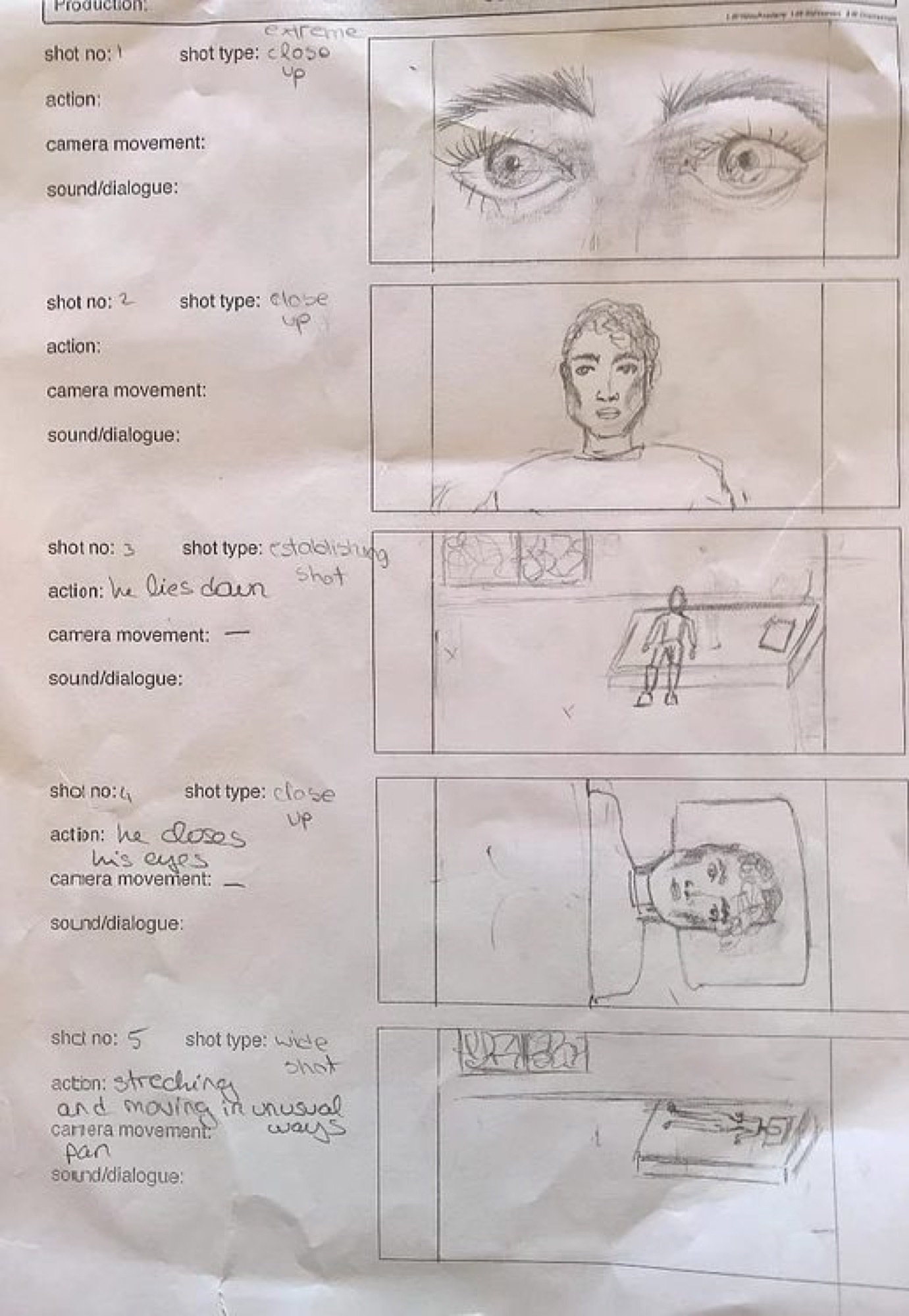
What each frame carries: the shot, the angle, the movement, the sound, the running time, and where the title sits.
Then the format rule for a screenplay: scene heading, action in the present tense, a character name over each line of dialogue, and every title and credit on a line of its own where it appears, because credits are part of the two-minute opening. Use the title research actually available; mark placement provisional where the comparison is still in progress.
Actual-material review (10 min):
Use the first four minutes of the existing ten-minute clinic to read the questions in Activity 3.17, pp. 80–81. Apply them to one current frame: who acts, whose perspective is missing, and whether a stereotype is supported by the actual image, rather than assumed? Show the teacher the frame and casting evidence beside the script and research. First establish which source and observations are actually available from the focused research actually completed after the proposal check. Use that initial evidence to check the provisional annotation, intended convention, character conflict and order of information; the full three-opening and titles studies remain in progress. Ask what the partner inferred and what the maker chose to revise. A genre variation is a local planning focus, not a Cambridge preference for subversion over effective conventional work. Check one design, framing or sound choice against the intended audience. Name one next practical action. Ask the maker to point to the reference, the frame or sound it changed, and the impression they want to give. Identify the representation supported by a framing, sound or performance choice. Explain whether it uses, questions or challenges a familiar convention.
The script (15 min)
Estimate duration through a read-through or animatic; page count alone cannot establish two minutes.
Written from the concept and the who-is-in-it notes: the action and information your opening needs, with any ident, title and credits placed where the reference research and intended meaning justify them.
No fixed first-minute/second-minute formula is required. Dialogue only where the audience needs a fact from it.
The teacher uses the existing ten-minute artifact check and circulation to ask: ask what the script changes from its genre models and how that choice appears on screen.
The storyboard (15 min)
one frame per shot, drawn on the printed grid (twelve frames a sheet; stick figures are fine, the use arrows where they clarify movement).
For this classroom review label each frame with shot type, angle, movement, sound and seconds. The two-minute Cambridge limit includes the opening titles. The grid and these five labels help a partner understand the plan.
Draw the title and each credit into the frame where they currently land. Use available title research and identify any font or placement still requiring investigation.
Draw enough frames to make the planned shots clear and estimate their duration. There is no Cambridge requirement for a fixed number of storyboard frames.
Pairs swap at the halfway point and read each other’s frames without the script: can I tell what the camera does?
The shot list (10 min)
The storyboard turned into a list in shooting order, not story order: every shot with its location, its people, its equipment and its light. Two columns added that the storyboard cannot hold: what could go wrong and the shot I would cut if I lose an hour. This is the sheet the call sheet is built from on Fri 11 Dec.
The instrument (5 min)
Cambridge’s research and planning strand on every desk, read the storyboard feedback checklist together: the review asks three questions of a storyboard, could a stranger shoot it, does it do what the research said, and does it fit two minutes, and answers in the strand’s own words.
The review, in pairs (25 min)
Storyboards swapped. Each reviewer works frame by frame with the checklist: every frame has its five labels; the title and credits are placed; the sound column is not empty; the running times add up to 120 seconds or fewer; the shortcut named in the who-is-in-it post is visible in a frame; the variation from the genre contract is visible in a frame.
Then the three questions answered in writing, describe → question → suggest, and an action list of three items in criteria language handed to the owner.
Give your partner the feedback sheet to use while revising the storyboard.
Posted (2 min)
the script and the storyboard posted before leaving, labeled Planning, dated today: the pages photographed or scanned, a concise explanation of what changed between the concept and the script. Keep the feedback where you can refer to it when you revise. Use the review actions to prepare a later supervised practical test.
Storyboard review and related analysis · follow-up reference
After the script/storyboard workshop, keep a copy of the partner review to select a later practical test. For the November 18 Section B practice, use Gender, Voice and Power.
Friday November 20 · Independent film-opening proposal
P6, 12:35–13:20. Use the November 20 and 23 classwork guide. If you start with the proposal, use the template and completed model in Friday independent work. Create a blog post titled Film Opening Proposal, label it Planning and save the six reasoned responses there. The teacher direction check follows this lesson and precedes focused research.
Later supervised practical reference
The following casting, recce and filmed-test guidance is retained for use after the proposal check, focused research and script/storyboard preparation. Use this guidance in a later supervised practical session, after those prerequisites.
The action lists first (5 min)
Apply the partner review’s actions to the storyboard: frames redrawn, seconds corrected, a credit placed. The teacher starts with the storyboards whose reviews identified the most issues.
Casting (6 min)
Use up to two minutes for Joy’s introduction of Becky in Everything Everywhere All at Once. Joy is trying to introduce her girlfriend to Gong Gong. Evelyn supplies the words “good friend.” Read Joy’s reaction. Ask whose words the grandfather receives and what the audience knows about their relationship. Use the other four minutes to check the maker’s performers are available, record their agreement, and choose whether to hold on the speaker or cut to the person whose relationship is being described. Keep any performer photograph with permission.
Recce and risk (9 min)
The location decided, the recce sheet started: enough photographs to explain the planned setups, how each spot will be used (which frames), the light at the time of day the shoot will happen, the sound problems (traffic, a fan, a corridor), and one risk per use with what removes it.
Photograph off-campus locations only within an agreed, realistic preparation plan with suitable access.
On-campus locations can be checked now with a phone.
Use a focused recce action to develop the actual A3 plan; arrange larger travel and preparation separately.
Test shots (19 min)
Two frames from the storyboard shot on a phone in the building, the hardest one and the first one, and looked at on the screen: does the shot type read, is the light enough, can the sound be heard. Equipment out by sign-out slip for the test, back before the bell.
Exit condition
Every student records at least one planned shot from their own storyboard before leaving. Aim for the first and the hardest shot. Before showing the clip, write down the impression and information you intended a viewer to take from it. Link one framing, sound or performance decision to the actual genre/narrative annotation and research. Ask one viewer what they inferred and which detail led them there. Record their words and the detail they noticed, then revise one framing, sound or performance choice to communicate the intended representation more clearly. Save the original, revision and reason. This is evidence from one viewer. For Section B, a claim about a wider audience also needs a release, campaign or audience source.
Record which practical requirements still need work and identify the next action for the following supervised check.
Post before leaving (6 min)
Post the casting, recce and test evidence actually produced at the supervised clinic, labeled Planning and dated when completed. Keep the practical result and the reason for any revision for the next planning review.
Assessment
| Item | Date | What | AO |
|---|---|---|---|
| Script and storyboard | After proposal check and research | Two minutes in screenplay format and a storyboard with the five labels on every frame and the titles placed; posted, checked at the desk, not graded. A3 material | AO3 |
| Related Section B practice | Wed November 18 | Gender, Voice and Power uses Hulu’s SXSW promotion to practice audience targeting. | AO1+AO2 |
| Film Opening Proposal | Work Fri November 20 or Mon November 23. Due Tue November 24 at 23:55. | Course Skills. Submit the direct link to the new proposal post with your six initial responses. | AO3 |
| Casting, recce and risk, test shots | After proposal, research and storyboard preparation | Practical planning and test evidence; checked, not separately graded. A3 material. | AO3 |
See the full register.
Practice
Friday independent work
Use the November 20 and 23 classwork guide. For the proposal, plan your own fiction-film opening of up to two minutes, including titles.
- Read the initial proposal in the completed example. Notice how it explains the effect of a specific choice, gives reasons for selecting a beginning and identifies what still needs checking.
- Open your coursework blog and create a new post titled Film Opening Proposal. Label it Planning and use today’s date. Keep your earlier alternatives and feedback where they are.
- Use your own ideas and previous feedback to answer all six template questions in the post. Explain what you want viewers to experience, how you will represent the main character, what resources you can use and what you need to research. Mark any choice you still need to check. If you cannot open your blog, write your answers in the template and keep them ready to publish.
- Publish the post by Tuesday, November 24. Open its direct link and check that all six answers are readable and explain your choices. Keep any unresolved question visible for the teacher direction check.
This is a Course Skills assignment. Submit the direct link to your proposal post by Tuesday, November 24. Read the rubric in Film Opening Proposal. Show the initial proposal at the teacher direction check before beginning focused opening research. The model’s later update shows a subsequent stage after feedback and research; The proposal you submit is the initial version. Use the detail and reasoning as a guide, without copying the model’s project or treating its length as a word-count requirement.
Script/storyboard practice after proposal check and research
Open the November slides by dated section
After the teacher direction check and focused research, use the actual proposal, opening study, annotation and next research question throughout the script/storyboard and later practical test. Keep the resulting evidence for the pitch. Read §6.3, p. 153. Use Olive’s breakfast and Activity 3.17, pp. 80–81. Sketch staying with Richard and cutting to Olive’s reaction. Label shot size and angle, then explain what each framing lets the audience see, hear and infer. Transfer one such choice to your own frame. Swap it with a partner and ask what image and sound they expect.
1. Pick any frame. Without the script, can a stranger tell what the camera does? Name the five labels the frame must carry.
Answer: Shot type, angle, movement, sound at that moment and seconds. These labels let the reviewer locate what the plan specifies and identify what still needs clarification.
2. Add up the seconds in your storyboard. What do you do if the total is 150?
Answer: Identify repeated information or unnecessary duration and choose a revision to the plan. Check the total again, including titles and credits. The opening must be no longer than two minutes.
3. Where does your title appear, in seconds, and why there?
Answer: Name the current second and explain the intended effect. Use the title/opening research actually available. If that comparison is incomplete, mark the decision provisional and identify the professional title placement you still need to investigate. Revise the plan when further research gives you evidence.
4. Identify a frame showing your variation from a genre convention. Identify a framing, sound or performance detail that constructs the intended representation.
Answer: Point to the frame and its labels. Explain the convention, what changed and the representation you intend. The reviewer should be able to locate the evidence without your spoken explanation.
5. Read your shot list. Name the shot you would cut if you lost an hour, and the thing most likely to go wrong.
Answer: Identify the shot and explain the consequence of removing it. Name the practical problem and a feasible alternative that preserves the essential information.
6. In the later supervised practical workshop, read Joy and Becky’s introduction. Name what Evelyn’s interruption lets the grandfather hear and what Joy’s reaction lets the viewer infer. Apply the choice to a shot you can film. Show it without explanation, record the viewer’s actual words and revise one framing, sound or performance decision. Save the original frame and your reason for the C1 reflection.
Source quotation
All video work should use a screenplay, alongside the storyboard, and you may also want to produce a script for your actors to use.
Cambridge International AS & A Level Media Studies coursebook, §6.3, p. 154.
Suggested reading
Assigned reading · printed coursebook pages
For the script/storyboard workshop after proposal check and research. Read §6.3, p. 153, “Storyboards for video productions”. Bring a frame with an image note and a sound note. Have your partner read it without the script: what would they expect to see and hear? Clarify a label for the partner review and test that prediction in a later supervised practical session.
Use the linked task brief, the Exam Answer Guide and the Shoot Guide as needed.