Paper 2 Examination Practice
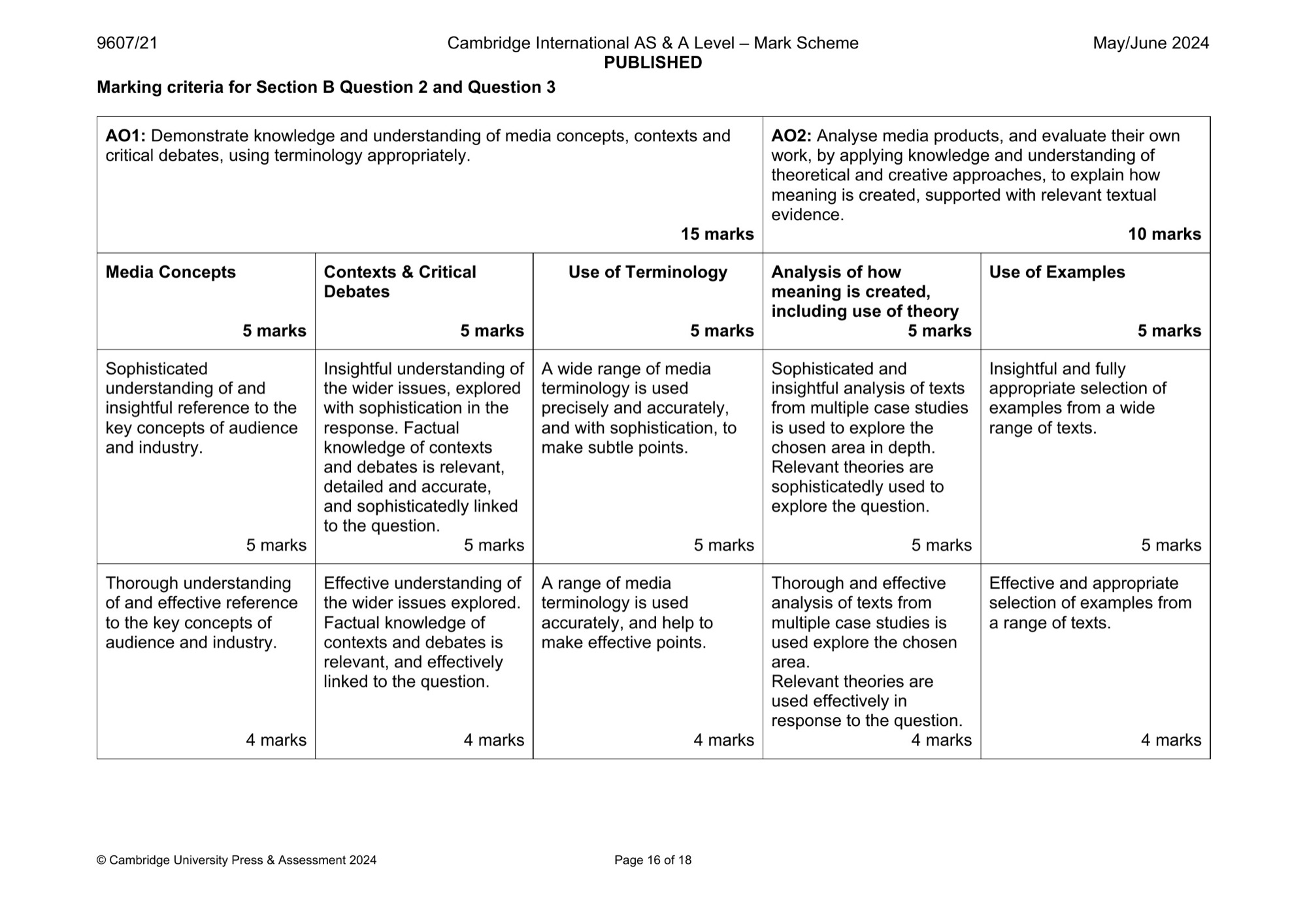
Section B case-study pack: Barbie and La Chimera: complete printable pack · Revision sentences and official marking grids (PDF)
Lesson slides: Download the deck (PowerPoint, 1.9 MB) · image credits
At a glance
| Days | 4, Mon (existing case-file review), Wed double (the timed Section B), Thu, Fri (last teaching day). Reflowed Tue 25 Aug: the plans drill joins Monday at two rounds; Thursday takes round three, the compare, and the calibration follow-up |
| Dates | Mon 4 Jan · Wed 6 Jan · Thu 7 Jan · Fri 8 Jan |
| Band/Unit | U6 Revision (Analytical Synthesis) |
| AO focus | AO1 + AO2 |
| Deliverable | the timed Section B script, 45 min, peer-marked then moderated |
| Feeds | End of Term Exam |
| Homework | Individual revision from the marked timed Section B and matrix; WS4.5’s five pairing sentences. No new graded task. Principal photography is January 24–February 21. Use concise dated production evidence and two footage copies; any short C2 practice fits within the agreed filming workload, with no extra weekly uploads. |
Objectives
By the end of this lesson, students should be able to:
- State the full paper structure and their per-section minute allocation from memory
- Write a complete Section B answer in 45 minutes using their own case studies
- Mark a peer script against the scheme and justify the band awarded
- Name their two most likely mark-loss points and the counter-move for each
Goal
Students rehearse the exam format and timing using their existing case file and December revision plan. Peer-marking makes every student use the criteria as a marker, helping them identify likely mark losses and specific responses.
How it runs
D1 · Mon 4 Jan: the paper, end to end
Case-file review (10 min):
Reopen the existing coverage matrix and class revision plan. Each student names one evidence gap and locates the relevant source or notes. No holiday pack is collected.
The A2 paper again, both sections (17 min)
The A2 paper back on the desks, with each student’s marked A2 script beside it.
Section A first, briefly: the extract screened once against its printed question.
Then its Section B, which A2 did not test: the paper’s Section B pair (media ownership and content; audiences as active participants) read against the case study, one question chosen, and a five-minute plan written for it.
The rubric’s own clock: 30 minutes viewing and notes (four screenings, no notes on the first, notes crossed out) · 45 minutes Section A · 45 minutes Section B.
The format is familiar from A2, A4 and the guided Section A; this is the assembled whole.
Read the Section A question aloud and identify what the actual paper asks. Familiarity with the format should support careful reading of the current prompt.
The drill (14 min):
five-minute Section B plans, two rounds, questions from the timed Section B bank: read, plan the reasoning required by the command with relevant case-study facts, pens down at five minutes exactly. The claim/evidence/counter/response structure is an argument rehearsal, not a universal examination template.
After each round, check whether the plan includes more relevant evidence and a clearer argument. Round three comes Thursday.
Close (4 min):
Each student writes their personal minute budget inside the sections: paragraphs, plan time, check time. Use that budget in Wednesday’s timed response.
The case-file review uses the pack audit and the student’s December target. Use original pack questions 2 and 4 for the two plan rounds, leaving the January 6 selection to the day. Check whether different questions produce different evidence choices, not a memorized general essay.
D2 · Wed 6 Jan (double): the timed Section B, full dress
Set-up (5 min):
One question chosen on the day from the bank; conditions on.
the timed Section B (45 min):
The full Section B, timed exactly, on their own case studies.
Peer-mark (30 min): Beat the Examiner, full dress
(routine): scripts swapped; every student marks a peer’s script against the official five-criteria rubric, band words and all, comments in the WS 4.6 comment-bank style; the closest banding to the moderated mark takes the round. Use the peer-marking process to practice applying the criteria.
Moderate (10 min):
The teacher moderates a live sample of three scripts in front of the room, thinking aloud where the peer marks drifted. Explain the evidence for each moderated band.
D3 · Thu 7 Jan: third plan, independent rewrite and feedback
Round-three plan (5 min):
Complete the third five-minute Section B plan from the question bank. Keep the command, key terms and relevant case facts visible. Use a counterargument where it helps answer a judgment question; an Explain answer needs developed reasons and relationships. In feedback, partners check whether a stranger could write the essay from it.
Independent writing (25 min):
Rewrite the weakest paragraph of your January6 timed Section B response using its actual feedback and the five-step chain. Explain the named evidence and its consequence for the argument. Write without a partner or a model answer. Use the question and your permitted notes.
Feedback (8 min):
Exchange the paragraph and use the official five criteria. Identify one inaccurate term, unsupported claim or missing link from evidence to meaning. The teacher checks the correction.
Rewrite (7 min):
Revise the weak connection independently. Keep the original and the revision together, underline the changed passage and hand in the document.
D4 · Fri 8 Jan: the AO economy, last teaching day
The economics (20 min):
Where the 25 marks actually sit: AO1 15 (concepts / contexts / terminology) · AO2 10 (analysis / examples), five criteria, best-fit per criterion.
First the A2 paper’s mark scheme read in full, after Monday’s return to the paper: the Section A worked reading, element by element and mapped onto the five criteria, and the Section B grid Monday’s plans are measured against; then the class’s timed Section B results against the same grid: which criteria the class addresses fully and which need more work.
Two loss points (15 min):
Each student leaves with two named loss points and the counter-move for each, written on one card that goes into the revision deck (“I list techniques without effects → every technique gets a ‘so that’ clause”).
The shoot briefing, and the second chance at the gate (10 min):
Window B students: the equipment signed out for the vacation by sign-out slip, one call sheet per shoot day on the blog before the first shoot day, concise dated notes and selected stills after each, the footage backed up in two places before the next day.
Anyone with December 23 repairs shows the revised evidence.
Approve a feasible plan or agree a specific repair, support and check before the break.
The first two spring weekends are reserved for limited pickups, not an automatic replacement for principal photography.
Then the exam logistics, once, calmly: window opens Monday, slot from the exam office, screening facilities booked, bring nothing but pens.
The last teaching day of the semester ends on the success check: the full paper structure and per-section minute budget, stated from memory.
Individual revision: The companion to WS 4.5 names all five pairing sentences: three supplied scenarios and two actual moments from the January 4 sealed A1 extract replay. Pair technique and scene content in each sentence. The longer plan-comparison discussion is condensed into Thursday’s eight-minute feedback block so the rewrite receives25 minutes.
Assessment
| Item | Date | What | AO |
|---|---|---|---|
| Timed Section B | Wed 6 Jan | Timed Section B script, 45 min, own case studies; peer-marked then moderated | AO1+AO2 |
Timed Section B on January 6 is the week’s assignment; no separate holiday pack is due January 4. See the full register.
Practice
Revision sentences and criterion feedback, with official grids
Use page 1 for five pairing sentences: the three publisher scenarios plus two actual moments from the sealed A1 extract extract replayed January 4. Use page 2 and the appropriate complete official grid for January 6 peer marking. WS 4.6 is a limited comment scaffold, not the full 25-mark scheme.
Use Barbie and La Chimera pack for the film-industry work in this lesson. Select source cards that answer the question, explain the institutional or audience consequence, and state the limit of the evidence. Keep the work in the existing case file.
The week’s goal is to make the exam boring. These make it boring faster.
1. State the paper’s clock from memory.
Answer: Thirty minutes of viewing and notes: four screenings, no notes on the first. Then forty-five minutes for Section A and forty-five for Section B. If you had to look that up, run this question again tomorrow.
2. Where do Section A’s 25 marks actually sit?
Answer: AO1 carries 15, across concepts, contexts, and terminology. AO2 carries 10, across analysis and examples. Five criteria, best-fit per criterion. Feeding the criteria you naturally starve is worth more than polishing the ones you naturally feed.
3. What should a five-minute Section B plan establish, and how will you check it?
Answer: Identify the command and focus, state your answer and select precise case evidence. For Explain, plan the reasons or relationships to develop. For Assess, Evaluate or To what extent, plan the judgment and evidence that qualifies it. A counterargument is not compulsory in every Explain answer. Check whether another reader can follow how the evidence answers this question.
4. Why does peer-marking a script teach more than being marked?
Answer: Because you read the mark scheme as a marker once, band words and all, before it is used on you. The scheme stops being an enemy the moment you have wielded it. The mark you award is a by-product. The reading is the lesson.
5. Write your two loss-point cards. Model: “I list techniques without effects, so every technique now gets a ‘so that’ clause.” Name your own two most likely mark losses and the counter-move for each. Put the card in your revision deck.
6. Run the plan drill: three rounds of five-minute Section B plans from your own case studies, pens down at five exactly. After each round, check whether your evidence and reasoning answer that question more accurately.
Weekly work and winter readiness
Use the weekly assignment route. Each normal teaching week has one Course Skills assignment or an attainment. Use existing classwork where the brief allows it. Every task produces material for the student’s own C1 portfolio or practices a C2 response. Other class exercises receive feedback without another submission.
Source quotation
You should view your media text extract numerous times.
Cambridge International AS & A Level Media Studies coursebook, §4.1, p. 86.
Suggested reading
Use the coursebook section cited above and the linked current task brief. For timed writing, consult the Exam Answer Guide; for production, use the Shoot Guide.