Lesson 08: Representation Applied to Your Own Product
Media Studies · Unit 4 · Lesson 08 of 16 · ← L07 | L09 →
At a glance
| Days | 6 — Mon (A2 due), Tue, Wed double, Fri, then Mon + Tue standalone |
| Dates | Mon 2026-10-26 · Tue 10-27 · Wed 10-28 · Fri 10-30 · Mon 11-02 · Tue 11-03 |
| Band/Unit | U4 Representation (S1 Unit 4) |
| AO focus | AO3 (A2 in); representation theory toward AO2 |
| Deliverable | A2 submitted day 1; stereotype audit of your own rough cut, evidenced for LB3 |
| Feeds | A3 |
| Homework | Production pickups identified by the audit |
These dates may shift when the school publishes the calendar for this period; any change will be confirmed in class.
Goal
You learn representation theory and then apply it straight to your own work. The week opens with A2 going in and closes with two standalone sessions where your rough cuts are screened as an audience would see them and audited for stereotypes you may not have noticed. The point is to find real problems while there is still production time to fix them.
How it runs
D1 — Mon 10-26: construction, not reflection
- A2 in (5 min) — submit your blog URL. Mid-terms are Thursday.
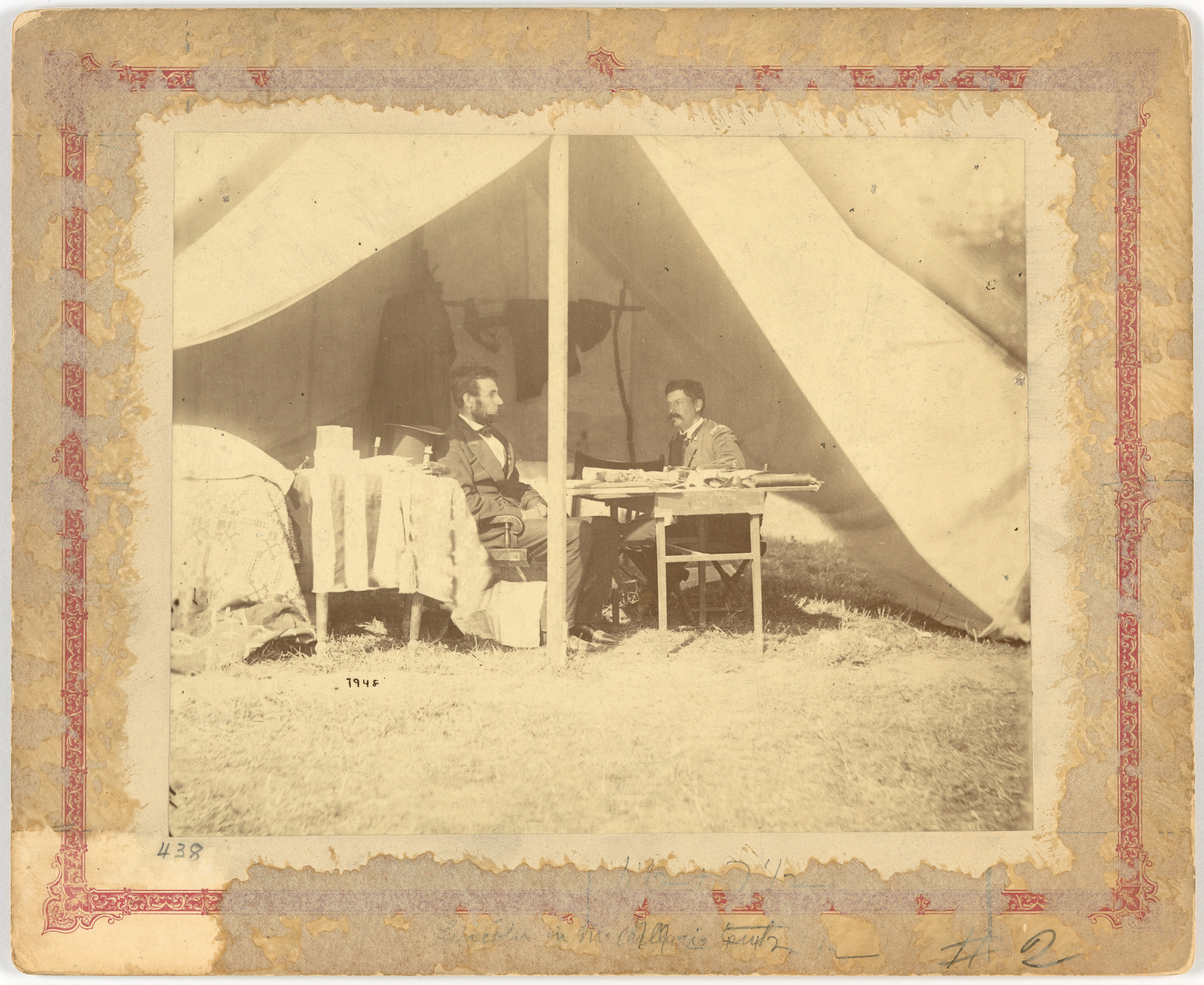
- The claim (15 min) — representation does not reflect the world; it constructs a version of it, by selection and combination (coursebook §3.3: “never objective”). Example: Lincoln and McClellan posed in a tent at Antietam, 1862 — the photo-op is older than the word. Every choice — the tent flaps, the table, who sits — is doing representation work.
- Same person, three ways (20 min) — one public figure, three found images (official portrait, news photo, meme or fan edit); in pairs, list what each version selects, combines, and asks you to conclude. The person never changed; the construction did.
- Close (5 min) — write one line in your sketchpad: “My C1 product represents … as ….” You will interrogate it all week.
D2 — Tue 10-27: Hall’s reading positions
- Input (15 min) — Hall’s encoding/decoding: the maker encodes a preferred meaning; audiences decode from dominant, negotiated, or oppositional positions. The meaning is finished in the audience, not the text.
- Place yourself (20 min) — one shared text; write your honest position on it and defend it with evidence from both the text and your own situation. The room will not agree — that disagreement is the theory working.
- Close (10 min) — theory card: Hall. Then the turn inward: what position does your C1 product assume its audience will take? Could it survive an oppositional reading?
D3 — Wed 10-28 (double): stereotyping as power
- Input (20 min) — from §3.3: a stereotype is not a lie, it is a shortcut with a beneficiary — who benefits, who pays; counter-stereotypes (UP’s Carl) and why they register as surprising at all.
- Case pair (35 min) — two contrasting stereotype cases worked in groups (one Western media, one Chinese media): identify the shortcut, its history, its beneficiary; then run Hall’s positions across both — who reads each dominantly, who oppositionally?
- Nation branding (25 min) — how is your country represented for global audiences? (Downton Abbey Britain as the worked example). In groups, list the selections a “China brand” makes and what each leaves out.
- Close (10 min) — WS 4.2 exit ticket: describe your own look today (micro); what does it represent (macro)?
D4 — Fri 10-30: absence
- The instrument (10 min) — selective construction’s quietest tool: absence. What is never in the frame cannot be argued with; who never appears cannot complain.
- Absence inventory (25 min) — inventory one text for its absences: who is missing, what work each absence does, what would change if it were repaired. Then the turn inward again: run the inventory on your own C1 planning — who is absent from your product, and is it a choice or a default?
- Close (10 min) — screening logistics for Monday: no introductions, no apologies.
D5 — Mon 11-02 (standalone): the screening
- Rough cuts screened under audience conditions (35 min) — the work speaks alone: no introductions, no apologies, no pausing. Complete response cards while watching: what did you understand the product to be saying; where did your attention drop; name one person or group and how the product positions them.
- Close (10 min) — cards are handed to the makers, unread by anyone else. Tomorrow they become evidence.
D6 — Tue 11-03 (standalone): the audit
- The audit (30 min) — each group audits its own product with the week’s full toolkit: construction (what did we select and combine?), positions (what reading did we assume?), power (whose shortcut did we borrow?), absence (who is missing?). The response cards are the audience’s testimony.
- The fix list (10 min) — convert findings into production pickups with dates; LB3 posted (screening participation, response quality). The pickups are your homework — this is why the audit happens now, with production time left.
Assessment
| Item | Date | What | AO |
|---|---|---|---|
| A2 | Mon 2026-10-26 | C1 blog mid-point, posts 1–7, submitted by URL | AO3 |
| LB3 | Tue 2026-11-03 | Screening participation and peer response quality | — |
See the full register.