Social Reality and Collective Agreement
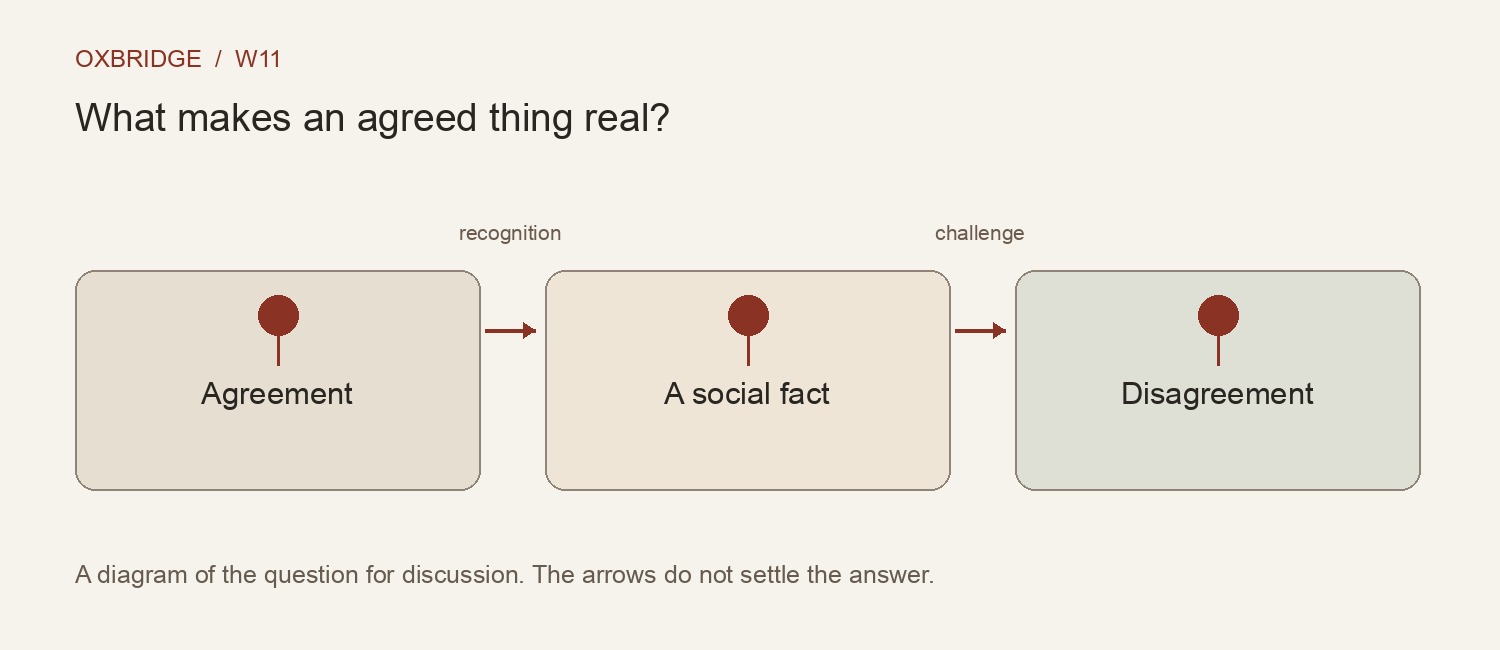
Whose agreement makes a thing real?
Unit plan
Money, borders, and weekends are real, but they depend on collective agreement.
Read the complete unit plan
Oxbridge · Seminar Plan · Weeks 11–12 · Memory and Forgetting | Power and Visibility
Unit question
Whose agreement makes a thing real?
Week 11: agreement
Money, borders, and weekends are real, but they depend on collective agreement.
Sort ten items into two categories: real independently and real by agreement. The items are gravity, money, a nation, Tuesday, a species, a debt, a disease, a genre, a race, and a language. Begin with gravity and Tuesday. Then discuss the items you found harder to place.
Some items are difficult to place in either category. Explain why you placed each item where you did, and what makes you move an item between categories.
Then consider whether everyone’s agreement carries the same weight. Whose agreement counts?
Week 12: Emmelhainz
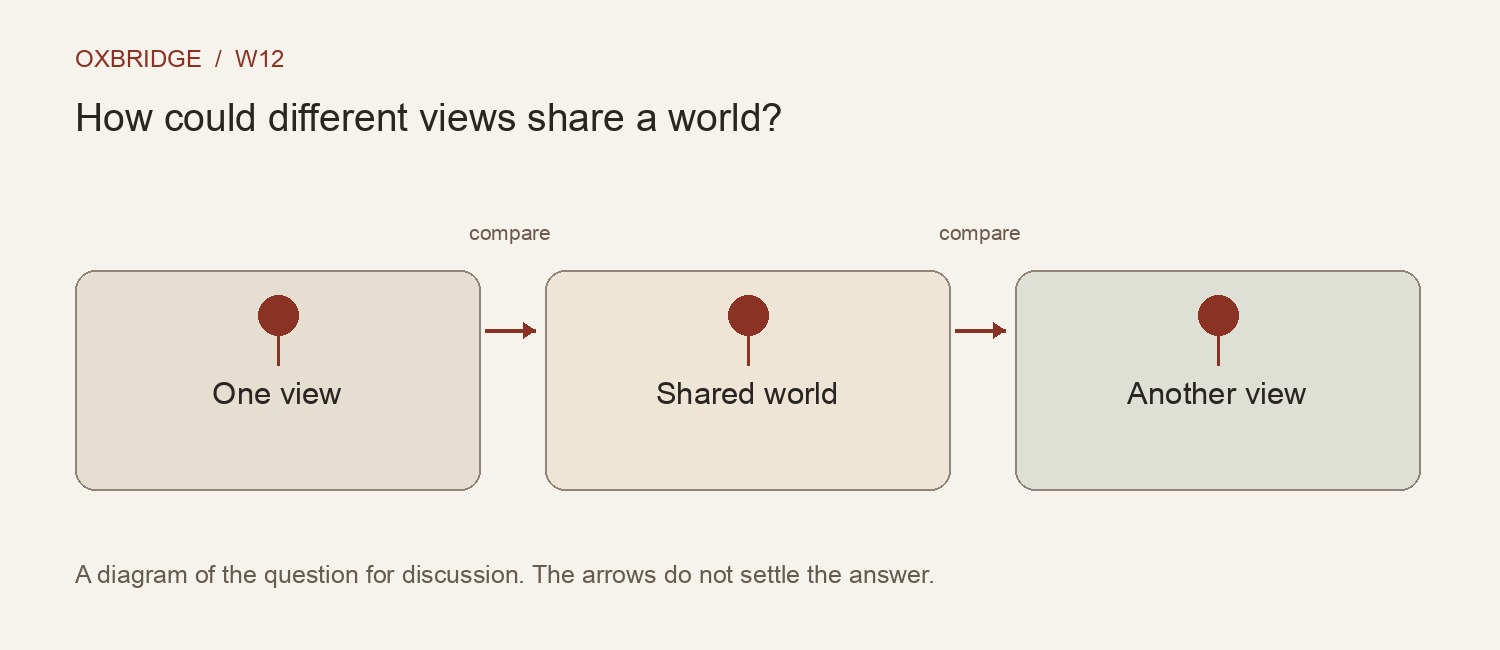
Irmgard Emmelhainz, “Can We Share a World Beyond Representation”, argues that the shared world has fragmented into private, algorithmically shaped worlds. Emmelhainz asks whether people can find common ground that does not depend on representation.
The session uses a student sheet with one central question and eight angle questions. Choose one angle and prepare a position. Present it and answer one question from the room before the next student speaks. Movement 2 is student-led.
The group-chat framing is:
There is one central question the whole discussion builds toward, and eight smaller questions beneath it approaching the same problem from different directions. Pick one angle. You do not need a final answer, just a position you are willing to defend and have challenged.
Sessions
- Whose Agreement Makes a Thing Real?: Sort the items, then discuss whose agreement counts.
- Is a Common World Still Possible?: Discuss Emmelhainz, using your own feeds as the opening evidence.
Concepts introduced
The unit introduces no new concepts. It applies the ontological turn to collective life. You examine reality as a relation, then ask who can establish that relation.
Preparation
This unit carries the heaviest student preparation in the course, and it is all spoken. W11 needs nothing in advance. For W12, every student must read Emmelhainz, choose one of eight angle questions, and prepare a position. You lead Movement 2. There is no fallback activity if you arrive unprepared.
Nothing is written or collected (discussion only).
The eight angle questions are not yet available.
Teaching notes
- In W11, explain why items move between the sorting categories. Identify what changed in your reasoning.
- In W11’s Movement 3, name one thing you believe is real that most people around you do not. Say what would make it count as real. Explain how it would count, rather than only stating your belief.
- In W12, focus on the philosophical question: whether sharing a world requires representation at all. The discussion is not about whether your feed is bad.
- In W11, consider the response, “It is not agreement, it is power”. This question leads into Unit 7, where you will examine power further.
Bridge to Unit 7
If agreement carries unequal weight, the next question is whose agreement carries more weight.
Lessons
Unit gallery